25 October, 2026 | 7:32 AM


Jawaharnagar dumpsite world’s top methane emitters
10-09-2026 12:00:00 AM
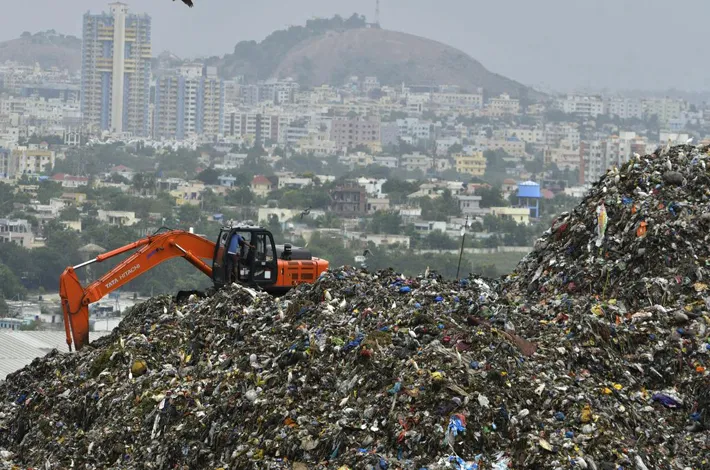
According to the report, Jawaharnagar is the largest waste-related methane emitter in India and the fourth largest in the world
metro india news I hyderabad
A new report by the Centre for Financial Accountability (CFA) has raised serious questions about Waste-to-Energy (WTE) plants in India. It says these plants received a maximum Pollution Index score of 100 out of 100, making them the most polluting industrial sector among those studied. Their pollution potential was found to be higher than that of open-cast coal mines, copper smelters and thermal power plants.
The findings are particularly worrying for Telangana. Hyderabad has one of India’s largest Waste-to-Energy facilities, with two plants at Jawaharnagar having a combined capacity of 48 MW. However, satellite data from UCLA and Carbon Mapper, supported by NASA’s Jet Propulsion Laboratory, show that the Jawaharnagar landfill is releasing about 5.9 tonnes of methane every hour.
According to the report, Jawaharnagar is the largest waste-related methane emitter in India and the fourth largest in the world. It is estimated to release around 49,000 tonnes of methane a year, contributing to global warming equivalent to about 3.96 million tonnes of carbon dioxide. The report questions whether burning waste is really solving Hyderabad’s garbage problem. About 60% of the city's waste is wet or organic. Such waste contains a lot of moisture and does not burn efficiently. While the waste is burned, large amounts of carbon dioxide are released, and waste that is not processed can continue to rot and produce methane.
Despite these concerns, the Telangana government is planning a new 4,000-tonne-per-day Waste-to-Energy and waste-processing facility at Siddapur in Ranga Reddy district, under the name ‘Eco-Town’. The project has been placed in the CPCB’s ‘Blue’ category following its 2025 classification. Environmental groups and residents of around 20 nearby agricultural villages and tribal settlements have protested against the project. They fear air pollution and contamination from toxic heavy metals, similar to concerns raised around Jawaharnagar.
Critics say the ‘Blue’ classification reduces environmental safeguards and makes it harder for pollution-control authorities to hold WTE operators responsible. They argue that communities may also lose opportunities to participate in public consultations and raise objections to such projects.
Ruchit Asha Kamal of Climate Front, Hyderabad, said the ‘Blue’ classification effectively allows incineration plants to pollute while shifting the risks to communities with less power to oppose them. CFA senior research associate Chythenyen Devika Kulasekaran said the organisation’s assessment, using the CPCB’s own pollution calculation method, found WTE plants to have a pollution score of 100/100.
The report recommends moving WTE incineration plants back to the ‘Red’ category for highly polluting industries. It also calls for independent, continuous monitoring of toxic pollutants, instead of allowing companies to assess themselves.
It further recommends that companies responsible for pollution should pay compensation and that funds should be set aside for the health needs of affected communities. Instead of spending more public money on large incineration plants, the report suggests promoting waste segregation, composting, biomethanation and CBG plants, while also giving waste workers a formal role in recycling and other environmentally friendly waste-management activities.