14 October, 2026 | 3:15 PM


Modi’s Israel visit signals strategic pivot
03-03-2026 12:00:00 AM
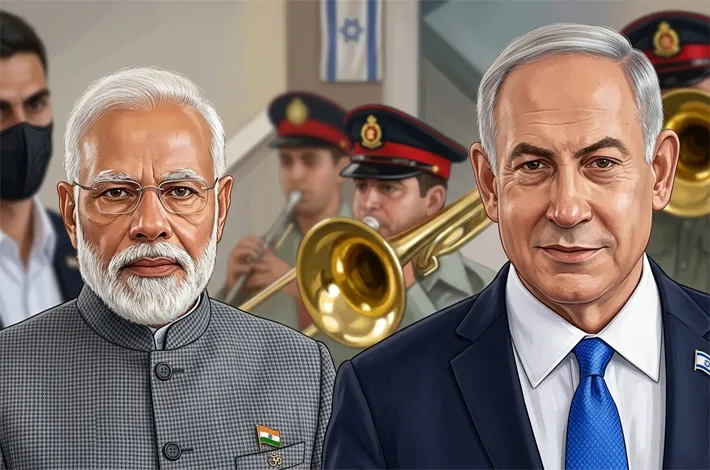
Prime Minister Narendra Modi's state visit to Israel on February 25-26, 2026, has marked a pivotal moment in bilateral ties, with the two nations formally elevating their relationship to a "Special Strategic Partnership for Peace, Innovation, and Prosperity." Accompanied by a high-level delegation, Modi held extensive talks with Israeli Prime Minister Benjamin Netanyahu in Jerusalem, culminating in the signing of over a dozen agreements and memorandums of understanding.
These pacts span critical areas including defense cooperation, cybersecurity, artificial intelligence, semiconductors, quantum technologies, space exploration, agriculture, water management, health, education, investment, trade, and economic linkages. Notably, Israel committed to welcoming up to 50,000 additional Indian workers over the next five years, while India agreed to extend its Unified Payments Interface (UPI) system to Israel, enhancing digital finance interoperability.
The visit also featured symbolic and substantive highlights. Modi became the first Indian prime minister to address a special plenary session of the Knesset, where he condemned the October 2023 Hamas attack, praised shared civilizational values, and emphasized unbreakable friendship. He toured Yad Vashem, Israel's Holocaust memorial, laying a wreath in a solemn ceremony alongside Netanyahu. The leaders reaffirmed commitment to joint initiatives like the India-Middle East-Europe Economic Corridor (IMEC) and the I2U2 grouping (India, Israel, UAE, US), framing these as platforms for connectivity, innovation, and prosperity amid regional challenges.
This development underscores a profound evolution in India's Middle East policy under Modi. While historical positions on Palestine and ties with Iran endure, the visit signals a decisive pivot toward Israel as a core strategic ally. The partnership draws strength from converging interests in counter-terrorism, technological innovation, and defense, with Israel viewed in India's strategic circles as a model of resilience and advanced capabilities in a turbulent neighborhood.Politically, the timing proved advantageous for Netanyahu amid domestic pressures and impending 2026 elections.
With normalization efforts stalled—particularly with Saudi Arabia and Indonesia—due to ongoing conflicts in Gaza and hardened Arab public opinion, Modi's high-profile support countered narratives of Israeli isolation. The embrace provided Netanyahu a platform to project global legitimacy from the leader of the world's largest democracy and a major economic power. However, the partnership's trajectory faces scrutiny over four key factors.
Netanyahu's domestic calculus prioritizes strength projection amid isolation risks. Israel's securitized, expansionist approach may clash with India's broader continental interests, including energy security, diaspora welfare (millions in the Gulf), remittances, trade routes, and connectivity. Over-reliance on a hard-edged posture could limit New Delhi's maneuverability in a diverse region.The Middle East's shifting geopolitics add complexity.
Iran has faced weakening through Israeli-U.S. actions, including recent direct confrontations, while Syria fragments into Turkish and Israeli spheres. A new Sunni alignment involving Turkey, Saudi Arabia, Qatar, and Bahrain emerges, reviving the Palestinian issue. Tensions between the UAE and Saudi Arabia persist, with Abu Dhabi hedging—cooperating with Israel on security yet maintaining Iranian channels for post-regime economic opportunities.
India, intertwined with Iran (via Chabahar port and trade), Saudi Arabia, the UAE, and others, thrives in interdependent frameworks rather than zero-sum conflicts or upheaval that could disrupt energy flows, investments, and migrant safety.Finally, longer-term potential exists for transformation. Deeper India-Israel engagement could diversify Israel's profile beyond security, fostering roles in energy, infrastructure, and connectivity—aligning with IMEC visions.
India's multi-alignment strategy offers leverage to promote balanced conditions, avoiding entanglement in rivalries amid peak military tensions.Following the visit, escalating regional events—including U.S.-Israel strikes on Iran and retaliatory actions—prompted Modi to hold urgent calls with Netanyahu and UAE leadership on March 1, 2026, stressing civilian safety and de-escalation. Domestic critics, including the Congress party, labeled the trip "ill-timed," arguing it risked perceptions of endorsing escalation antithetical to India's balanced foreign policy tradition.
Post-visit, escalating events prompted Modi to hold urgent March 1, 2026, telephonic talks with Netanyahu and UAE's Sheikh Mohamed bin Zayed, stressing civilian safety and de-escalation. Modi chaired a Cabinet Committee on Security meeting, voicing deep concern over West Asia volatility. Opposition Congress criticized the visit as "ill-timed" and "shameful," alleging tacit endorsement of escalation antithetical to India's rules-based order tradition.
As West Asia grapples with volatility, India's calibrated navigation will be essential to protect multifaceted interests while capitalizing on strategic synergies with Israel. The Modi visit illuminates both the promise of deepened cooperation and the perils of a fractured regional landscape.