18 September, 2026 | 2:01 AM


Modi-Trump talks: Breakthrough reached in relations with US?
13-12-2025 12:00:00 AM
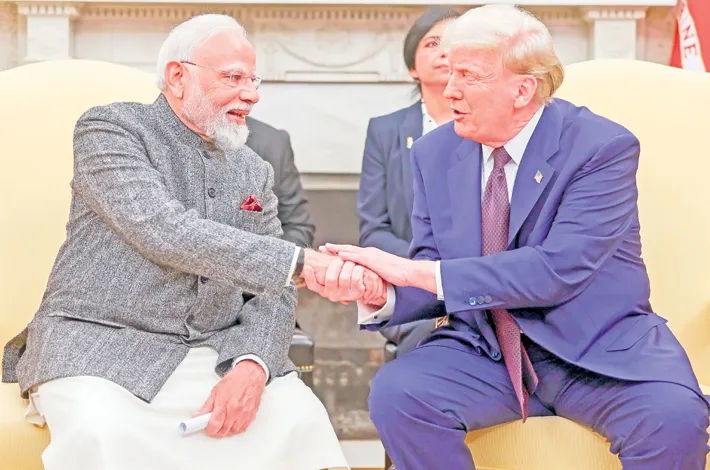
In a significant diplomatic development, Prime Minister Narendra Modi held a telephone conversation with United States President Donald Trump on Wednesday, their first direct contact in several months. The leaders reviewed the progress of the India-US Comprehensive Global Strategic Partnership and pledged to deepen cooperation in trade, critical technologies, energy, defense, and security. Following the call, PM Modi posted on X (formerly Twitter), describing it as a “warm and engaging conversation” and reiterating that both nations would continue working together for global peace, stability, and prosperity.
The timing of the call — coming days after Russian President Vladimir Putin’s high-profile visit to New Delhi — has sparked intense speculation that Washington is eager to prevent any perceptible drift in India-US ties, especially as bilateral trade negotiations approach a critical phase. Talks on a bilateral trade agreement, which were widely expected to conclude by the end of 2025, had stalled earlier this year when President Trump reportedly demanded additional concessions beyond what Indian negotiators considered their “best and final” offer. Sources indicate the deal was virtually ready in April 2025, with even US officials acknowledging it as India’s strongest proposal yet, but the final sign-off was withheld at the presidential level.
A senior official of the Centre for Development and Peace Research, noted that while logical and rational factors favor an early conclusion, “the unpredictability factor is one person — President Trump.” He expressed cautious optimism that contentious issues around agriculture and farm subsidies may have been resolved, adding that the call itself, after a gap of over six months, signaled renewed political push from both sides.
A former official of the US commerce department suggested the “Russia factor” is very much in play. He pointed out President Trump’s transactional approach and his current preoccupation with China and Russia may paradoxically work in India’s favor. He highlighted the $12 billion subsidy Trump has had to announce for American soybean farmers after Chinese retaliatory tariffs crippled exports — a clear domestic political liability that makes alternative markets, including India, more attractive.
A senior political commentator echoed this view, arguing that the US National Security Strategy explicitly identifies China as the primary threat and mandates deeper commerce and technology partnerships with India. “You cannot confront China effectively without India,” he asserted, warning that continued high tariffs on Indian goods while simultaneously expanding defence cooperation “cannot cut both ways.”
Domestic pressure mounting on trump
Another former Indian ambassador underlined growing bipartisan concern in the US Congress over the state of India-US relations. With midterm elections looming in November 2026 and Trump’s approval ratings under pressure amid persistent inflation and rising grocery bills, Republican lawmakers are reportedly urging the White House to avoid alienating New Delhi. He described the US political establishment as increasingly worried that failure to mend ties with India could prove costly both strategically and electorally.
Business community upbeat, markets rally
Business leaders welcomed the development. CEO of a business consultancy firm asserted that markets have already begun rallying on expectations of a deal. “Billions in trade and investment are sitting on the fence,” he said, emphasizing that clarity on tariffs would unlock significant US investment in Indian technology, AI, and manufacturing. He also flagged the H-1B visa impasse as another irritant that needs simultaneous resolution for the relationship to truly blossom.A former White House AI policy adviser, attributed the rush to India's vast consumer market, entrepreneurial talent, and adoption potential. He recommended India prioritise private-sector-led innovation, ease infrastructure regulations, and focus on AI diffusion across businesses and public services, citing India's digital public infrastructure as a global model. He expressed cautious optimism on global AI governance, noting the Trump administration's preference for bilateral deals over broad regimes, aligning with progress in India-US commercial ties.
Cautious optimism prevails
While most analysts agree that the signals are overwhelmingly positive and a deal by March 2026 now appears probable, the consensus is tempered by President Trump’s well-documented unpredictability. As one geopolitical expert put it: “India has put its best foot forward; the ball is now entirely in America’s court.” With geopolitical compulsions aligning on both sides — countering China, securing supply chains, and stabilizing domestic economies — the Modi-Trump telephone call may well mark the turning point in one of the most consequential bilateral relationships of the 21st century.