20 October, 2026 | 10:16 AM


Monsoon delay leaves farmers in the dry
20-06-2026 12:00:00 AM
metro india news I hyderabad
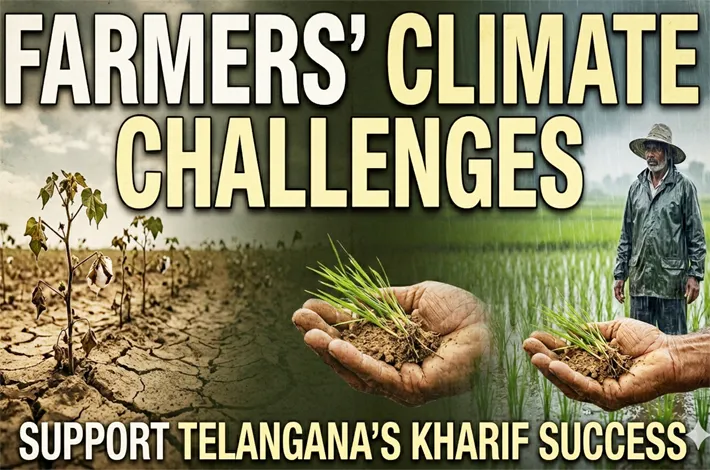
Farmers continue to face mounting challenges every year as agriculture remains increasingly vulnerable to either excessive rainfall or prolonged dry spells. Despite investing months of hard work and resources, cultivators often remain uncertain whether their crops will survive until harvest. In many cases, crops suffer severe damage even before reaching maturity, leaving farmers burdened with losses and debt. The current kharif season has entered its third week, but the delayed arrival of the southwest monsoon has created drought-like conditions across several parts of Telangana.
From sowing seeds to harvesting and marketing produce, farmers are forced to overcome numerous obstacles throughout the agricultural cycle. Despite the uncertain weather conditions, the Agriculture Department has prepared an ambitious cultivation plan for the ongoing kharif season. The government expects crops to be cultivated over 13.466 million acres across the state. Of this, paddy is projected to cover nearly 6.9 million acres, while cotton cultivation is expected on about 4.8 million acres.
While a few districts have received early showers, many others are yet to witness significant rainfall. Traditionally, one or two spells of heavy rainfall during the last week of May provide enough moisture for farmers to begin land preparation and sowing activities. This year, however, weather conditions have deviated significantly from the norm.
According to Agriculture Department officials, farmers in districts such as Adilabad, Warangal, Nalgonda, and Khammam have already sown cotton on more than 300,000 acres. In the erstwhile Warangal district alone, cotton has reportedly been sown on nearly 40,000 to 50,000 acres. Farmers who borrowed money to purchase seeds for the first sowing now fear they may have to incur additional debt to buy seeds again if re-sowing becomes necessary.
During the last agricultural year, more than 13.2 million acres were brought under cultivation across Telangana. Paddy accounted for 6.704 million acres, cotton 4.585 million acres, maize 641,000 acres, red gram 492,000 acres, and soybean 362,000 acres.
Overall cultivation exceeded the targeted acreage, supported by favorable rainfall and abundant water storage in reservoirs and irrigation projects.
This year, however, concerns over water availability emerged as early as the beginning of summer. Despite these concerns, farmers continue to prefer paddy and cotton, primarily because both the Central and State governments procure these crops at Minimum Support Prices (MSP).
Dryland crop promotion remains a challenge. With forecasts indicating below-normal rainfall due to the El Niño effect, the government has been encouraging farmers to adopt dry land crops that require less water. However, farmer organizations argue that awareness campaigns have remained largely limited to official announcements and advertisements.
Farmer leaders contend that cultivators need practical guidance on suitable dryland crops, cultivation methods, market opportunities, and profitability. As rainfall remains elusive in many regions, the coming weeks are expected to be crucial for the success of Telangana’s kharif season and the livelihoods of thousands of farming families.