13 September, 2026 | 10:25 PM


Oil surge clouds growth outlook
03-04-2026 12:00:00 AM
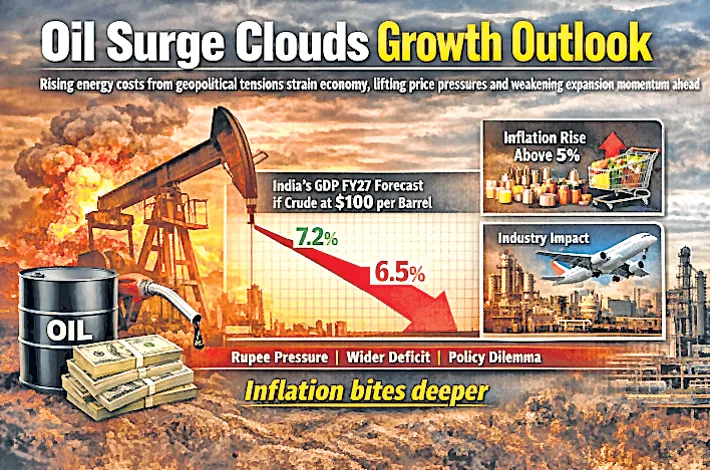
Inflation bites deeper |Rising energy costs from geopolitical tensions strain economy, lifting price pressures, weakening expansion momentum ahead
Business Desk mumbai
India’s economic growth outlook faces fresh downside risks as elevated crude oil prices, driven by the ongoing West Asia conflict, threaten to slow momentum and stoke inflationary pressures, according to a report by CareEdge Ratings.
The report warns that if crude oil prices sustain around $100 per barrel, India’s GDP growth could moderate to 6.5% in FY27, while inflation may rise above the 5% mark. This reflects the economy’s sensitivity to energy costs, given its heavy dependence on oil imports, ANI reported on Thursday.
Under more favourable conditions, when crude prices hovered between $60 and $70 per barrel, India’s growth was estimated at 7.2%, with inflation around 4.3%. However, the outlook weakens as oil prices climb. At an average of $90 per barrel, GDP growth is expected at 6.7%, with inflation in the range of 4.5–4.7%.The report outlines a clear inverse relationship between crude prices and growth.
At $110 per barrel, GDP growth could fall to 6.1%, while a further spike to $120 per barrel may drag growth below 6.0%. Inflation, meanwhile, is projected to accelerate sharply, reaching 5.8–6.0% at $110 and rising further to 6.4–6.6% at $120 per barrel.Sectoral impact is expected to be uneven.
Industries such as airlines, petrochemicals, ceramics and glass are likely to face the most severe impact due to high input costs and limited ability to absorb price shocks. Meanwhile, oil marketing companies, fertilisers, synthetic textiles, tyres, packaging and basmati rice exports may experience significant pressure but retain moderate resilience.
Sectors including gas distribution, cement, construction, automobiles, speciality chemicals, semiconductors, paints and hospitality are likely to see a moderate impact. In contrast, upstream oil and gas, along with thermal and renewable power, pharmaceuticals, coal mining and shipping, are expected to remain relatively insulated. The report highlights that while domestic demand continues to provide a buffer to the economy, sustained high crude prices could erode consumption by pushing up inflation and increasing production costs.
With geopolitical tensions showing little sign of easing, crude oil remains a critical variable for India’s macroeconomic stability, shaping both growth prospects and inflation trajectory in the coming fiscal years.
The evolving crude price trajectory will remain central to policy calibration in the coming quarters.
A sustained surge in oil prices could complicate the Reserve Bank of India’s inflation management strategy, potentially delaying any monetary easing cycle. Higher fuel costs may also widen the current account deficit and exert pressure on the rupee, adding another layer of macroeconomic stress.
Fiscal dynamics could be impacted if the government is forced to adjust excise duties or increase subsidies to cushion consumers.