31 October, 2026 | 1:10 AM


Optogenetics: A Tool of Neuroscience to Aid Brain Health
31-10-2026 12:00:00 AM
Science Corner
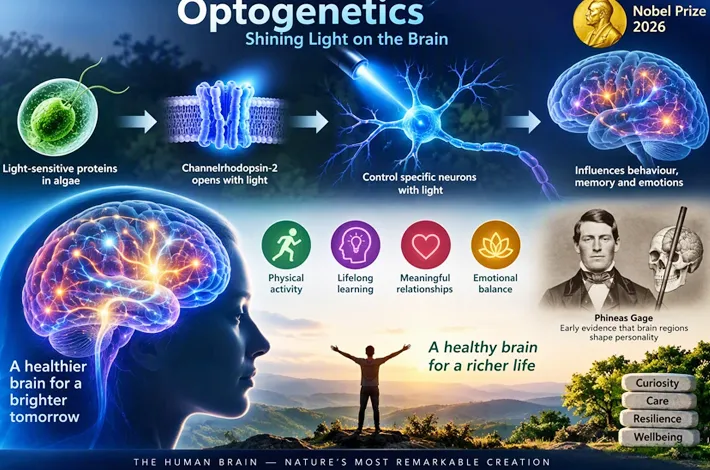
The 2026 Nobel Prize in Physiology or Medicine was awarded jointly to Karl Deisseroth, Peter Hegemann, and Georg Nagel for discoveries that transformed our understanding of the brain. Their work led to the development of “optogenetics”, a technique that allows scientists to control specific nerve cells using light and observe the effects on behaviour, memory, emotions, and thought.
The human brain, weighing about 1.4 kg, contains nearly 86 billion neurons connected through trillions of synapses. For several decades, neuroscientists could observe brain activity but not the precise role of individual neurons. They communicate through electrical impulses and chemical messengers called neurotransmitters, such as dopamine, serotonin, glutamate, and acetylcholine, which regulate behaviour. The brain represents only about 2% of body weight, but it consumes nearly 20% of the body's energy, for highly demanding thinking, learning, and decision-making.
The breakthrough began in the 1990s when Hegemann studied the single-celled green alga Chlamydomonas. He proposed that it possessed a protein capable of sensing light while functioning as an ion channel. Nagel later identified this protein as channelrhodopsin-2, which opens in response to light and generates electrical signals. They demonstrated that this light-sensitive protein could function in living cells, creating new opportunities for neuroscience research.
A major advance came in 2005 when Deisseroth and colleagues introduced the gene for channelrhodopsin-2 into neurons, making them responsive to light. By delivering brief light pulses, they could activate selected neurons with remarkable precision within milliseconds. This achievement marked the birth of optogenetics, which combines three disciplines: genetics, to introduce light-sensitive proteins into specific cells; optics, to deliver controlled light; and neuroscience, to study the resulting effects on brain activity and behaviour.
For the first time, researchers could switch individual neurons on or off in a living brain and directly study their functions. Optogenetics became one of the most powerful tools enabling scientists to map neural circuits, investigate memory formation, study emotions and behaviour, and explore the biological basis of neurological and psychiatric disorders. The brain is a dynamic organ that continuously processes information, stores memories, regulates emotions, and guides decision-making. Its development begins before birth; full cognitive maturity often occurs in the mid-twenties rather than at 18 years and continues until 25 years of age.
This extended maturation period has reshaped our understanding of adulthood. Maintaining brain health throughout life is one of the greatest “arts of living”. A healthy brain supports learning, memory, reasoning, emotional balance, and social interaction. Lifelong curiosity, intellectual engagement, meaningful relationships, and regular physical activity help keep the brain resilient as we age and may reduce the risk of disorders such as Alzheimer’s disease and other forms of dementia.
One of the most famous examples of the brain’s influence on personality is the case of “Phineas Gage”, a railroad construction foreman in the United States. In 1848, an iron rod passed through his skull during a blasting accident, severely damaging part of his frontal lobe. Physically he survived but his personality changed, from responsible and dependable, he became impulsive and unreliable. His case provided early evidence that specific brain regions play critical roles in emotional regulation, judgment, decision-making, and social behaviour.
From light-sensitive proteins in algae to the precise control of neurons with light, optogenetics has revolutionized neuroscience and illuminated the workings of the brain. Its development highlights a timeless truth: “despite remarkable advances in technology and artificial intelligence, the human brain remains nature’s most extraordinary creation”. While artificial intelligence can process vast amounts of information, the human brain remains uniquely capable of creativity, emotion, adaptability, and consciousness, making its lifelong care and preservation essential.
(Dr Swarnabala Ganti is a consultant at Swaram Biochem, AgriLife India & Som Phytopharma and regulatory affairs specialist and R&D scientist)