31 October, 2026 | 12:57 AM


SOLD FOR A SONG!
31-10-2026 12:00:00 AM
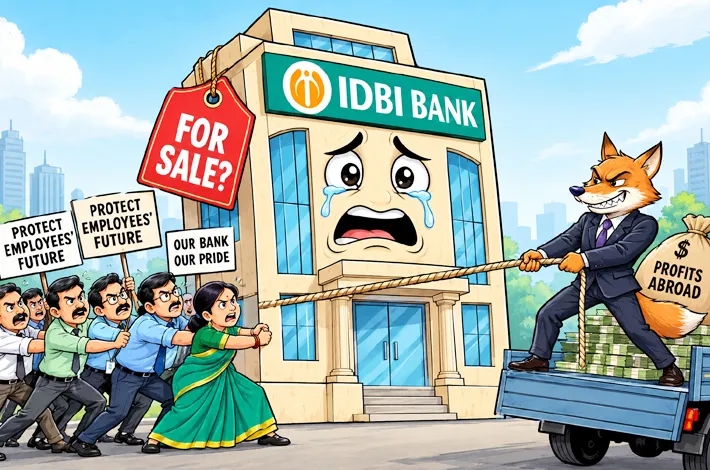
IDBI Bank handed to Fairfax at Rs 81 a share: a public asset transferred while profits soared
Who changed valuation after the bids?
■ Why was the sale not reopened to all bidders?
■ How can rules meant for physical assets and railway scrap be applied to the sale of a bank?
■ What tax relief was given to close the deal, and how much was it worth?
■ Will the government place the complete Core Group minutes before Parliament?
Public banks not assets to be sold off, they are tools to build nation.
-Rahul Gandhi,
Leader of Opposition in Lok Sabha
metro india news I hyderabad
In October, the Cabinet Committee on Economic Affairs approved the sale of a combined 60.72 per cent stake in IDBI Bank held by the Government of India and LIC to Fairfax Financial Holdings entity for Rs 52,878 crore. Fairfax will pay Rs 81 per share.
The government stake falls from about 45.5 per cent to 15 per cent and LIC’s from roughly 49 percent to 19 percent, transferring management control to the Canadian group led by Prem Watsa. Officials describe it as strategic restructuring and the largest FDI in India’s financial sector. Critics, bank employees and opposition leaders call it a distress sale of a revived public institution.
IDBI began as the Industrial Development Bank of India in 1964 to finance industrial growth. Years of high non-performing assets pushed it into the Prompt Corrective Action framework. After capital support and operational cleanup it exited PCA, rebuilt asset quality and returned to sustained profitability.
Last year the bank reported profits exceeding Rs 9,000 crore. Recent quarterly results continued to show healthy net interest income and earnings. A bank that was once a fiscal burden is now generating returns for the public owners. That turnaround supplies the core of the political and employee backlash.
The offer price of Rs 81 sits below the market price that hovered near Rs 90 around the approval date and well below an earlier reserve price of around Rs 94 that had led to rejection of lower bids. The government later set a fresh benchmark of Rs 75.99 based on independent valuations and accepted Fairfax’s Rs 81 as above that figure.
Process details circulating in reports note that revised valuations followed receipt of the final offer. Employee representatives and opposition voices argue the methodology undervalues tangible assets, real-estate holdings, franchise value, customer relationships and the earnings power of a cleaned-up balance sheet. At Rs 81 the 60.72 percent stake is priced as if the recovery never happened.
Rahul Gandhi, Leader of the Opposition, issued an open letter to IDBI employees on 29 October 2026. He recalled meeting staff who asked why a bank they had made profitable was being sold. He raised the matter in the Lok Sabha and received no substantive reply. Gandhi wrote that seven years earlier the bank was losing money and that the subsequent profits belonged to the employees’ effort.
He cited a 2003 parliamentary assurance that the government would retain at least 51 percent ownership, stating that a promise to Parliament is a promise to the people. After the transaction the combined government-plus-LIC holding drops to 34 percent. Gandhi warned that private control would end reservations for SC, ST and OBC candidates and further weaken service conditions. He declared public banks tools for nation-building rather than assets for disposal and stated he stands with the employees.
The United Forum of IDBI Officers and Employees has rejected the deal outright. The forum demanded immediate suspension of the process, full disclosure of valuation assumptions, treatment of real-estate and other assets, and parliamentary scrutiny.
Members point to the bank’s 19,000-plus workforce, including large numbers from reserved categories, women employees and persons with disabilities, and fear dilution of protections, pension security and development-oriented lending priorities. They scheduled a two-day nationwide hunger strike for early November.
Government officials have responded that the share-purchase agreement prevents adverse changes to existing service conditions and pension commitments, that IDBI is already classified as a private bank under RBI rules, and that the institution will remain board-managed under the same labour laws. Employees remain unconvinced that contractual language fully substitutes for public-sector character and parliamentary oversight.
Data underline the tension. IDBI’s recovery delivered multi-thousand-crore annual profits after years of losses. The sale monetises that recovery for the exchequer and LIC at a fixed Rs 81 while market trading reflected higher investor expectations. Fairfax gains controlling ownership of a cleaned-up franchise with nationwide branches, a large deposit base and established corporate and retail relationships. The buyer already holds a stake in CSB Bank and faces a regulatory timeline to resolve dual-promoter issues.
Residual government and LIC stakes of 15 percent and 19 percent leave limited ongoing influence once management control shifts. The transaction will transfer more than Rs 26,000 crore each to the government and LIC. Opponents see the timing—after the hard recovery work was completed by public capital and staff—as the decisive fact.
A bank restored to health with public resources is now being transferred at a price that, relative to market levels and earlier reserve indications, looks modest. Employee protests, the parliamentary assurance of 2003, the reservation implications and the profit numbers form a coherent critique: the public bore the cost of repair and now watches control pass for a figure that does not fully capture the restored value.
The deal still requires remaining regulatory clearances and is targeted for completion in early 2027. Until then the political contest continues. IDBI’s balance-sheet recovery is measurable. The price at which majority control changes hands is a policy choice open to public judgment.