10 October, 2026 | 6:56 PM


OU students protest
04-12-2025 12:00:00 AM
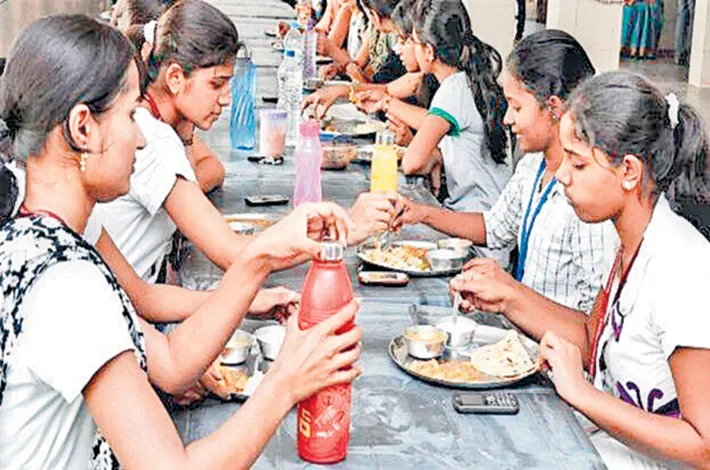
Hostel food crisis persists, relentless agitations not fruitful
Students at Osmania University continue to battle recurring food quality issues in their hostel messes, alleging that the administration has failed to act despite repeated protests. Girls, in particular, face limited food portions and poor-quality meals, a problem made worse by the lack of routine complaints or questioning from their side.
Food-related grievances are not new on the OU campus. Over the years, persistent complaints have led to protests across several hostels. Students say the pattern rarely changes—watery curries, stale rice, improperly cooked meals, and, at times, alarming foreign objects such as worms, glass pieces, and even razor blades. The latest protest, led by law students, again pushed the administration to respond as students gathered on the main road, holding rice bowls to highlight the alleged stale food being served. Their slogans targeted the vice-chancellor and chief warden, demanding that long-pending issues finally be resolved.
Ajay Kumar Dandu, Secretary of the Students’ Federation of India (SFI) at OU, said these protests have become a routine part of campus life, though with little lasting impact.
“This issue comes up at least twice a month. Boys come out, protest, and demand better food quality. After every protest, the quality improves for a few days and then returns to the same poor standards,” he said. Ajay added that somewhere on campus, some group of students is almost always protesting about food or related issues.
He also highlighted the lesser-discussed problem of unequal food quantity for girl students. According to him, boys receive unlimited servings because they question and protest, while girls—occupied with classes, assignments, and preparation—rarely raise objections and are therefore given limited portions unless a major complaint is made.
Ajay said that in his three years at OU, he has never seen government officials or food safety inspectors visit the hostels. He believes the absence of consistent supervision has allowed food quality to deteriorate repeatedly, even after the major protest in March 2025 when cockroaches were found in the food.
“They should have followed regular safety checks after the March incident,” he said, adding that students are now planning to approach the chief warden for sufficient and nutritionally balanced meals for girls, though he remains skeptical of the outcome.
Shravani, a psychology student staying in the hostel, said the quantity provided to girls is unfairly limited.
“It may be enough for some, but not for everyone. We were told at the beginning that portions would be limited for girls. This is unfair,” she said. She also pointed to declining quality. “The curd is like water, not once have we received proper curd. Compared to boys who always complain and get unlimited food, we don’t,” she said.
The students’ ongoing struggle highlights a cycle of recurring complaints and temporary fixes. With no sustained corrective measures in place, food quality and quantity issues—especially for female students—remain one of Osmania University’s most persistent challenges.
Protests have become a routine part of campus life, though with little lasting impact.
Ajay Kumar Dandu, -Secretary of the Students’ Federation of India (SFI)