23 October, 2026 | 4:41 AM


PVR INOX Bets on Small-Town India for Its Next Growth Chapter
08-09-2026 12:00:00 AM
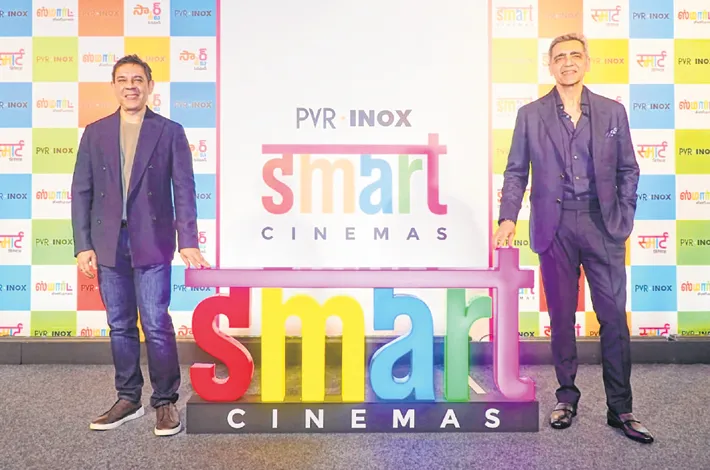
The multiplex giant launches a new franchise-led format targeting Tier III and IV cities, with the first Smart Cinema now open in Muzaffarpur and 300 cities identified for Phase 1
As India grows with a healthy 7 to 8 per cent growth every year, the next wave of consumerism and consumption is going to come from these Tier III cities. They are now the anvil of commercial development, of retail development, of high consumerism. This is the time when organised retailing is coming into these places.
Sanjeev Kumar Bijli, Executive Director, PVR INOX Limited
Ashad Hussain
PVR INOX’s next growth story won't be written in India’s metros. It will be written in its smaller cities. The multiplex giant has unveiled PVR INOX Smart Cinemas, a new exhibition format designed to bring premium movie-going experiences to Tier III and IV cities that have long remained underserved by organised cinema.
The first Smart Cinema opened in Muzaffarpur, one of North Bihar's most prominent commercial and educational centres, last month. PVR INOX has already signed six new Smart Cinema properties for delivery over the next nine months, with Barrackpore and Rampur among the cities opening this year. Discussions across several other growth markets are also actively underway. In the first phase, the company has identified approximately 300 cities across India as potential Smart Cinema destinations.
Why Tier III Markets Are Becoming Attractive
The strategic logic is straightforward. Of PVR INOX's roughly 1,800 screens, fewer than 5 per cent are in Tier III towns. The company believes these markets represent its biggest untapped opportunity as rising incomes, organised retail and changing consumer behaviour reshape demand beyond India's largest cities.
For Renaud Palliere, Chief Strategic Advisor and CEO of Smart Cinemas, the opportunity reflects a broader shift in India's economic narrative. “The defining element of the last 20 years of India’s growth was symbolic of the skyscrapers of Mumbai. And now this narrative is shifting towards the growth markets that are becoming the anchor of economic growth,” he said. “PVR INOX’s own journey, the recovery of the industry and the recovery of the last few years of hard work is really showing that now the business is back and it is time to no longer look into the rearview mirror, but to look forward with what is the next chapter of growth for the business.”
An Asset-Light Model
The Smart Cinema format is designed as an asset-light model without compromising on the core movie-going experience. A standard PVR INOX screen costs approximately `3 to 4 crore to build, while Smart Cinemas come in at roughly `1.9 crore per screen.
Ajay Bijli, Managing Director, PVR INOX Limited, said the lower investment does not come at the cost of the cinema experience. “There is no compromise on sound and projection system. We still have DCI compliant 2K laser projectors. We have 7.1 Dolby sound. Legroom and seat width will be 1,100 by 575 millimetre, which is very comfortable. Food, beverages, service, everything will be non-compromised. The moment you enter the cinema, even before you enter the auditorium, you will say wow. You see colour, you see posters, you enter a world of movies.” Smart Cinemas will also screen Hollywood films, either in dubbed versions or in the original English language, depending on the theatre and the market. Food and beverage offerings will be tailored to each market rather than a standard menu, with pricing suited to local consumer expectations.
On ticket pricing, the company has done city-by-city research from the ground up. Using Muzaffarpur in Bihar as the benchmark example, tickets will be priced 30 to 35 per cent lower than Patna, while spend per head will be 20 to 25 per cent lower. Against existing local operators, PVR INOX expects pricing to remain comparable or even 10 to 15 per cent lower. “At the end of the day, it is about value engineering the experience, but not changing the experience,” Ajay Bijli said.
The Model
The expansion operates on a FOCO, Franchise-Owned Company-Operated, structure enabling PVR INOX to partner with developers and entrepreneurs across India while retaining operational control over the cinema experience.
Maneesh Gaur, Chief Development Officer, PVR INOX Limited, said the model creates a lower-risk proposition for developers entering emerging markets. “What it provides is a completely de-risked partnership with one of the largest anchors in entertainment. It becomes far more predictable in terms of the business for a new developer coming into the emerging market. We are moving this partnership from just renting a large area and opening screens to a growth partnership where we actually give the opportunity and work together to create retail destinations for these growth markets.”
Cinema vs OTT
The expansion also comes at a time when theatrical exhibition continues to be measured against the rise of streaming platforms. Sanjeev Kumar Bijli dismissed the idea that the two compete directly. “This debate is really hackneyed and very stale. Home entertainment has always coexisted with out-of-home entertainment. The Indian consumer wants to go out. He wants to see films on the big screen. Unless you have a 14-metre screen and 100 people watching with you on your couch, there is a very big difference.”
The Geography
The geographic ambition remains pan-India. Of PVR INOX's approximately 1,800 screens, around 600 are already in southern India, while the first phase of Smart Cinemas spans around 300 cities across the South, East and North. “We are not biased to any geography. It is one country, one nation, and one market,” Ajay Bijli said.
The additional screens could create more opportunities for independent, regional and international films in markets that have traditionally been dominated by mainstream releases. PVR INOX already distributes independent films through its distribution arm PVR INOX Pictures, with The Invite, Hukum, and Back Rooms. “We have always been someone who would like to programme all kinds of films in all cinemas and in all cities just to see what the response is,” said Ajay Bijli. “A while ago, we released regional films in non-traditional markets and found they were getting a very good response. Then we introduced Japanese anime and were surprised to see that get a phenomenal response."
Renaud Palliere, Chief Strategic Advisor and CEO, Smart Cinemas, echoed the same optimism about audience appetite in smaller markets. "The aspiration and expectations are huge. People want to see the same product, have a great time, be entertained, escape for the duration of the film. We are going there with the same product, the same DNA, the same quality and service standard and the same sincerity as we would go anywhere else in the market.”
Ajay Bijli closed with a line that perhaps best captures what PVR INOX is building toward. “Our picture abhi baaki hai.”
Smart Cinemas is the most significant structural shift in Indian theatrical exhibition in years. Not because of what it builds, but because of where it builds it. If the format works, it will not just add screens to PVR INOX’s count. It will redefine where the Indian multiplex industry believes its future lies.