15 September, 2026 | 9:52 AM


Rahul Gandhi not invited to meet Putin: Protocol or Politics?
06-12-2025 12:00:00 AM
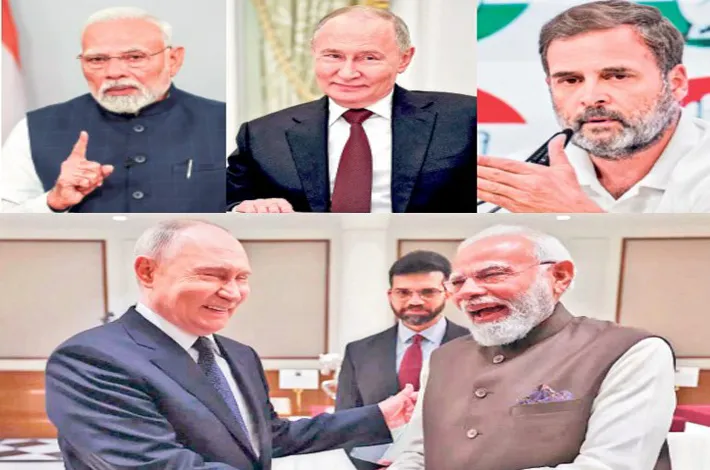
Russian President Vladimir Putin received a grand welcome in the Indian capital on Thursday, marking his first visit to India since the Ukraine war began in February 2022. Prime Minister Narendra Modi broke with recent diplomatic convention by personally receiving Putin at Palam technical airport, before the two leaders rode together to the venue of bilateral talks. The high-profile reception underscored the enduring strategic partnership between Delhi and Moscow, with both sides expected to sign major agreements in defense, energy, healthcare, nuclear cooperation and trade.
The optics were unmistakable: nearly 25 years after their first official meeting, India and Russia continue to project themselves as “partners of consequence” at a time when global geopolitics is in flux. The United States and China, observers noted, would be watching the body language between the two leaders extremely closely. Within hours, however, the visit triggered a fresh political storm in India.
Leader of the Opposition in the Lok Sabha, Rahul Gandhi, publicly complained that he had not been invited to meet the visiting Russian President, accusing the Modi government of deliberately discouraging foreign dignitaries from engaging with the opposition. Speaking to reporters, Gandhi claimed this was a break from long-standing parliamentary tradition followed during the tenures of Atal Bihari Vajpayee and Manmohan Singh.
“We too represent India; it is not only the government that represents the country,” Rahul Gandhi said, and reminded that used to be a norm that the Leader of the Opposition meets visiting heads of state or government. That norm is being deliberately broken out of insecurity, he alleged. The Congress leader suggested that the Ministry of External Affairs was actively advising foreign delegations against meeting him, adding that opposition leaders were being sidelined from international engagements.
BJP leaders hit back swiftly, releasing photographs and details of several foreign leaders whom Rahul Gandhi has met since becoming Leader of the Opposition in June 2024, including Bangladesh’s Sheikh Hasina, Vietnam’s then-Prime Minister Phạm Minh Chính, Malaysia’s Anwar Ibrahim, Mauritius Prime Minister Pravind Jugnauth and New Zealand Prime Minister Christopher Luxon. Government sources clarified that meetings between visiting dignitaries and opposition leaders are arranged only if the visiting side specifically requests them — and in this case, the short 30-hour visit notwithstanding, the Russian side evidently did not.
A BJP spokesperson dismissed Rahul Gandhi’s charge as baseless, pointing out that Putin has visited India multiple times since 2014 and has never met any Congress leader during those trips. He made it clear that the government is protecting national interest, not displaying insecurity and reminded of former US President Barack Obama’s unflattering description of Rahul Gandhi in his memoir “A Promised Land” and questioned what “alternative perspective” Gandhi would offer Putin — repeating past claims made abroad that India’s economy is dead or that democracy is under attack.
Congress leaders defended the democratic convention of opposition leaders meeting visiting heads of state, arguing that governments change and foreign leaders like to engage with alternative voices. They accused the Modi government of systematically dismantling parliamentary norms, citing the passage of money bills to bypass the Rajya Sabha and the alleged misuse of central agencies. BJP leaders however countered by highlighting instances where Rahul Gandhi himself has skipped key national events to which he was invited — Independence Day and Republic Day celebrations at the Red Fort, the swearing-in of the Chief Justice of India and the Vice-President — questioning his commitment to constitutional traditions while demanding protocol for himself.
Political analysts noted that Putin’s tight schedule and the absence of any request from the Russian side for a meeting with the Leader of the Opposition made the controversy largely manufactured. A Congress clarification from an earlier occasion — quoted by party leader Randeep Surjewala — had itself acknowledged that meetings with visiting dignitaries are arranged based on mutual interest rather than rigid protocol.
As the war of words played out on television screens, Putin and Modi concluded their restricted and delegation-level talks, followed by a private dinner. Official sources described the discussions as “extremely productive,” with both sides reaffirming their “special and privileged strategic partnership.” For the moment, the diplomatic red carpet has been rolled back, but the domestic political slugfest over protocol, tradition and alleged insecurity shows no sign of abating.