20 October, 2026 | 2:28 PM


Reviving OU Legacy
11-12-2025 12:00:00 AM
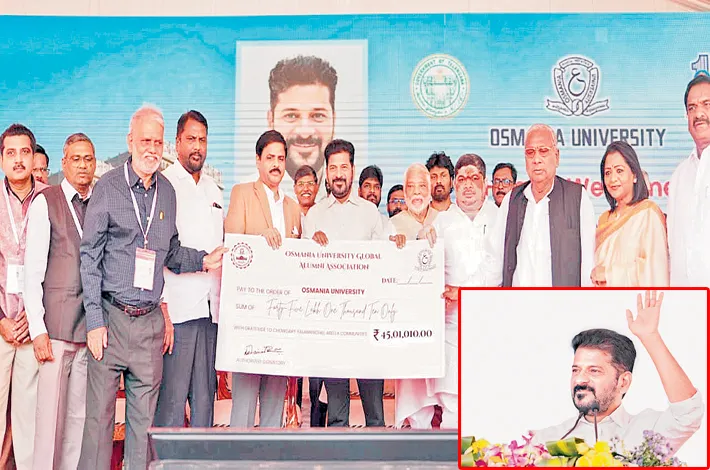
On Wednesday, Chief Minister Revanth Reddy stepped onto the hallowed grounds of Osmania University (OU) for the second time since assuming office, addressing a vibrant gathering of students, faculty, and alumni at the iconic Arts College. This visit, coinciding with the 16th anniversary of the 2009 Congress announcement for Telangana statehood, underscores the university's enduring role as the intellectual cradle of the Telangana movement. Hailing the students as the "fighting spirit" of the state, Reddy reiterated his vision to transform OU into a global powerhouse, on par with Oxford and Stanford, while emphasizing a collaborative revamp driven by their input.
Revanth Reddy's affinity to OU is no mere political gesture. As the first Chief Minister to visit the campus post the 2014 Andhra Pradesh bifurcation – a decade-long oversight by his predecessor K. Chandrasekhar Rao – his inaugural trip on August 25, shattered a 15-year silence. Amid heavy barricades and security, he inaugurated two new hostels – Dundubhi and Bhima – accommodating 1,200 students at a cost of Rs 90 crore, and laid the foundation for a digital library and modern reading room. "Osmania University and Telangana are synonymous, like conjoined twins," he declared, vowing Rs 1,000 crore for comprehensive development to restore its "past glory." He pledged a return in December – the "miracle month" of Telangana's genesis – sans police, for an open dialogue at the Arts College, where he would "sanction whatever you want."
Today's event, dubbed "Saarvam Siddham" (All is Ready), fulfilled that vow. Free of the August pomp, Reddy engaged directly, inspecting academic blocks, hostels, and facilities. He lauded OU's students as the "intellectual heart" of Telangana, crediting their activism in the 1969 agitation and the 2001-2014 movement for birthing the state. "You are not just learners; you are the conscience keepers of our society," he said, drawing cheers from the crowd. The program, starting at 11:15 a.m., featured interactions with Vice-Chancellor Prof. Kumar Molugaram and alumni, highlighting OU's centennial legacy since its 1918 founding by Nizam Mir Osman Ali Khan – India's seventh-oldest university and the first to adopt Urdu as the medium of instruction.
However, beneath the applause lies a university yearning for renaissance. OU's glorious past is etched in history: from its Adikmet campus, envisioned as a blend of Eastern and Western scholarship, to producing luminaries like Sarojini Naidu and P.V. Narasimha Rao. It was the epicenter of the 1938 Vande Mataram protests against colonial rule and the Telangana armed struggle, fostering radical ideas for social equity. In the 1980s, it expanded inclusively, mirroring societal diversity. But decades of neglect have corroded its foundations. Crumbling infrastructure, outdated curricula, and funding shortages have tarnished its academic image, with students protesting unfulfilled job promises during the 2017 centenary under the previous regime. Today, challenges include heritage preservation amid urbanization, faculty shortages, and adapting to digital-age demands, all while serving over 300,000 students across affiliates.
Revanth Reddy's strategy to revive this legacy is multifaceted and student-centric, a departure from top-down governance. He has directed officials to finalize development plans by month's end, incorporating feedback via drop boxes, a dedicated website, and today's consultations. Key proposals include new academic blocks and hostels with 10% excess capacity for future growth, cycle tracks, walking paths, and urban forestry in green zones. Heritage icons like the Arts College will be conserved, while non-historic structures yield to modern builds – a pragmatic pivot avoiding "huge renovation costs." Symbols of OU's "fighting spirit" – perhaps murals of past protests – will infuse designs, blending nostalgia with innovation. Reddy's "any amount of money" commitment, starting with the Rs 1,000 crore pledge, taps state coffers and potential public-private partnerships for fundraising.
This approach could succeed where predecessors faltered. By empowering students – echoing OU's activist roots – Reddy fosters ownership, mitigating resistance to changes. Preserving heritage while modernizing addresses dual imperatives:
cultural identity and global competitiveness. Aligning with national schemes like NEP 2020, OU could introduce interdisciplinary programs, AI labs, and international tie-ups, elevating rankings from its current mid-tier status.
The National Institutional Ranking Framework (NIRF), managed by the Ministry of Education, Government of India, is the primary national benchmark. Osmania University as per NIRF is ranked 53 this year compared to 70 last year. The university authorities should put enough work to make OU among the 10 ranks as per the NIRF. Moreover, the state government should ensure that it should release the adequate funds it has promised to the OU. Not mere statements.
Reddy's parting words are worth repetition: "OU's revival is Telangana's revival." If executed with transparency and speed, this could not only restore a century-old glory but position OU as South Asia's beacon of progressive education. For a state born from student fervor, it's a fitting chapter – one where the youth, once agitators, become architects.
Not courage, but affection
CM's emotional pitch to students
Telangana Chief Minister Revanth Reddy visited Osmania University on Wednesday and reiterated the government’s commitment to transforming the 108-year-old institution into a world-class university. Emphasizing that affection—not courage—is what brought him to OU, he recalled its historic role in Telangana’s socio-political movements and its legacy of producing transformative leaders.
Expressing a deep emotional bond with the students, Revanth Reddy said he came to OU with “a heart full of affection,” determined to lay a new path of development for the historic institution. He called upon the youth to uphold OU’s legacy and emerge as torchbearers of Telangana’s progress.
The Chief Minister announced that the government is proceeding with the previously declared ₹1,000-crore comprehensive development plan to elevate OU to international standards. A Digital G.O copy sanctioning ₹1,000-crore for the varsity development and makeover was handed over later to the Vice-chancellor by the CM. In his address, CM noted that despite Telangana’s decade-long aspirations, OU had been systematically weakened, and his administration is determined to restore its academic strength and institutional pride.
Revanth Reddy highlighted OU’s legacy as the cradle of resistance and intellectual awakening—from the Telangana Armed Struggle to the statehood movement. He paid tribute to distinguished OU alumni such as P.V. Narasimha Rao, Jaipal Reddy, George Reddy, and Gaddar, stating that the campus has always been at the forefront of defending justice, equality, and the identity of Telangana.
The Chief Minister clarified that ongoing recruitment for teaching and non-teaching positions at OU will be done transparently, free from political influence, ensuring that only individuals with commitment to students’ future will be appointed. He urged students to stay away from political traps and focus on building careers as doctors, lawyers, civil servants, and future leaders of Telangana.
Further, he underscored that education remains the only true pathway to upliftment, equality, and empowerment. While acknowledging that access to education has improved, he stressed the need for high-quality, equitable education for all. The Chief Minister reaffirmed initiatives aimed at bridging the gap between private and government institutions, including Young India Integrated Residential Schools, Young India Skills University, and the ambitious Young India Sports University set up with a vision leading toward the 2036 Olympics.
Revanth Reddy also reiterated the government’s commitment to social justice. He outlined key initiatives already undertaken, including the categorization of SC communities, the caste census, and efforts to ensure equal opportunities for underprivileged communities. “Freedom, social justice, and equal opportunities were the demands of Telangana’s youth—not land or wealth,” he asserted.