14 October, 2026 | 12:59 PM


Rising Gulf Tensions Will Oil Push India into Crisis?
04-03-2026 12:00:00 AM
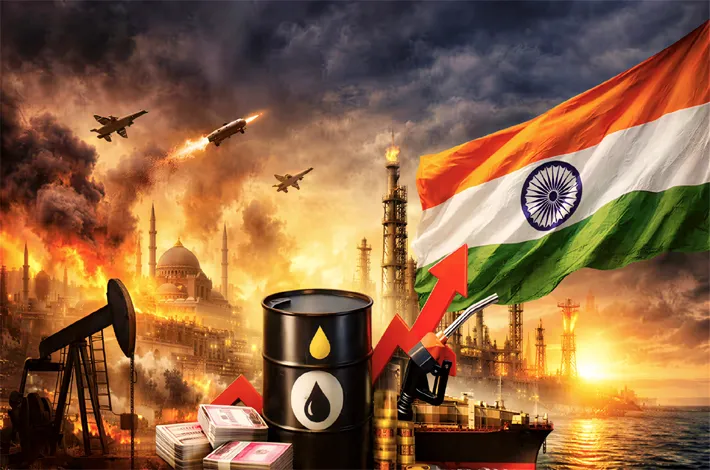
As tensions escalate in West Asia involving Iran, the United States, and Israel, questions are rising about whether India faces an inevitable oil crisis. The focal point of concern is the Strait of Hormuz, the narrow 33-kilometre waterway separating Iran from Oman and the UAE, which serves as the principal maritime exit from the Persian Gulf. This critical chokepoint carries roughly one-fifth of the world’s daily oil consumption and about 20 percent of global liquefied natural gas, with nearly 80 percent of these cargoes destined for Asia. Any disruption, even temporary, can ripple through global energy markets and sharply impact India’s energy security.
For India, which imports around 85 percent of its crude oil and a significant portion of LNG, the stakes are particularly high. Much of this energy supply—especially from the Middle East and increasingly from Russia—transits the Strait of Hormuz. A squeeze or threat to this corridor could quickly inflate India’s import bill, push up costs of LPG and petrol, increase freight and insurance premiums, and feed into household inflation through higher energy prices and derivative costs. Products across sectors—from aviation fuel to paints, tires, cement, and chemicals—could feel the pinch.
Experts argue that while India holds strategic petroleum reserves covering about 45 days of consumption, the main concern is not physical closure of the strait, which has never occurred historically, but the market reaction to heightened risk. Past crises, including the Libyan civil war, Houthi attacks on Saudi facilities, and the Russia-Ukraine conflict, have seen crude prices spike past $100 per barrel before markets stabilized.
Even minor disruptions could add $5–$12 to crude prices initially, potentially pushing Brent crude past $90 or even $100, with significant consequences for the rupee, oil marketing company margins, and the current account deficit.
Despite the alarm, some analysts caution against panic. While Iran has threatened to close the strait, a full blockade seems unlikely, given potential backlash from Saudi Arabia, other Gulf states, the United States, and China, which relies heavily on Gulf flows. An energy expert noted that markets may experience volatility over the next seven to ten days but predicted that prices would eventually stabilize based on supply-demand fundamentals, likely not exceeding $95–$100 for a sustained period.
Diplomatic efforts are central to India’s response. External Affairs Minister Dr. S. Jaishankar has engaged his Iranian counterpart and other regional foreign ministers, focusing on energy security and the safety of nearly 10 million Indians living in the Gulf. Prime Minister Narendra Modi has spoken directly with leaders in Israel and the UAE, emphasizing de-escalation through dialogue. Officials hope that OPEC nations will boost production to offset short-term disruptions and that practical diplomacy will prevent a prolonged crisis.
Nevertheless, economists warn of macroeconomic risks. A sustained Brent crude price of $90–$95 could exacerbate imported inflation, reverse recent gains in the rupee, widen the current account deficit, and challenge the Reserve Bank of India’s inflation-targeting efforts. While buffers such as excise duty cuts on fuels or potential RBI interventions exist, prolonged disruptions and rising logistics costs could deliver a "double whammy" to growth and economic stability.
Recent developments have intensified these concerns. Iranian threats to close the strait, attacks on tankers, precautionary halts in regional energy production including Qatar’s LNG output, and Brent crude surging past $80 have created a fear-driven spike in global markets. Analysts caution that short-term volatility could unwind if tensions stabilize quickly, but a broader regional escalation remains a major uncertainty.
One economist quantified the potential impact: crude priced at $60–$70 before the current crisis now carries a risk of an $80–$100 spike, implying roughly an 8 percent hit to India’s current account deficit, alongside potential foreign portfolio outflows as investors seek safe havens. She emphasized that the situation could normalize within a few months, giving policymakers time to adjust, and that government levers such as excise duty reductions and monetary policy flexibility could mitigate short-term shocks.
Voices from multiple sectors converge on a few key measures: vigilant diplomacy, diversified energy sourcing—including West Africa, the US, and Latin America—and targeted domestic measures to cushion the impact. While India’s strategic reserves and rerouting options may manage a temporary supply choke, any prolonged escalation in the Gulf would test India’s energy resilience and economic stability in ways that remain difficult to predict.
The debate over whether India can escape an oil crisis ultimately hinges on the interplay of geopolitics, market psychology, and domestic policy levers. If dialogue fails and disruptions intensify, the cost to consumers and the economy could be significant.
But if diplomacy and market responses align quickly, India may weather the immediate storm while preparing for long-term energy security challenges. The question remains pressing: is the country merely observing from the sidelines, or can it actively shape the outcome to avoid the worst-case scenario?