14 October, 2026 | 1:43 PM


The Ummah Utopia Broken promises in a modern warfare
04-03-2026 12:00:00 AM
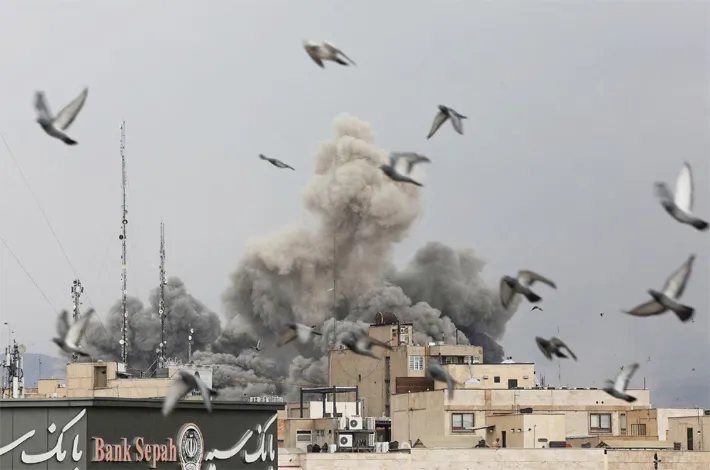
The ongoing Israeli military campaign against Iran has starkly highlighted a long-suspected truth: the pan-Islamic solidarity, often invoked as the Ummah, remains more rhetoric than reality. In practice, Iran is largely isolated, left to face a powerful, nuclear-backed adversary on its own, as its leadership and military infrastructure come under systematic attack. The conflict exposes the limits of religious brotherhood in the modern geopolitical arena, where national interest consistently outweighs theological solidarity.
A particularly revealing episode occurred when an Iranian general publicly claimed that Pakistan had promised to retaliate with nuclear weapons should Israel use them against Iran. The claim was swiftly refuted by Pakistan’s foreign minister in parliament, who described it as “fake news” and reaffirmed Islamabad’s stance as a “responsible nuclear state.” The debunking of this assertion underscored a broader reality: Pakistan’s nuclear arsenal has never been intended as an instrument of pan-Islamic defense, despite past political rhetoric.
The origin of this narrative traces back to Zulfikar Ali Bhutto, who at the 1974 Islamic summit in Lahore invoked the idea of an “Islamic bomb.” Bhutto argued that Christian, Jewish, communist, and Hindu nations had nuclear weapons, so why shouldn’t Muslim nations? His rhetoric aimed less at collective defense than at attracting financial support from oil-rich Muslim states flush with petrodollars following the 1973 Yom Kippur War. Libya’s Muammar Gaddafi was persuaded to invest, leaving symbolic traces of solidarity, such as his name emblazoned on Lahore’s cricket stadium. Yet, the reality today reflects a complete detachment from such pan-Islamic commitments.
Since then, Pakistan has prioritized national interests over any ideological obligation. Successive governments have watched neighboring Muslim nations, from Iraq and Libya to Syria, Afghanistan, and now Iran, endure devastating military campaigns without lifting a finger in their defense. Pakistan’s complex involvement in Afghanistan illustrates this pragmatism: it nurtured and supported both the Taliban and the United States, then switched positions when it suited national interests. Despite sharing a long border with Iran and not recognizing Israel formally, Pakistan has provided no substantive support to Tehran.
The absence of aid or even vocal solidarity from other Muslim nations is equally striking. Not a single state has sent humanitarian assistance — not food, medicine, or even symbolic support beyond routine United Nations ceasefire votes. Gulf Arab states, in particular, seem quietly relieved at the weakening of Iran’s revolutionary regime and its nuclear ambitions. Even Shia-majority nations such as Azerbaijan, which purchases Israeli kamikaze drones, and Iraq, remain silent. The pattern is clear: sectarian identity does not override national calculations, and practical interest invariably takes precedence over ideological or religious solidarity.
The numbers add further perspective. Muslims make up about a quarter of the world’s population and generate roughly 23 percent of global GDP, including some of the planet’s wealthiest nations. In contrast, the Jewish population is less than 0.2 percent. Yet, even with this demographic and economic weight, no coordinated deterrence has emerged against a nuclear-armed Israel backed by the United States. Protests against Israeli military actions have often been louder among Western Jewish communities than across Muslim-majority populations worldwide, highlighting the disconnect between religious identity and political action.
Institutional structures meant to foster pan-Islamic coordination have largely failed. The Organisation of Islamic Cooperation (OIC), despite its 57-member composition, has had minimal impact on collective causes. The Gulf Cooperation Council, the most cohesive regional bloc, aligns closely with Western powers and considers Iran its primary rival. Qatar is one of the few exceptions, attempting a delicate balancing act: maintaining ties with Iran, hosting US military bases, sheltering Hamas leaders, and quietly facilitating intelligence coordination with Israel. Even these efforts reflect national strategy rather than a genuine collective Islamic purpose.
History reinforces this enduring pattern. The last notable instance of multiple Muslim states coordinating against a non-Muslim adversary was the 1973 Yom Kippur War, when Egypt, Syria, and Iraq fought Israel. Pakistan’s involvement, however, was limited to assisting Jordan, motivated by strategic reciprocity rather than pan-Islamic solidarity. More often, internal conflicts among Muslim nations have claimed far more lives than external wars. Saudi-led operations in Yemen, Sudan’s civil wars, and Syria’s devastating conflict all illustrate the human cost of intra-Muslim strife, driven largely by political and territorial ambitions rather than religious brotherhood.
As Israel presses its campaign against Iran, the episode underscores the enduring truth: the idea of a borderless, unified Ummah remains largely aspirational. In the 21st century, Muslim-majority nations, like all others, act first and foremost in their national interest. Religion may inspire rhetoric, bolster political messaging, and evoke historical narratives, but it rarely dictates policy when survival, strategic advantage, or state security is at stake.
The crisis surrounding Iran, therefore, is more than a regional conflict; it is a litmus test for the concept of pan-Islamic unity. The results are sobering. Decades of rhetoric, symbolic gestures, and shared religious identity have not translated into meaningful collective action. Instead, the modern geopolitical reality is one of pragmatic self-interest, highlighting the enduring tension between ideology and strategy. The Ummah remains, for now, more a vision of the past than a force in the present.