14 October, 2026 | 7:06 AM


Rising school fees in Karnataka: A battle between affordability and operational costs
07-03-2026 12:00:00 AM
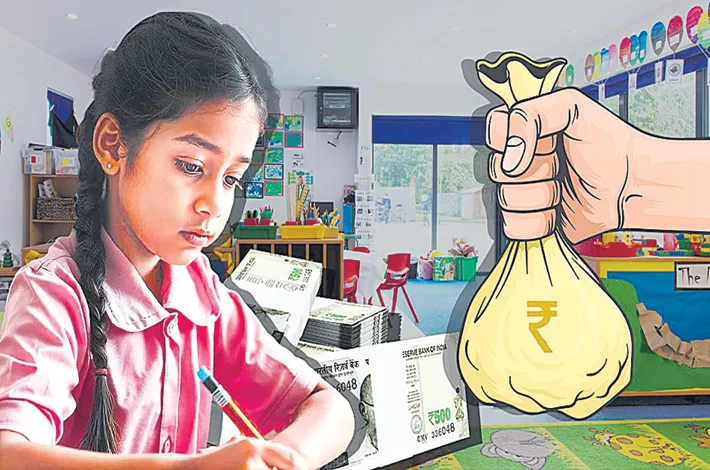
An office bearer of the Karnataka Associated Management of Schools (KAMS) defended the schools' position, emphasizing that most budget schools charge between Rs 10,000 to Rs 40,000 annually
As the new academic year approaches in Karnataka, thousands of families in Bengaluru and across the state are facing a familiar yet escalating challenge: proposed fee hikes in private schools. Parents are voicing strong opposition to increases ranging from 5% to 8%, with some budget schools pushing for up to 12%—a significant jump from the 2-4% hikes seen in previous years. Amidst inflation-stretched household budgets and an uncertain job market, many families argue that these hikes are arbitrary and frequent, demanding government intervention to ensure education remains accessible and affordable.
Private school managements, however, justify the revisions by citing rising operational costs, including staff salaries, electricity, water charges, and declining enrollment. They claim these factors force them to adjust fees to sustain quality education. Parents counter that the hikes lack scientific basis and transparency, fearing sharp rises in additional charges like transport, extracurricular activities, and development fees, which could push overall education costs even higher. Activists highlight that with nearly 19,000 private schools in Karnataka, the absence of a clear fee regulation law creates a regulatory vacuum that schools exploit, directly impacting the right to education.
The debate intensifies when comparing Karnataka's situation to other states. Parents' groups advocate for a transparent fee regulation framework similar to Delhi's proposed model, which includes a committee comprising school management, government representatives, and parents to review and approve any hikes. Supporters believe this system would bring accountability and balance, allowing schools to recover costs while giving parents a voice. In contrast, private school associations in Karnataka oppose such involvement, arguing that fee decisions should remain with management and that parent participation could violate legal principles from past court rulings.
An office bearer of the Karnataka Associated Management of Schools (KAMS) defended the schools' position, emphasizing that most budget schools charge between Rs 10,000 to Rs 40,000 annually, serving the majority of society at costs lower than government per-child expenditure. He points to the TMA Pai committee judgment and Karnataka High Court rulings that have quashed rigid fee regulations, asserting that schools should not be forced into fixed pricing. He acknowledged rising costs like electricity and water bills, noting that many schools face penalties without occupancy certificates, and argued against blanket regulations, suggesting case-by-case evaluations instead.
On the parents' side, Anubha Srivastava Sahay, President of the India Wide Parents Association, stressed the need for justification and transparency in fee hikes. She referenced successful models in Gujarat, approved by the Supreme Court, and upcoming regulations in Delhi, questioning why Karnataka's government isn't auditing schools or implementing the Right to Education (RTE) Act properly. Sahay argued that schools cannot arbitrarily increase fees without sharing balance sheets or audit accounts with the education department, pointing out that RTIs filed by parents often reveal a lack of data. "You have all the right to raise the fees, but you have to justify it," she insists, criticizing the lack of a proper regulatory framework despite decades of parental fights.
A member of the Parents Coordination Committee in Bengaluru, took a stronger stance, accusing private schools of "looting" parents for years without proper reasons. He highlights the absence of Parent-Teacher Associations (PTAs) in 99% of schools, violating the 1983 Education Act, and claims selections for such bodies are biased. He alleged political corruption, noting that many politicians, MLAs, and MLCs own or invest in schools, leading to favoritism. He cited recent approvals of 1,768 new private schools in 2024-25, questioning why investments continue if costs are so burdensome, and accused the education department of surrendering to private managements by extending registration deadlines and breaking rules.
The discussion reveals deep frustrations on both sides. The school managements urged parents to question high-charging schools directly and condemn exorbitant hikes by a minority (20-30%), but maintain that unavoidable cost increases due to inflation and commercialization make some revisions necessary. They challenged associations to meet government officials to resolve issues rather than generalizing. Parents however demand implementation of court judgments in a way that prevents profiteering, emphasizing that education shouldn't be treated like a commodity with fluctuating prices.
As the panel wraps up, the core question looms: Will Karnataka adopt a model like Delhi's to regulate school fees, or will parents continue to bear the brunt? With children's futures at stake, advocates like Sahay call for stakeholders to sit across the table and discuss solutions without political interference. This ongoing debate underscores the tension between ensuring quality education and maintaining affordability, a issue that shows no signs of resolution anytime soon.