18 October, 2026 | 7:01 PM


Salman Khan attends RSS @100 Formality or ideology?
10-02-2026 12:00:00 AM
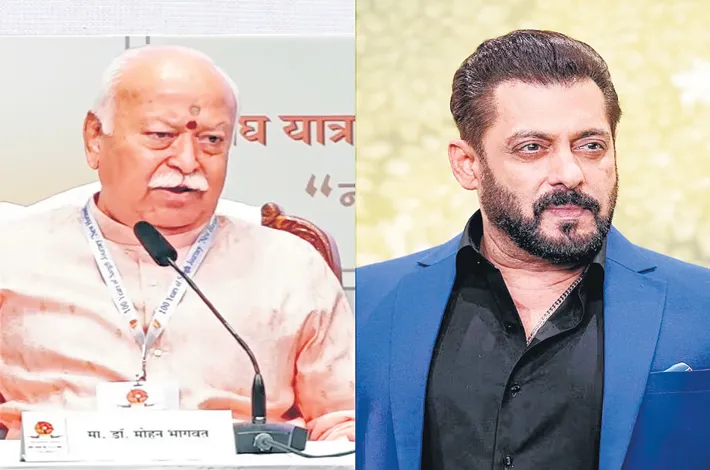
Bhagwat emphasized the organization's core values, stressing the importance of national unity over political power, communal harmony, and the adoption of swadeshi principles
The Rashtriya Swayamsevak Sangh (RSS) marked its 100th year of existence with a series of celebratory events, including a high-profile lecture series in Mumbai. Attended by notable personalities from various fields, the gathering drew significant attention due to the presence of Bollywood celebrities. Among them, superstar Salman Khan stood out, not only for his attendance but also for his attentive participation during RSS chief Mohan Bhagwat's address.
Bhagwat emphasized the organization's core values, stressing the importance of national unity over political power, communal harmony, and the adoption of swadeshi principles. His speech resonated with the audience, which included luminaries from the creative industry, highlighting the RSS's role in fostering societal good. The event featured a star-studded lineup from Bollywood, including Akshay Kumar, Ranbir Kapoor, filmmaker Subhash Ghai, and poet-filmmaker Prasoon Joshi.
Bhagwat specifically praised Salman Khan for his enduring influence on the younger generation, noting how college students often imitate his style. He urged that positive societal values should become "fashionable," using Khan as an example of cultural impact. This acknowledgment added a layer of intrigue, especially given Khan's recent history of wearing a limited-edition watch inspired by the Ram Mandir in Ayodhya—a move that had previously drawn criticism from some religious clerics.
Khan's appearance at the RSS centenary thus amplified discussions on celebrity involvement in socio-political events. However, Salman Khan's presence quickly became a flashpoint for controversy, particularly among opposition circles. Critics questioned his motives, suggesting it might stem from fear or a desire to safeguard his career amid perceived RSS influence.
One opposition voice remarked that celebrities might be attending to "satisfy" the organization, warning that surrendering to "fascist forces" rarely pays off. They argued that such attendance wouldn't shield individuals from potential communal attacks, labelling it a misguided step. This backlash came roughly a year after the Ram Mandir watch incident, underscoring a pattern of scrutiny on Khan's actions that intersect with cultural or religious symbols.
A political analyst challenged Khan's attendance, referencing RSS ideologue M.S. Golwalkar's writings in "Bunch of Thoughts," which labeled Muslims, Christians, and communists as internal threats to Hindu society. He cited historical incidents like the 1999 murder of missionary Graham Staines by a Bajrang Dal member and inflammatory statements from RSS affiliates, questioning whether Khan endorsed such views.
He suggested Khan should clarify his stance, implying the attendance might indicate a shift toward communalism, either by force or conviction. A university professor who is an RSS ideologue countered by highlighting the RSS's transformation in its centenary year, shifting from cadre-building to mass mobilization for a broader nationalistic movement. He defended Khan's right to attend, accusing the opposition of infringing on civil liberties by dictating personal choices.
He praised Bhagwat's outreach, including visits to mosques for dialogue, and emphasized the RSS's philosophy of unity beyond religion. He argued that the organization views Bharat Mata as supreme, allowing religious freedom within India's constitutional and civilizational framework. Sinha drew parallels between Bhagwat's efforts and global leaders like Nelson Mandela and Martin Luther King Jr., who promoted reconciliation and non-violence.
A muslim activist offered a more conciliatory view, noting that celebrities like Khan often attend diverse events, from spiritual gatherings to weddings, without issue. He advocated for inclusive invitations across communities, whether for Islamic programs or RSS events, to foster unity and dispel fears. He also acknowledged the RSS's invitations to opposition figures and stressed that mutual engagement could bring peace and strengthen the nation.
However, he echoed concerns about public perceptions shaped by media, calling for messages of love from both sides to build trust. A Hindu activist applauded the RSS's olive branch to all communities, likening Bhagwat's approach to nation-building efforts by Mandela, King and Gandhi. He criticized unnecessary negativity toward positive steps, noting the RSS's evolution from past ideologies and its rejection of untouchability and casteism.
Easwar urged moving beyond "ghosts of the past" and appreciating inclusive actions, including Bhagwat's rebukes of hardliners within his own fold The discussion circled back to personal liberties, with some sections insisting Khan, as a public figure who has professed liberal, multi-faith views, owed the nation an explanation on aligning with RSS ideology. As the RSS enters its second century, such celebrity involvements may continue to fuel debates on personal choice, communal harmony, and national integration.