24 September, 2026 | 3:05 AM


SC Decries ‘Consider Jurisprudence’ as Counterproductive
26-02-2026 12:00:00 AM
Calls for Decisive Relief in Long-Pending Cases
In a landmark observation that could reshape judicial practices across India, the Supreme Court has sharply criticized the prevalent trend of "consider jurisprudence," where courts frequently remand cases back to government authorities or administrative bodies for reconsideration rather than delivering definitive judgments. The apex court emphasized that if a litigant's claim is legally justified and deserves relief, it must be granted promptly and decisively, without unnecessary postponement or evasion.
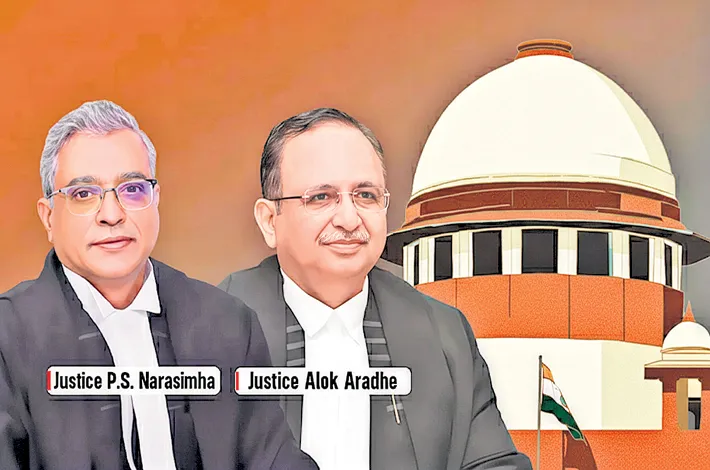
The remarks were made in the case of Mahendra Prasad Agarwal v. Arvind Kumar Singh & Ors., decided by a Division Bench comprising Justice Pamidighantam Sri Narasimha and Justice Alok Aradhe. The dispute originated from a protracted battle over the sanctioning of teaching posts in a private college, which has languished in the legal system for 16 years. Repeated remands by lower courts and the High Court had created a vicious cycle of delays, with authorities directed merely "to consider" the petitioners' representations, leading to no substantive resolution despite multiple rounds of litigation.
Deprecating this approach, the Bench described it as "counterproductive and harms the system." In its judgment, the court stated: "There is no doubt about the fact that the 'consider jurisprudence', so routinely adopted these days and if we may use the expression — to throw the ball out of the Court, is counterproductive and harms the system." The justices further stressed, "If a case deserves relief, it must be granted then and there, unflinchingly if need be. Balancing of equities is not to be confused with avoiding or postponing the relief."
The Supreme Court highlighted the pitfalls of vague directives that fail to establish a clear right or impose specific compliance requirements. Such orders, the judgment noted, often result in endless loops of reconsideration, fresh appeals, and even contempt proceedings, exacerbating judicial backlog and eroding public trust. "When a claim of right is legal and justified, relief must follow," the Bench asserted, cautioning against the misuse of contempt jurisdiction as a "shortcut" for relief when appealable orders are available. Labeling this a "bad practice," the court urged judges to avoid procedural shortcuts that undermine the appellate process.
In a direct intervention, the Supreme Court instructed the High Court to adjudicate the matter on its merits without further remanding it to the authorities. The Bench observed that the government's position was already clear from prior proceedings, making additional remands redundant and likely to cause more delays. This directive aims to bring closure to the petitioners' ordeal, ensuring that administrative entitlements, such as service-related approvals, are resolved efficiently.
Legal experts have hailed the ruling as a much-needed course correction for the judiciary. "This judgment is a wake-up call for courts to assert their authority in rights-based disputes," said senior advocate Rajiv Dhawan in an interview. "In areas like employment, education, and administrative sanctions, prolonged uncertainty can devastate livelihoods. By rejecting deferral tactics, the Supreme Court is promoting accountability and reducing the human cost of litigation." Others point out that the observation aligns with ongoing reforms to streamline judicial processes, including digitalization and backlog reduction initiatives under Chief Justice D.Y. Chandrachud's tenure.
The case underscores a broader issue plaguing India's courts: the over-reliance on remand orders to sidestep complex decisions. According to data from the National Judicial Data Grid, over 40 million cases are pending nationwide, with administrative and service matters forming a significant chunk. Critics argue that "consider jurisprudence" contributes to this crisis by shifting responsibility back to bureaucrats, who may lack the expertise or incentive for swift action. The Supreme Court's stance echoes earlier critiques in cases like Union of India v. Major Bahadur Singh (2006), where similar concerns about judicial abdication were raised.
Reported widely, including by legal portal Live Law on the day of the verdict, the judgment serves as a reminder that judicial restraint should not equate to inaction. It reinforces the principle that when clear legal entitlements are at stake—be it in education, employment, or governance—courts must deliver unflinching justice. As India grapples with a burgeoning caseload, this ruling could inspire lower courts to adopt a more proactive role, fostering efficiency and restoring faith in the system. With its emphasis on finality, the decision may well mark a turning point in how Indian judiciary handles protracted disputes, prioritizing relief over endless procedure.