17 August, 2026 | 5:47 PM


Still Beautiful, Still
23-06-2026 12:00:00 AM
T P Venu I hyderabad
Once every four years, the world comes together for a month-long celebration of "the beautiful game," as football has come to be known, and each time it never fails to enthral. This year, the expanded 48-team FIFA World Cup, hosted across the United States, Canada and Mexico, has already produced a blend of dominant performances, surprise results and emerging underdog stories.
Co-hosts Mexico and the United States have made strong starts. Mexico won its opening two matches to become the first team to virtually secure a place in the Round of 32, while the USA impressed with victories over Paraguay and Australia to top Group D. Canada has also exceeded expectations, including a stunning 6-0 victory over Qatar.
Among the traditional heavyweights, Germany has been the standout team. The Germans thrashed Curaçao 7-1 before defeating Ivory Coast to move to six points from two matches.
Argentina, France, England and Brazil have also begun positively, underlining their status as title contenders.
The tournament's biggest surprise has been the performance of smaller nations. Cape Verde earned global attention by holding Spain to a goalless draw and later securing a dramatic 2-2 result against Uruguay, keeping alive hopes of a historic knockout-stage berth.
Another feel-good story has been Egypt. Inspired by Mohamed Salah, the Pharaohs defeated New Zealand 3-1 to register a landmark World Cup victory and move to the top of Group G.
The tournament has also been notable for its attacking football. Germany's seven-goal haul, Sweden's 5-1 win over Tunisia, Canada's six-goal blitz against Qatar and several other high-scoring matches have contributed to one of the highest goals-per-game averages in World Cup history at this stage.
As the second round of group matches concludes, the race for places in the new 32-team knockout stage is intensifying. With several groups still finely balanced and underdogs continuing to challenge established powers, the competition appears wide open heading into the decisive final round of group fixtures.
Over the decades, the World Cup has produced countless memorable moments and legendary players. Brazil's Pelé became the only footballer to win three World Cups, Diego Maradona inspired Argentina's triumph in 1986, while later generations witnessed the brilliance of Zinedine Zidane, Ronaldo Nazário, Cristiano Ronaldo and Lionel Messi.
Brazil remains the most successful nation in World Cup history with five titles, followed by Germany and Italy with four each. The tournament has also helped football expand beyond its traditional strongholds, giving emerging nations a platform to showcase their talent on the biggest stage.
As always, attention is focused on the favourites. France, Spain, England, Brazil, Argentina and Portugal are among the leading contenders for the trophy.
France enters the competition with one of the most talented squads in world football. Led by Kylian Mbappé, it possesses depth, pace and experience across the field. Spain, fresh from its European success, combines youthful energy with technical excellence and will be eager to add another World Cup crown to its collection.
Defending champions Argentina once again carry the hopes of millions. While Lionel Messi may be in the twilight of his career, his influence remains immense. Brazil, meanwhile, is searching for a sixth title and hopes to restore its dominance on the global stage.
England continues to boast one of the most exciting generations of players in its history, while Portugal combines youthful talent with experienced leadership. Football experts also believe climate conditions, particularly heat and humidity in some host cities, could influence results and potentially favour South American teams accustomed to similar environments.
Yet the beauty of the World Cup lies in its unpredictability. Morocco's remarkable run to the semi-finals in 2022 demonstrated that traditional powerhouses can be challenged. Nations such as Japan, Saudi Arabia and several African teams will hope to spring surprises and write their own chapters in football history.
Cristiano Ronaldo's Last Dance
Few athletes have defined an era like Cristiano Ronaldo.
The Portuguese superstar has shattered records wherever he has played. He remains the only player to score 100 goals with four different clubs, finish as top scorer in four major domestic leagues and score more than 900 official goals for club and country.
The 2026 World Cup could represent Ronaldo’s final appearance on football’s grandest stage. For a player who has won virtually every major honour in the game, the World Cup remains the one prize that has eluded him.
His World Cup journey began in Germany in 2006 when Portugal reached the semi-finals. Since then, he has experienced the highs and lows of international football, including round-of-16 exits, a quarter-final defeat and a disappointing group-stage elimination.
Yet Ronaldo's hunger remains undiminished. Even in the later stages of his career, he continues to inspire teammates through his professionalism, determination and relentless pursuit of excellence.
For football fans around the world, this World Cup may offer one final opportunity to witness one of the game's greatest competitors on its biggest stage.
Why Football is called the ‘Beautiful Game’
Football's enduring popularity lies in its simplicity. All that is needed is a ball and a space to play. From the beaches of Brazil to the streets of Hyderabad, football can be enjoyed by anyone regardless of age, background or social status.
The phrase “the beautiful game” is most closely associated with Brazilian legend Pelé, whose artistry and joy embodied everything that makes football special.
Unlike many sports that feature frequent stoppages, football flows continuously. Players express themselves through movement, creativity, dribbling, passing and teamwork. Greats such as Pelé, Diego Maradona, Johan Cruyff, Zinedine Zidane and Lionel Messi transformed football matches into works of art.
Football's beauty also lies in its unpredictability. A single goal can alter the course of a match. Underdogs can topple giants. Unknown players can become national heroes overnight.
Perhaps most importantly, football possesses a unique ability to unite people. It creates shared memories, inspires communities and generates emotions that transcend generations.
It is this blend of skill, drama, passion and humanity that has earned football its timeless reputation as “the beautiful game.”
Hyderabad's Tryst with Football
India may not be a football powerhouse today, but during the 1950s and early 1960s, the country enjoyed a golden era in the sport. At the heart of that success was Hyderabad, one of India's most influential football centres.
Following India's Olympic debut in 1948, Hyderabad emerged as a major talent hub. Unlike many regions where shorter matches were common, local competitions in the city were played over the full 90 minutes, helping players develop superior fitness and endurance. The city soon became a prolific producer of elite footballers.
The strength of Hyderabad football was evident at the 1956 Melbourne Olympics, where seven players from the city featured in the Indian squad—the highest representation from any Indian city. Footballers such as S.K. Azizuddin, Muhammad Noor, Tulsidas Balaram, Mohammed Zulfiqaruddin and Yousuf Khan became national stars. Former India captain Shabbir Ali later remarked that the country once looked to Hyderabad for football talent.
No account of the city's football legacy is complete without Hyderabad Police FC.
Known for its discipline, fitness and tactical organisation, the team dominated Indian football in the early 1950s, winning the prestigious Rovers Cup five consecutive times from 1950 to 1954. Their dramatic victory over Mohun Bagan in the 1950 Durand Cup final remains one of Indian football's memorable moments.
Behind much of this success stood Syed Abdul Rahim, widely regarded as the architect of modern Indian football. Through innovative coaching and tactical excellence, he transformed the national team. His greatest achievement came at the 1962 Asian Games in Jakarta, where India defeated South Korea 2-1 to win the gold medal. Four Hyderabad players—Peter Thangaraj, Tulsidas Balaram, Yousuf Khan and Afzal—played key roles in that triumph.
Though Rahim died in 1963, his legacy endures. Hyderabad's contribution remains one of the most glorious chapters in Indian football history.
Messi Mesmerises
If Cristiano Ronaldo's story is about unfinished business, Lionel Messi's is about legacy.
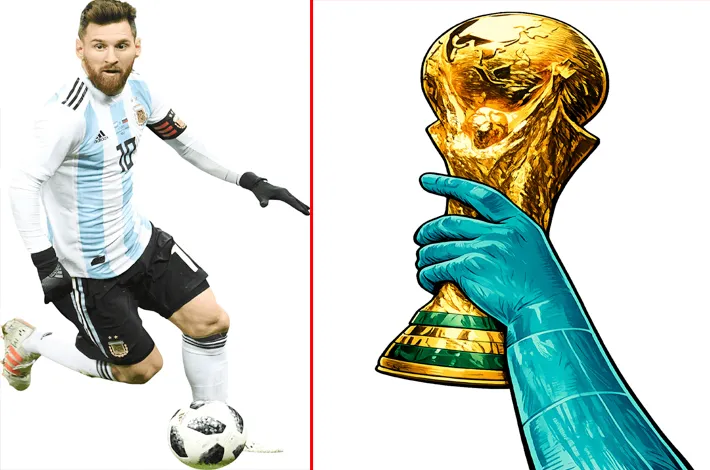
The Argentine captain arrived at the 2026 FIFA World Cup with nothing left to prove. By leading Argentina to the title in Qatar in 2022, Messi completed football's ultimate set of honours and secured his place among the game's immortals.
Yet at 38, he remains far more than a symbolic figure. Messi has once again emerged as the heartbeat of Argentina's campaign, combining vision, creativity and composure to devastating effect. His stunning hat-trick in the group stage was a reminder that his brilliance remains intact, instantly becoming one of the defining moments of the tournament and strengthening Argentina's hopes of retaining the trophy.
Messi's World Cup journey began in 2006 and now spans two decades. During that time, he has broken records, won major individual honours and become one of the most influential players in tournament history.
The 2026 edition is especially significant as it marks his sixth World Cup appearance, a rare achievement that may also represent the final chapter of an extraordinary career.
Messi seems determined to make that chapter memorable. Even as younger stars take centre stage, he continues to dictate games and produce moments of magic. Whether Argentina successfully defends its title or not, fans know they may be witnessing the final World Cup performances of one of the greatest footballers the sport has ever seen.