23 October, 2026 | 8:01 AM


Gen Alpha steps out, echo Gen Z activism
17-08-2026 12:00:00 AM
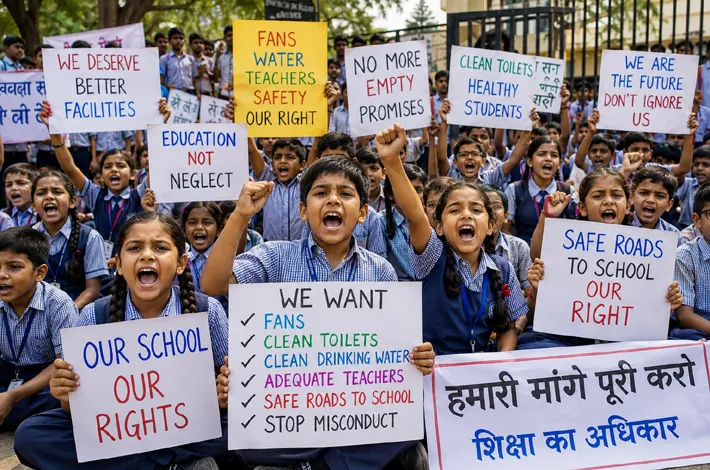
Students alleged that repeated complaints had been ignored and that some fans had even caused electric shocks. Carrying portraits of B.R. Ambedkar, they marched and occupied the campus
metro india news I hyderabad
Across India’s towns and villages, a new generation is rewriting the rules of student protest. Generation Alpha—children born roughly between 2010 and 2025, many still in primary and secondary school—has taken to the streets in multiple states, demanding the basics that successive governments have long promised but frequently failed to deliver. Fans in sweltering classrooms, clean toilets, functional drinking water systems, adequate teachers, safe roads to school, and protection from misconduct.
Inspired by the recent Gen Z-led agitations over exam paper leaks that culminated in the resignation of Union Education Minister Dharmendra Pradhan, these schoolchildren have organised sit-ins, locked gates, blocked roads, and marched to collectorates. In several cases, authorities have responded with concrete action. The wave has been visible and multi-state. Reports document protests in Uttar Pradesh, Bihar, Rajasthan, Madhya Pradesh, Maharashtra, Jharkhand, and Uttarakhand. Unlike Gen Z’s focus on national-level policy failures in competitive examinations, Gen Alpha’s grievances are hyper-local and immediate: the conditions under which they study every day.
Videos circulating on social media show children as young as 10–13 holding placards, chanting for their rights, and refusing to disperse until officials engage. One of the largest early demonstrations occurred on 28 July 2026 at Sarvodaya Inter College in Kishanpur, Fatehpur district, Uttar Pradesh. Nearly 1,500 students from Classes 6 to 12 staged a prolonged sit-in lasting five to six hours. They demanded functional ceiling fans (at least four per classroom), repaired electrical wiring, clean toilets, safe drinking water including RO systems and coolers, adequate desks and benches, better midday meals, a library, computer lab, and sports facilities.
Students alleged that repeated complaints had been ignored and that some fans had even caused electric shocks. Carrying portraits of B.R. Ambedkar, they marched and occupied the campus. District Inspector of Schools Rakesh Kumar and the principal responded with written and verbal assurances: fans would be installed immediately, wiring repaired, benches provided within a month, and other facilities addressed. The protest ended after these commitments. Similar scenes unfolded elsewhere. In Rajasthan’s Barmer and Jalore districts, students locked school gates over chronic teacher shortages, insisting that first-, second-, and third-grade posts be filled so classes would not go unattended. Authorities promised immediate deployment of teachers. In Bihar’s Gaya district, around 40 students from Simuara Middle School walked several kilometres to the Tikari Sub-Divisional Magistrate’s office to highlight dirty toilets, a non-functional hand pump, poor midday meals, and missing sports equipment. Transport and infrastructure issues have also driven action.
In Uttar Pradesh’s Hamirpur district, students and villagers from Chandu Pur gram panchayat undertook a “Tiranga Yatra,” marching about 5 km to the Collectorate on 11 August to demand a paved road to their school—something they said had been missing since Independence. In Madhya Pradesh’s Jabalpur, students of Sandipani (or Sandeepani) Vidyalaya in Patan blocked the Patan-Jabalpur road after the school was shifted roughly 10 km away to Sakra village. They complained that the distance left them exhausted, that studies suffered, and that teachers had threatened transfer certificates or failure if they protested.
They demanded regular bus service. The Sub-Divisional Magistrate assured action, after which the blockade ended. Safety concerns have featured prominently. In Rajasthan, girls at a government senior secondary school accused teacher Naresh Kumar Jain of inappropriate touching and misconduct. They said repeated complaints went unheard. Students blocked the road, staged a chakka jam, and demanded his suspension, declaring they would not back down and questioning whether their voices would be suppressed because they are girls. Officials intervened; in a parallel Ajmer case around the same period, a teacher facing similar allegations of inappropriate physical contact was suspended after students locked the gate and protested.
Successes have been tangible and rapid in several instances, illustrating the power of organised, visible pressure from children too young to vote. In Jharkhand’s Garhwa district, students aged 10–13 at Government Plus Two High School in Kandi blocked a road for nearly seven hours opposing the transfer of headmaster Malay Kumar Singh, whom they credited with improving the school. After confrontation and sustained protest, the district education officer revoked the transfer order and allowed him to continue on deputation. In Uttarakhand’s Khatima, a three-day protest at an Eklavya Model Residential School over food quality, water, power, and cleanliness led to the principal’s removal and an official inquiry. Across the Fatehpur, Barmer, and other sites, inspections, deadlines for fans and water systems, and temporary teacher postings followed. Analysts note that Gen Alpha has absorbed lessons from Gen Z’s recent victory.
The Cockroach Janta Party-led protests over NEET irregularities forced a high-profile resignation and policy commitments with relatively limited violence. Schoolchildren appear to have internalised that collective action, social media amplification, and refusal to accept bureaucratic indifference can compel response. Officials who once dismissed complaints now form committees, issue assurances, and act under the glare of viral videos. Yet challenges remain. Many government schools continue to suffer from underfunding, vacant posts, and delayed maintenance. Assurances of “soon” or “within a month” must translate into lasting infrastructure rather than temporary fixes. Questions also arise about adult facilitation or political amplification of some protests, though the core demands—hygiene, teachers, safety, and access—are fundamental and longstanding. Child safety protocols during protests and the risk of backlash or academic disruption require careful handling by administrations.The phenomenon signals a deeper shift. India’s youngest students are no longer passive recipients of whatever facilities are provided.
They are articulating rights-based claims to a functional education environment and demonstrating organisational capacity. Whether this remains a series of local victories or evolves into sustained pressure for systemic reform in school infrastructure and accountability will depend on consistent follow-through by state education departments and continued civic attention. For now, Gen Alpha has shown that even those too young to cast a ballot can make institutions listen—and sometimes act.