20 October, 2026 | 11:54 AM


Sunlight to shield households, soften bills!
04-04-2026 12:00:00 AM
The Turning of the Light | Clean power, calmer futures: India expands energy capacity beyond 200 GW as homes, farms, industries embrace resilient, affordable energy pathways
Before the guns fall silent,
the sun still rises free,
No empire can tax its fire,
no throne command the sea.
The wind defies all borders,
unbought, untamed, unknown,
And light will break the age
where power was hoarded, not grown .....
Palazhi Ashok Kumar
MUMBAI
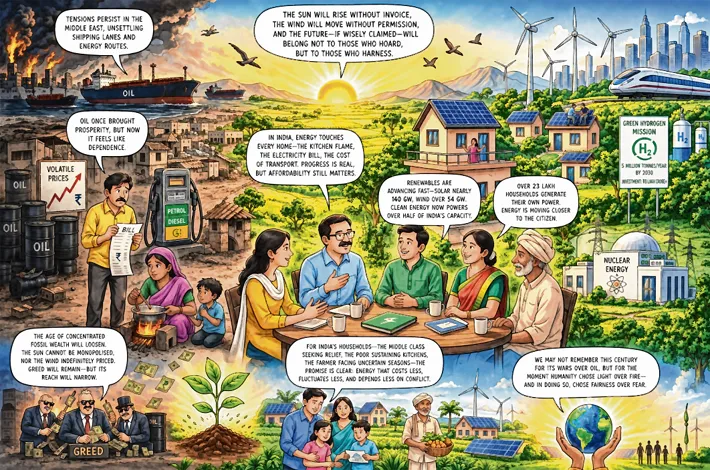
At first light, before markets stir and before missiles redraw maps, the earth will continue its quiet generosity. The sun will rise without invoice, the wind will move without permission, and the future—if wisely claimed—will belong not to those who hoard, but to those who harness.
Yet the present remains tethered to older forces. Across the Middle East, tensions persist, unsettling shipping lanes and casting long shadows over global energy routes. Oil, once the bedrock of prosperity, increasingly reveals itself as a vulnerability. What was built as strength now behaves like dependence. Beneath it lies a harder truth: greed, entrenched and strategic, has shaped an energy order where control often outweighs fairness. For the global middle class—and more starkly for the poor—this reality is immediate.
In India’s homes, energy is not an abstraction but a daily arithmetic. The kitchen flame, the electricity bill, the cost of transport—each reflects distant conflicts and volatile markets. Progress is undeniable: rural electricity supply now exceeds 22 hours daily, and urban access is near universal. Yet affordability remains fragile, and dignity often negotiable. And still, the future is already advancing. India’s renewable energy expansion is no longer gradual; it is structural. Solar capacity has surged to nearly 140 GW, while wind energy stands at over 54 GW. Non-fossil fuel sources now account for more than half of installed electricity capacity, signalling a decisive shift in the nation’s energy architecture.
Electricity demand continues to rise—crossing 1,829 billion units and heading towards 2,000 billion units—but its composition is changing. Over 23 lakh households now generate their own power through rooftop solar. Energy is moving closer to the citizen, reshaping the relationship between consumption and control. This shift carries implications beyond infrastructure. The age of concentrated fossil wealth—the realm of the “richy rich”, built on scarcity and leverage—will begin to loosen. Renewable energy disperses advantage. The sun cannot be monopolised, nor the wind indefinitely priced. The architecture of power itself is being rewritten.
Greed will remain—but its reach will narrow. Policy momentum reinforces this transition. The National Green Hydrogen Mission, targeting 5 million metric tonnes annually by 2030, will reduce fossil dependence while attracting investments exceeding ₹8 lakh crore. The question is no longer whether the world will transition—but how quickly it must.
For India’s households—the middle class seeking relief, the poor sustaining fragile kitchens, the farmer navigating uncertain seasons—the promise is tangible: energy that will cost less, fluctuate less, and depend less on distant conflict.