16 November, 2026 | 3:23 AM


‘tg eyes aerospace, defence leadership’
16-11-2026 12:00:00 AM
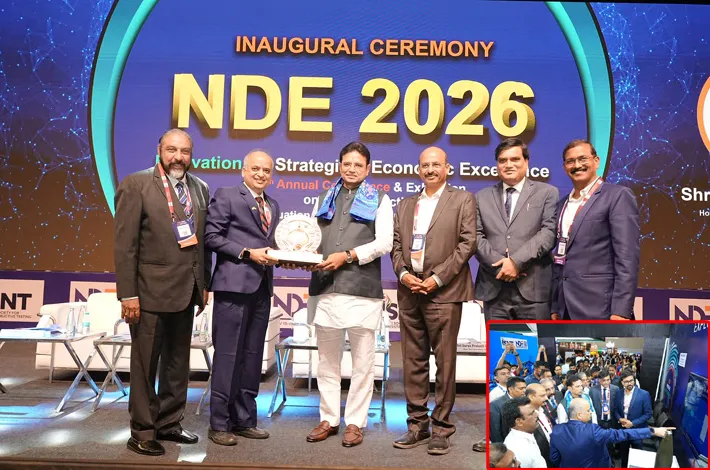
The government ïs committed to strengthening the ‘Made in Telangana’ brand and increasing the State's participation in global supply chains.
D Sridhar Babu IT & Industries Minister
metro india news I hyderabad
Telangana IT & Industries Minister Duddilla Sridhar Babu said the State is working towards a position to become a leader in aerospace and defence sectors. He added that by building capabilities across the entire value chain, including design, engineering, quality testing, certification and research, Telangana would become a hub.
Addressing the national conference on ‘Non-Destructive Evaluation and Enabling Technologies (NDE–2026)’, organised by the Indian Society for Non-Destructive Testing (ISNT) at HITEX, Hyderabad, on Sunday, the Minister said the State was looking beyond manufacturing to develop a comprehensive ecosystem that would enable local industries to compete in global markets. He said the government was committed to strengthening the ‘Made in Telangana’ brand and increasing the State's participation in global supply chains. Efforts were being made to connect local industries with global markets and help them tap the growing opportunities in the aerospace and defence sectors.
Highlighting the importance of Non-Destructive Evaluation (NDE), Sridhar Babu said NDE professionals played a critical role in ensuring the safety, quality and reliability of aircraft, helicopters and other aerospace and defence equipment. With advanced materials and emerging technologies transforming the manufacturing landscape, inspection and testing methods must also evolve, he said. The adoption of Artificial Intelligence, Digital Twins and advanced inspection techniques would be increasingly important in improving accuracy, quality and reliability.
The Minister said the demand for skilled NDE professionals was expected to grow in the coming years. The government was keen to equip Telangana's youth with industry-relevant skills and develop a workforce capable of meeting the requirements of emerging sectors. He invited ISNT, industry representatives, universities and research institutions to work with the State government in strengthening the NDE ecosystem.
Responding positively to ISNT's proposal to establish an NDE Centre of Excellence in Hyderabad, Sridhar Babu asked the organisation to submit a detailed proposal for the government's consideration. ISNT President Dr. Jaitish R. Joshi, NDE–2026 Chairman Surya Prakash Gajjala, Convenor Mohan P. Nair and MIDHANI CMD Dr. S. V. S. Narayana Murthy, among others, attended the conference.
Rajnath bats for indigenous defence technologies
Defence Minister Rajnath Singh has called for making India not merely a user of advanced technologies but also a developer, innovator and global leader in critical domains. He stressed the need to strengthen the country's Non-Destructive Testing (NDT) ecosystem to enhance defence preparedness and achieve technological self-reliance.
Virtually addressing the 36th Annual Conference on Non-Destructive Evaluation and Enabling Technologies and the 15th International Symposium on Non-Destructive Testing in Aerospace on November 15, he emphasised the importance of developing indigenous capabilities in advanced inspection technologies, specialised sensors, evaluation equipment and associated software.
He said reducing technological dependencies and securing critical defence supply chains required stronger domestic capabilities and consistent quality assurance practices across the defence industrial ecosystem. Public Sector Undertakings, private manufacturers, start-ups and MSMEs had an important role to play in this effort. He asserted that there could be no compromise on the accuracy, reliability and integrity of testing results, particularly in strategic applications.
Explaining the significance of NDT, Rajnath Singh said the technology enabled the examination of materials, components and structures without damaging them. Just as ultrasound and X-rays help examine the human body without surgery, NDT techniques detect internal defects in critical components without dismantling or damaging them.
He pointed out that as Indian defence systems become increasingly sophisticated, every critical material, component and manufacturing process must meet the highest standards of quality and reliability. Hidden defects could affect operational availability, increase maintenance costs, reduce equipment life and even jeopardise mission success. "We need to move beyond a culture of merely identifying defects towards actively preventing them by embedding quality at every stage of the manufacturing process," he said. The Defence Minister said quality in missiles, aircraft, naval platforms and spacecraft was not merely a manufacturing requirement but an essential element of operational reliability and national security. India's pursuit of Aatmanirbharta in defence was therefore a strategic necessity and not merely an economic objective.
Citing achievements in missile development, naval platforms, aerospace engineering, radar systems and space applications, he said India's growing indigenous defence ecosystem reflected its expanding scientific and industrial capabilities. The commissioning of the country's first indigenous aircraft carrier, INS Vikrant, was an important milestone in the Aatmanirbhar Bharat journey. He also highlighted initiatives such as Innovations for Defence Excellence (iDEX) and the Technology Development Fund (TDF), which have encouraged innovation, technological development and experimentation in the defence sector.
Pointing to the transformation underway in NDT, Rajnath Singh said Artificial Intelligence, Machine Learning, Robotics, Advanced Sensors, Digital Twins and Predictive Analytics were expanding the scope of inspection and structural health monitoring. Their integration with established inspection techniques could improve accuracy, efficiency and the ability to detect complex defects.
He called for greater investment in research, advanced equipment, software and skilled manpower to develop indigenous solutions suited to India's strategic and industrial requirements and make them competitive internationally. He also stressed collaboration among the Government, industry, academia and research institutions. The three-day conference, organised by the Indian Society for Non-Destructive Testing in Hyderabad, has brought together over 2,000 professionals, researchers, industry experts and students to discuss emerging technologies and applications in NDT, particularly in defence and aerospace.