15 October, 2026 | 8:00 AM


Trump's tariff hike amid Supreme Court setback
24-02-2026 12:00:00 AM
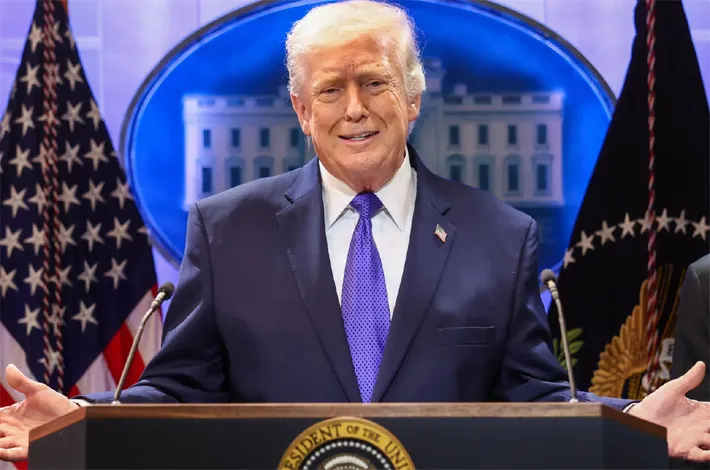
■ Trump imposed a 15% tariff on all imports under Section 122 of the 1974 Trade Act after the Supreme Court ruled his prior broad emergency tariffs unlawful.
■ The tariff hike is expected to raise global consumer prices, increase trade volatility, and heighten tensions with major partners like China and the EU.
■ India faces around 18.5% effective tariffs but remains relatively insulated due to ongoing FTA negotiations that could soon eliminate duties.
■ Experts describe Trump as vindictive and transactional, predicting he will use other legal tools and escalate foreign tensions to maintain dominance and rally his base.
■ Panelists offer mixed advice for India, ranging from accelerating the US FTA to diversifying trade partnerships and avoiding over-reliance on America.
In a bold escalation of his trade policies, US President Donald Trump has imposed a 15% tariff on all imports, up from the previous 10%, following a Supreme Court ruling that deemed his earlier broad tariff measures under emergency powers unlawful. Announced under Section 122 of the 1974 Trade Act, which permits temporary surcharges to address balance of payments issues, this new measure is set to last up to five months unless Congress intervenes to make it permanent.
Trump sharply criticized the court's decision as "ridiculously anti-American," highlighting that the US had already collected over $130 billion in tariff revenue under the prior framework. This development is poised to raise consumer prices globally and intensify trade tensions with key partners like China and the European Union. The announcement has sparked widespread debate on its economic and political ramifications.
Experts dissected Trump's strategy, labeling it a potential "flip-flop" in the face of judicial constraints. A senior political commentator argued that Trump's persistence reflects an obsession with his own worldview, enabled by multiple constitutional provisions. He pointed to Section 122's temporary allowance for 15% tariffs, as well as other mechanisms like Section 232 of the 1962 Trade Expansion Act, which could justify higher duties on national security grounds without needing Supreme Court or congressional approval. He also referenced the Trading with the Enemy Act, Smoot-Hawley provisions, and anti-dumping duties as tools in Trump's arsenal, warning that the president might become "more vindictive" toward non-cooperative nations.
He emphasized that the Supreme Court's ruling did not outlaw tariffs outright but criticized the method of imposition via the International Emergency Economic Powers Act as overly broad and arbitrary. This, he suggested, opens the door for Trump to pivot to more targeted, product-specific tariffs—such as 28% on aluminum or 56% on steel from China—allowing greater manipulation without oversight.
For India, he viewed the situation optimistically, noting that the country's tariffs would rise to around 18.5% (including MFN rates) but could soon drop to zero under an impending Free Trade Agreement (FTA). He praised the Modi government's negotiations, highlighting how India swiftly removed objectionable items like agriculture and pulses from the fact sheet. He predicted Trump would accelerate the FTA to bolster his political capital ahead of midterms, positioning India as a strategic partner in initiatives like the AI summit and defense pacts, ultimately insulating it from broader tariff impacts.
A former NITI Aayog chairperson offered a more cautious perspective, describing the tariff hike as the "biggest inflection point in global economic history" since Trump's reelection. She lamented the limited role of multilateral institutions like the WTO in resolving disputes, urging India to adopt a "look anywhere but America" policy. She advocated accelerating bilateral and plurilateral agreements with other nations, arguing that India's 14-17% reliance on US trade should not lead to capitulation to a "bully."
She criticized the lack of ease in doing business with the US, pointing to volatility that could slow global growth as forecasted by the WTO. She also decried Trump's attacks on the judiciary as "constitutionally blasphemous," underscoring a breakdown in the separation of powers. She portrayed Trump as a "transactional president" prioritizing "Trump first" over genuine America First policies, driven by the US's high 102% debt-to-GDP ratio and the need to weaponize tariffs for revenue.
A foreign affairs expert framed Trump's actions through the lens of narcissism, asserting that the president views himself as infallible. He explained the pivot to Section 122 as a pre-planned "Plan B" from Trump's playbook, as outlined in his 1987 book The Art of the Deal. He predicted Trump would blame the judiciary for hindering manufacturing's return to the US, using inflammatory rhetoric to rally his MAGA base ahead of midterms. He warned of increased global trade volatility, with tariffs fluctuating unpredictably and deterring commerce. For India, he acknowledged relative insulation due to lower exposure but stressed the need for careful calibration in future negotiations.
As midterms loom, polls show 62% opposition to Trump's tariff policies even in red states, potentially forcing more aggressive tactics. The discussion concluded on a note of uncertainty, with experts agreeing that while India stands to benefit from strategic positioning under Modi, the world must brace for Trump's unyielding pursuit of economic leverage. Time will reveal whether these measures yield long-term gains or further isolate the US on the global stage.