17 October, 2026 | 4:46 PM


Universities key to build a knowledge based society
06-01-2026 12:00:00 AM
Metro India News | AMARAVATI
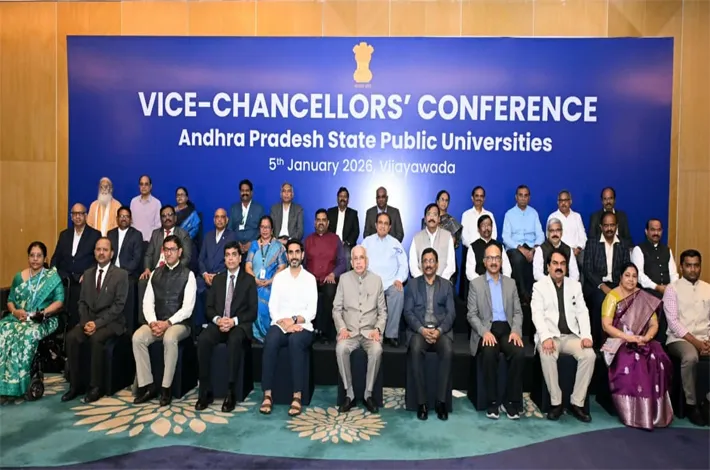
Emphasizing that universities are the backbone of a knowledge-based society, State Education, IT and Electronics Minister Nara Lokesh on Monday called upon Vice Chancellors of public universities to emerge as leaders of reform and transformation, rather than remaining confined to administrative roles. The meeting was chaired by Governor Abdul Nazeer, who also serves as Chancellor of State universities.
Governor Abdul Nazeer on Monday stressed the need to significantly improve the National Institutional Ranking Framework (NIRF) performance of Andhra Pradesh’s public universities, noting that only Andhra University featured in the top 50 and Acharya Nagarjuna University in the top 100 as per the NIRF Rankings 2025. He also called for special attention to the needs of rural, tribal and first-generation learners, ensuring that equity is reflected not just in enrolment numbers but in student success and life outcomes. In an era of rapid technological advancement, he said degrees alone were no longer sufficient, and students must be equipped with adaptive skills, digital literacy and lifelong learning abilities.
Meanwhile, addressing the gathering, Minister Lokesh outlined five key challenges that Vice Chancellors must urgently address to strengthen public universities. The first, he said, was the growing mismatch between teaching and real-world needs. Degrees from Indian universities, including Andhra Pradesh, were facing declining global demand due to outdated curricula. He urged universities to undertake comprehensive, periodic curriculum reforms aligned with emerging global trends.
The second challenge was the proliferation of degrees with limited employment outcomes. Weak internship, apprenticeship and placement mechanisms had eroded the credibility of university education. Insufficient collaboration between industry and academia, he said, had further widened this gap. The third issue was research with little practical impact. Lokesh observed that while publications had increased, meaningful innovation, patents, start-ups and technology transfer remained limited. Universities, he said, must become engines of innovation that directly address societal challenges.
The fourth challenge related to governance. Excessive time spent on administrative matters was undermining academic focus. While acknowledging faculty shortages and legacy governance issues, Lokesh stressed the need for data-driven decision-making, improved faculty capacity and a sharper focus on academic standards. The fifth concern was the lack of equity and continuity in student experience. Deficiencies in mentoring, welfare systems and mental-health support had become serious issues, he warned.
Stressing that universities must serve as bridges between education and employment, Lokesh criticised outdated teaching methods. “Continuing to teach obsolete content is not just a waste of time, it is a betrayal of our students,” he said. Degrees must restore dignity of labor and self-respect. Recalling his observations during the padayatra, he pointed out that many graduates found jobs only after undergoing short-term training in private hubs like Ameerpet, highlighting systemic failures in formal education. He advocated stronger industry-linked courses, mandatory internships, apprenticeships, alumni mentoring and multidisciplinary learning. Research, he added, must shift from mere journal publications to solution-oriented outcomes addressing water scarcity, climate change, agricultural productivity, public health and nutrition. Lokesh urged Vice Chancellors to engage directly with students by holding weekly “open house” sessions to understand their concerns.