14 September, 2026 | 2:46 AM


1.90 lakh quintals of paddy missing
14-01-2026 12:01:46 AM
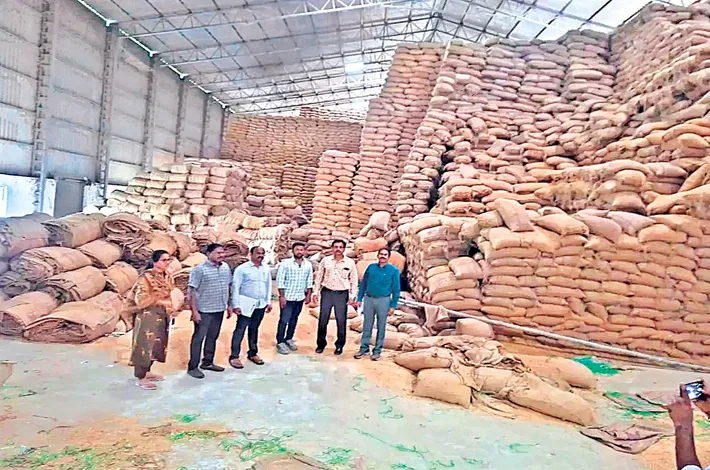
- Vigilance and Enforcement officials expose irregularities worth nearly Rs 60 crore in just 19 rice mills in just two days
- Telangana has over 4,800 rice mills. The 19 mills inspected represent less than 0.4 percent of the total
If a cursory inspection of just 19 rice mills can expose irregularities worth nearly Rs 60 crore, the scale of the alleged scam across Telangana’s entire rice milling sector is difficult to imagine. Vigilance and Enforcement officials, who conducted limited raids over two days, have uncovered massive diversion of government rice, raising serious questions about the functioning of the public distribution and procurement system.
During inspections carried out on Monday and Tuesday, Vigilance and Enforcement teams checked 19 rice mills spread across nine districts — Mahabubabad, Peddapalli, Rangareddy, Vikarabad, Narayanpet, Suryapet, Nalgonda, Kamareddy and Nizamabad. Even within this narrow exercise, officials detected large-scale diversion of Custom Milled Rice (CMR) meant for government supply.
According to officials, nearly 1.90 lakh quintals of paddy were found missing or illegally diverted, along with around 1.72 lakh gunny bags. The total value of these irregularities has been estimated at approximately Rs 60 crore. Out of the 19 mills inspected, 14 were found to be involved in serious violations, prompting the registration of criminal cases.
District-wise findings further underline the magnitude of the problem. Nizamabad district alone accounted for irregularities worth about Rs 19.73 crore. Suryapet followed with violations valued at around Rs 19.32 crore, while Narayanpet recorded diversions worth Rs 15.91 crore.
In Peddapalli, the value stood at Rs 11.38 crore, Mahabubabad at Rs 4.86 crore, and Rangareddy at Rs 0.88 crore. These figures emerged despite inspections being limited in scope and duration.
What has drawn sharper criticism is the fact that Telangana has over 4,800 rice mills, including raw and boiled rice units. The 19 mills inspected represent less than 0.4 percent of the total. Under the procurement system, paddy purchased from farmers by the government is supplied to rice mills for milling. The mills are required to return Custom Milled Rice to the Civil Supplies Department or the Food Corporation of India. However, vigilance officials say that diversion begins even before the paddy reaches the mills, with quantities disappearing during transportation. What reaches the mills is allegedly diverted further, either by selling raw paddy or rice in the open market for higher profits.
In the ongoing 2025 Kharif season, the government has procured about 70.82 lakh metric tonnes of paddy from farmers. This includes 32.45 lakh metric tonnes of coarse variety and 38.37 lakh metric tonnes of fine variety, all supplied to rice mills. With inspections covering only a handful of mills, the actual stock position and the extent of diversion across the state remain largely unknown.
Sources point out that fine variety rice fetches premium prices in the open market, often selling for Rs 44 to Rs 46 per kg after milling. In contrast, mills reportedly supply coarse or recycled rice to the government as CMR. There are also allegations that fine rice distributed through ration shops is bought back by traders at Rs 14 to Rs 16 per kg, routed back to mills, recycled, and then supplied again to the government, creating a cycle of repeated misuse.