20 October, 2026 | 9:55 AM


A Love Forged in Time
16-08-2025 12:00:00 AM
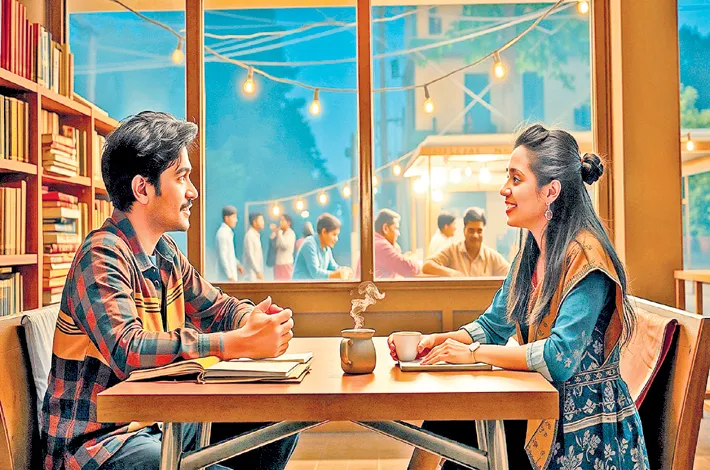
In the sultry summer of 1983, Mohan Sarma, a lanky 24-year-old Telugu Brahmin, stepped off the train at Howrah Station, his heart pounding with a mix of nerves and excitement. Clutching a letter of admission to Presidency College, Calcutta, for an MA in English Literature, he felt the weight of his dreams. His modest upbringing in Vijayawada had instilled in him a quiet determination, and now, in this bustling city, he was ready to carve his path.
On the first day of classes, Mohan sat in the back of the lecture hall, his eyes scanning the room. That’s when he saw her—Arunima Sengupta, with her sharp wit and cascade of dark hair, commanding attention as she debated Keats with the professor. Her confidence was magnetic, yet her smile, when it landed on Mohan, was warm and unguarded. By the end of the week, Arunima had sought him out, intrigued by his reserved demeanor and the way his eyes lit up when discussing Tagore. “You’re not like the others, Mohan,” she teased, her Bengali accent curling around his name. “You actually listen.”
Arunima’s parents, Professor Samar Sengupta, a renowned historian, and Dr. Shalini Sengupta, a pediatrician, took an immediate liking to Mohan when Arunima brought him home for Durga Puja. Over steaming plates of bhog, Samar quizzed Mohan on postcolonial literature, while Shalini, with her gentle demeanor, asked about his family. Mohan’s sincerity and quiet intellect won them over, though Samar jokingly warned, “Don’t let Arunima drag you into her wild ideas!”
Over the two years of their MA, Mohan and Arunima became inseparable. Study sessions in the college library stretched into late-night debates over chai at roadside stalls. Arunima’s fiery idealism complemented Mohan’s introspective nature. She challenged him to question the world; he grounded her with his steady presence. Their bond deepened, unspoken but palpable, in stolen glances and shared silences.
As graduation loomed in 1985, Arunima proposed a radical idea: joining an NGO in the Chota Nagpur Plateau to work with tribal communities. Mohan, inspired by her passion and his own desire to understand India beyond books, agreed. Their decision stunned their families. Mohan’s parents, traditional and cautious, feared for his safety in the remote region. Samar and Shalini, proud of Arunima’s ideals but protective, argued she was throwing away a promising academic career. Yet, Mohan and Arunima were resolute, driven by a shared vision of purpose.
In the rugged landscapes of Chota Nagpur, they found a different India—one of resilience and struggle. The NGO focused on education and healthcare for Adivasi communities, and Mohan and Arunima threw themselves into the work. They taught children under banyan trees, organized health camps, and learned the rhythms of tribal life. The simplicity of the villages, the warmth of the people, and the stark realities of poverty reshaped their worldviews. Mohan, once shy, found his voice advocating for better resources. Arunima, always bold, softened as she listened to the stories of women who reminded her of her mother.
Their work brought them closer. Long evenings spent planning projects turned into moments of vulnerability. One night, under a starlit sky, Arunima confessed her fears of failing the people they served. Mohan took her hand, his touch steady. “We’re doing this together, Aru,” he said, the nickname slipping out naturally. She smiled, her heart racing, and in that moment, their bond transcended friendship. Their first kiss, tentative yet electric, sealed a love that had been growing for years.
Physically, their connection deepened in the quiet moments—shared glances during chaotic village meetings, her head resting on his shoulder after exhausting days, his fingers brushing hers as they passed tools during a school repair. Intellectually, they challenged each other, debating development models and dreaming of a just India. Emotionally, they became each other’s anchor, navigating the highs of small victories and the lows of bureaucratic setbacks.
After two years, in 1987, a new calling emerged. Inspired by a retired army officer who visited their NGO, Mohan and Arunima felt a pull toward a different kind of service. The officer’s stories of discipline, camaraderie, and national duty resonated with their desire to make a broader impact. They decided to join the Indian Army, a choice that shocked their families even more than the NGO. Samar and Shalini, though proud, worried about the dangers. Mohan’s parents pleaded with him to return to a “safe” life. But Mohan and Arunima, now bound by love and shared ideals, were unwavering.
They trained rigorously, their time in Chota Nagpur having toughened them for the Army’s demands. Mohan, with his quiet strength, excelled in strategy, while Arunima’s charisma made her a natural leader. Their love grew amidst the challenges, their letters during training filled with dreams of serving together. When they were commissioned as officers, they stood side by side, their eyes meeting with a promise: to face every challenge as they always had—together.
In the years that followed, Mohan and Arunima’s love became a quiet legend in their regiment. Their story, born in the hallowed halls of Presidency College, tempered in the villages of Chota Nagpur, and forged in the discipline of the Army, was one of two souls who found each other and, in doing so, found their purpose. Their love was not just for each other but for the India they served—a love that endured, unbreakable, through every trial.