16 August, 2026 | 7:01 AM


A New Era for BJP in Bihar
11-03-2026 12:00:00 AM
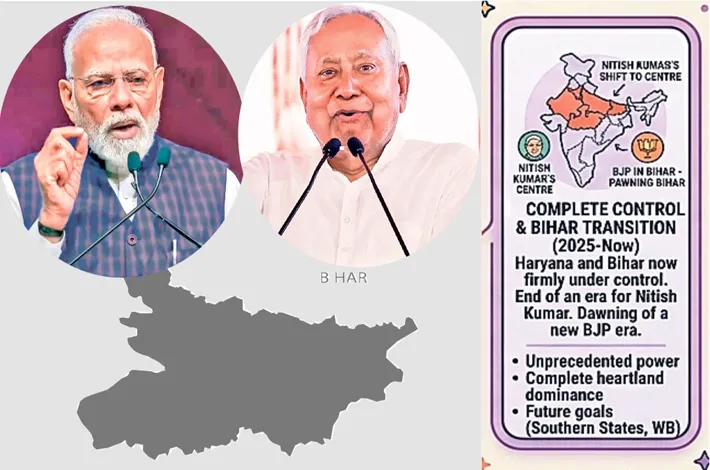
After a record spell as Bihar Chief Minister, Nitish Kumar moves to the Centre, an end of an era for him, personally. For the BJP, however, it's the dawn of a new era. Under Prime Minister Narendra Modi, the Saffron Party reached a new peak in its four-decades-long journey since the party’s formation on April 6, 1980. For the BJP, the Hindi-heartland has been its original political turf but the complete control over it eluded the Saffron Party.
The transition and the transfer of power in Bihar from the Socialist outfit to the Saffron Party is of enormous political significance for the BJP. With Haryana earlier and Bihar now firmly under its political sway, for the first time ever, the BJP gains control over the entire extent of the Hindi-heartland.
The credit for the Hindutva Ideology goes first to the Jan Sangh and later to the leadership of Atal Behari Vajpayee and L K Advani, who successfully managed to woo the electorate. As a result, it became that much easier for the BJP to expand its footprint across the geographic territory, under Prime Minister Modi.
For the BJP to establish its political dominance in two of the largest Hindi-heartland States, Madhya Pradesh and Uttar Pradesh, required sheer hard work. Madhya Pradesh is the original Hindutva Laboratory, long before Gujarat. Nanaji Deshmukh worked with Vanvasi Kalyan Ashram in Madhya Pradesh. It helped in expanding the Sangh footprint across the State. In Uttar Pradesh, it was the Ayodhya Movement that brought the BJP on to the political centrestage. In 1991, the BJP under Kalyan Singh stormed to power.
Despite these two major States of Madhya Pradesh and Uttar Pradesh coming under its political sway, Haryana and Bihar remained out of the reach of the BJP. Haryana largely remained the turf of the three Lals -- Devi Lal, Bhajan Lal and Bansi Lal. Prime Minister Modi succeeded in leading the BJP to power in Haryana in 2014. There has been no looking back for the party in the State.
In Bihar, however, the BJP has always been the junior partner of Janata Dal (United) under Nitish Kumar. In the Bihar Assembly elections in 2020, the BJP managed to steal the march over Nitish Kumar, winning 74 seats to the Janata Dal (United) seats tally of 43. In the Bihar Assembly elections in 2025, the BJP won 89 seats to the Janata Dal (United) tally of 85 seats. Tactically, the BJP allowed Nitish Kumar to remain in the driver's seat, all along,
Now, the Modi-Shah duo have succeeded in securing Nitish Kumar's consent to move to the Centre, paving the way for the BJP to take charge of the State. In the process, the Saffron Party gains complete political dominance across the entire Hindi-heartland.
Nitish Kumar is no stranger to the Saffron Party. In fact, during the JP Movement since 1974, Socialists and Saffron Party stalwarts had a common rise. Nitish Kumar of Janata Dal (United), Lalu Prasad Yadav of RJD, Sharad Yadav from the Socialists, who was Union Minister in the Vajpayee Government and Sushil Modi of the Saffron Brigade were all together. Arun Jaitley became close to Nitish Kumar since then.
Anti-Congressism became the common glue for all of them, with the sole exception of Lalu Yadav, who crossed over to the Congress-led UPA and now the INDIA Bloc. During his last days, Sharad Yadav personally requested and got Rahul Gandhi to admit his daughter Subhashini Yadav into the Congress.
At the end of Emergency, major Opposition parties came together in 1977 to form the Janata Party. When the Janata Party Government under Morarji Desai dismissed 9 State Governments and ordered Assembly elections, the Janata Party swept the polls. In Madhya Pradesh, erstwhile Jan Sangh leader Kailash Joshi became the State Chief Minister.
Much earlier, in 1967, Samyukth Vidhayak Dal (SVD) Governments were formed across the States, after the Congress under Indira Gandhi lost power, although she scraped through to retain power at the Centre with a thin majority. In Uttar Pradesh, the Jan Sangh came to power as part of the SVD Government under Chaudhry Charan Singh, when Kalyan Singh of the Jan Sangh and Mulayam Singh, a Socialist, became Ministers.
Since the times of Jan Sangh, its precursor, the BJP, has leveraged its good relations with Socialists and other Non-Congress parties to expand and enlarge its political base. This strategy did help the party to progressively forge ahead to challenge and dislodge the Congress.
With the exit of Nitish Kumar from the political scene, the BJP is hoping that his vote-base will automatically shift to the BJP, strengthening the party in Bihar.
On the other hand, there's an argument that Nitish Kumar's vote bank may not shift entirely to the BJP. Nitish Kumar's vote-base comprises a sizable chunk of Muslims, besides Non-Yadav OBCs and Extreme Backward Classes or Most Backward Classes (EBCs/MBCs). Since RJD is identified with Yadavs, there is a view that Non-Yadav OBCs and EBCs may even gravitate towards the Congress.
Nitish Kumar's departure from Bihar political scene is by no means a surprise. In fact, ahead of the Bihar Assembly elections in 2025, it was openly discussed that Nitish Kumar may not be the Chief Minister after the polls. But, since the BJP contested the polls under Nitish Kumar's leadership, he was sworn in as the Chief Minister. However, at the first opportunity, in the form of Rajya Sabha elections, Nitish Kumar has been shifted out.
Indeed, it was quite a spectacle that for the Janata Dal (United) leader's filing of the nomination for the Rajya Sabha elections, Home Minister of India Amit Shah and ruling BJP President Nitin Nabin were present on the occasion in Patna. Amit Shah personally reached Patna to oversee the transition.
Gaining control over the Hindi-heartland could augur well for the BJP which has vowed to make India a "Congress-Mukt Bharat". The Saffron Party has already set its sights on gaining ground in the Southern States like Telangana, Tamil Nadu, Kerala and Karnataka. In West Bengal, it hopes to defeat Mamata Banerjee in the Assembly polls to be held shortly.
(Writer is Delhi-based senior journalist, political commentator and analyst. Views are personal.)
From “Phir Subah Hogi” to BJP’s rise
In fact, for Vajpayee and Advani, it was a daunting task even to attempt to sell their ideology to the people during the Nehruvian era. In a private chat, Advani recalled how the successive electoral defeats made it depressing. After one such defeat, Vajpayee and Advani, for distraction, had gone to see Raj Kapoor-Mala Sinha starrer, Phir Subah Hogi. And they came back, taking heart that indeed someday there would be dawn for the Saffron Party.
After the BJP First Plenary Session, at the public rally in Mumbai in December, 1980, Vajpayee prophesied " Andhera chatega, Suraj niklega, Kamal khilega" (Darkness will go, Sun will come out, Lotus will bloom). Now, the BJP under Prime Minister Modi has justified what was borne out in Vajpayee's poetic flourish.