23 September, 2026 | 12:37 AM


Advantage BJP!
23-09-2026 12:00:00 AM
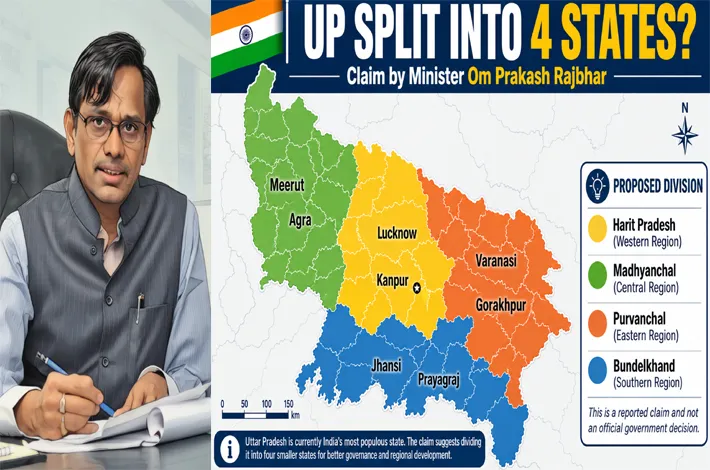
At present, no such legislative process is under way for the creation of new states. Politically, the timing is significant as Uttar Pradesh Assembly elections are due in early 2027
C L Rajam :
Suheldev Bharatiya Samaj Party (SBSP) chief and Uttar Pradesh Cabinet Minister Om Prakash Rajbhar has ignited a fresh political controversy by asserting that the country’s most populous state will be divided into four smaller units: Poorvanchal (Purvanchal), Madhyanchal, Bundelkhand and Harit Pradesh (also referred to as Haritha Pradesh). Speaking at party events in Deoria and Ambedkarnagar, Rajbhar claimed Prime Minister Narendra Modi had assured him that the reorganisation could proceed after the completion of a caste census.
He further stated that a member of the Rajbhar community would become the first chief minister of a separate Purvanchal state. Rajbhar linked the proposal to demands for equitable distribution of the 27 per cent OBC reservation, arguing that a caste census would remove obstacles to both sub-categorisation and state reorganisation. He portrayed the division as inevitable and positioned support for a Rajbhar chief minister in Purvanchal as a condition for future alliances.
No corresponding statement has come from the Prime Minister’s Office, the Bharatiya Janata Party national leadership or the Uttar Pradesh government confirming any such plan. Another NDA ally, Nishad Party chief and minister Sanjay Nishad, dismissed the remarks as misleading, noting that the state is progressing and that special funds already target regions such as Bundelkhand and Purvanchal. Uttar Pradesh remains India’s largest state by population, estimated at around 24 crore people. It elects 80 members to the Lok Sabha and has a 403-member Legislative Assembly. These numbers give the state decisive weight in national politics.
Any party seeking a stable majority at the Centre must perform strongly in Uttar Pradesh. The state’s sheer size has long been cited as a challenge to effective administration, balanced development and rapid response to regional disparities. Eastern districts face high out-migration and employment pressures, Bundelkhand contends with drought and resource constraints, western areas are more industrialised and agriculturally intensive, and the central belt houses major administrative and economic centres including Lucknow and Kanpur.
The idea of carving smaller states out of Uttar Pradesh is not new. In November 2011, the Bahujan Samaj Party government led by Mayawati passed a resolution in the state Assembly proposing division into Purvanchal, Bundelkhand, Awadh Pradesh and Paschim Pradesh. The resolution was forwarded to the Centre but was never acted upon. Subsequent governments did not revive the formal process. Earlier discussions, including those dating back to B.R. Ambedkar’s advocacy for smaller, more manageable administrative units, have periodically resurfaced, often ahead of elections. Rajbhar himself has raised the demand in previous years, including in 2018.
Under Article 3 of the Constitution, Parliament holds the power to form new states or alter existing boundaries. Any concrete move would require a bill, consultation with the state legislature, detailed boundary demarcation, decisions on capitals, sharing of assets and liabilities, and administrative restructuring. At present, no such legislative process is under way. Politically, the timing is significant. Uttar Pradesh Assembly elections are due in early 2027.
In the 2024 Lok Sabha elections, the BJP’s tally in the state fell sharply to 33 seats while the Samajwadi Party secured 37, altering the earlier dominance seen in 2014 and 2019. Speculation about internal dynamics within the BJP, including differences in approach between Chief Minister Yogi Adityanath and central leaders, has circulated in political commentary, particularly after the 2024 results, though both sides have publicly rejected claims of any serious rift. A strong performance by the Samajwadi Party under Akhilesh Yadav in 2027 would reshape state politics and carry national implications given Uttar Pradesh’s parliamentary weight.
Division into four states would fundamentally alter these equations. Smaller units would dilute the concentrated influence currently wielded by any single state-level leader or party. A loss or gain in one of the new states would have limited spill over effects on the others or on national calculations. Proponents argue that smaller states are easier to administer, allow more focused development planning and reduce the distance between citizens and government. Regional issues could receive dedicated attention, and specialised schemes for drought-prone, migration-heavy or industrially dense zones could be tailored more precisely.
This would also restrict Yogi’s and Akhilesh’s power and their hold on people. If the BJP, loses one or two states among the four, it will have no impact on its poll performance elsewhere in the country. In fact it will be advantage for the BJP.
The social composition of leadership could also change. Advocates of reorganisation note that chief ministers drawn from different communities—Scheduled Castes, Backward Classes, Yadavs, Brahmins or other groups—could be positioned in the four states, broadening representation and potentially satisfying diverse caste constituencies.
In Purvanchal, where the Rajbhar community has significant demographic presence in several districts, local leaders could gain prominence. Such an outcome would create multiple power centres rather than a single dominant state leadership. For the BJP and its allies, the arrangement could offer strategic flexibility. Managing four smaller governments might prove administratively simpler and politically less risky than depending on a single large state. Even if one unit changed hands, the impact on the national government would be contained.
At the same time, the proposal carries risks. Creating new states involves complex negotiations over resources, water sharing, bureaucracy and identity. Historical experience with state reorganisation shows that demands for further division or special status can emerge once the first step is taken. Opposition parties have already criticised the claim, accusing the NDA of double-speak or election-time rhetoric.
Rajbhar’s intervention has therefore revived a long-standing administrative and political question at a moment when caste census discussions, reservation debates and the approach of state elections are already intensifying competition. Whether the statement reflects an actual policy direction or serves primarily as mobilisation rhetoric for his community remains unclear in the absence of any official endorsement.
What is certain is that Uttar Pradesh’s size continues to make it both a prize and a challenge in Indian politics. Any serious move toward reorganisation would require sustained political will, detailed preparation and parliamentary consensus far beyond a single ministerial claim. Until such steps materialise, the four-state proposal remains a recurring idea whose practical realisation faces substantial constitutional, administrative and political hurdles.