20 October, 2026 | 12:06 PM


Amrapali’s Redemption
17-08-2025 12:00:00 AM
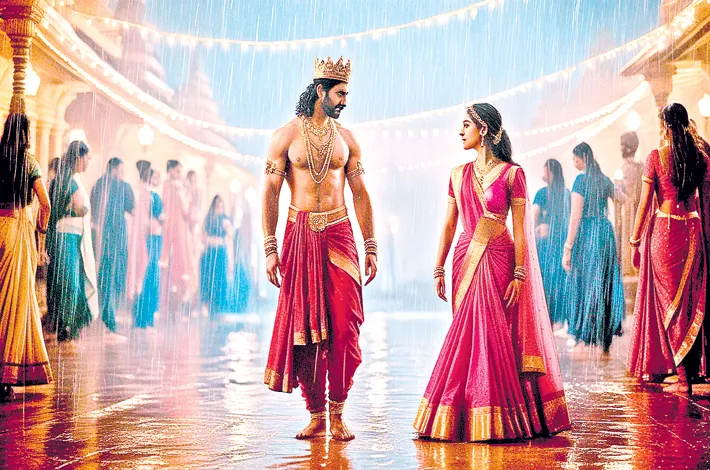
The festival was a spectacle of light and sound. Amrapali performed under a canopy of stars, her movements like ripples on a sacred river. Her eyes met Vinay’s across the crowd, and for a moment, the world fell silent. His gaze was not one of possession but of wonder, as if he saw not the nagarvadhu but the woman beneath. After her performance, he approached her, his voice low and earnest.
In the heart of ancient Vaishali, where jasmine bloomed under moonlit skies and the air hummed with the melodies of courtesans, lived Amrapali, the most celebrated dancer of the realm. Her beauty was a legend, her grace a spell that captivated kings and commoners alike. Yet, beneath her silken veils and the chime of her anklets, Amrapali’s heart was a caged bird, yearning for a love that transcended the gilded chains of her destiny.
Amrapali was no ordinary woman. Chosen as the nagarvadhu, the courtesan of the republic, she belonged to no one and everyone. Her days were filled with performances in the grand halls of Vaishali’s elite, her nights with the hollow adoration of men who saw her as a prize, not a soul. But Amrapali’s spirit was restless. She dreamed of a love that was hers alone, untainted by duty or desire for power.
One evening, as the monsoon clouds gathered over Vaishali, a stranger arrived at the city gates. Ajatashatru, the young king of Magadha, had come under the guise of a warrior named Vinay to negotiate peace with Vaishali’s council. His reputation as a fierce conqueror preceded him, but his eyes, deep and searching, held a vulnerability that intrigued Amrapali when they met at a grand festival.
The festival was a spectacle of light and sound. Amrapali performed under a canopy of stars, her movements like ripples on a sacred river. Her eyes met Vinay’s across the crowd, and for a moment, the world fell silent. His gaze was not one of possession but of wonder, as if he saw not the nagarvadhu but the woman beneath. After her performance, he approached her, his voice low and earnest.
“Your dance,” he said, “it speaks of a heart that longs for freedom.”
Amrapali, unused to such words, smiled cautiously. “And you, warrior, what do you seek in Vaishali?”
“Peace,” he replied, but his eyes lingered on her, hinting at a deeper truth.
Over the next few days, Vinay became a regular at Amrapali’s performances. They spoke in stolen moments—by the lotus ponds, under the shade of banyan trees. He shared stories of his childhood, of a mother who taught him to find beauty in the ordinary. She, in turn, revealed fragments of her own heart: her love for poetry, her dreams of a life beyond the stage. With each meeting, Amrapali felt the walls around her heart crumble. Vinay saw her not as a courtesan but as a woman, and in his presence, she felt whole.
But love in Vaishali was a dangerous game. The council, suspicious of Vinay’s intentions, watched him closely. Rumors swirled that he was no mere warrior but Ajatashatru, the ambitious king plotting to annex Vaishali. Amrapali’s heart wavered. Could she trust this man who had awakened her soul? Or was his affection a ploy, as so many had been before?
One stormy night, as rain lashed the city, Vinay came to her chambers. His face was taut with urgency. “Amrapali,” he said, “I can no longer hide the truth. I am Ajatashatru, king of Magadha. I came to Vaishali for conquest, but I found you instead. My heart is yours, but my duty binds me to my kingdom. Will you come with me?”
Amrapali’s world spun. The man she loved was her city’s enemy. To follow him would mean betraying Vaishali, the only home she had ever known. Yet to stay would mean losing the one person who saw her for who she truly was. “I cannot leave,” she whispered, tears mingling with the rain. “My duty is to Vaishali, as yours is to Magadha.”
Ajatashatru’s eyes darkened with pain. “Then let this night be ours,” he said, and they stood together in the rain, their hands entwined, hearts breaking under the weight of their choices.
The next morning, Ajatashatru was gone, and Vaishali prepared for war. The council declared Amrapali a traitor for her closeness to the enemy, stripping her of her title. Shunned and heartbroken, she wandered to the outskirts of the city, where the Ganges flowed silently. There, she met a Buddhist monk, his serene presence a stark contrast to her turmoil.
“Why do you suffer, child?” he asked.
“I loved a man I cannot have, and I lost the only life I knew,” she confessed.
The monk smiled gently. “Love is not a chain, nor is duty a cage. True freedom lies in letting go of both.”
His words pierced Amrapali’s soul. She realized that her love for Ajatashatru was real, but so was her love for herself—a self she had never fully embraced. She chose to renounce her past, not out of shame but to seek a higher truth. She joined the Buddhist sangha, trading her silks for saffron robes, her dance for meditation.
Years later, Ajatashatru, now a weary king, visited a monastery by the Ganges. There, among the monks, he saw a woman whose eyes still held the fire of the nagarvadhu he had loved. Amrapali, now a bhikkhuni, smiled at him with a peace that transcended their past.
“You found your freedom,” he said softly.
“And you, your truth?” she asked.
He nodded, his heart lighter. They parted not as lovers but as souls who had touched eternity through each other. Amrapali’s journey, from courtesan to monk, was her redemption—not from love, but into it, a love for all beings, boundless and free.