23 October, 2026 | 3:32 AM


Children’s Life at Stake?
05-09-2026 12:00:00 AM
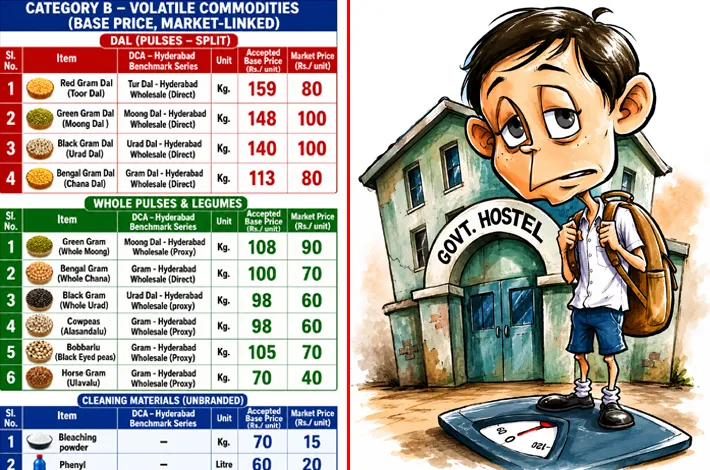
PMU Faces Scrutiny Over Inflated Procurement Rates for Welfare Student Amenities
■ A detailed inquiry needs to be conducted into whether NACOF is subcontracting to other vendors, who they are, what their background is, and the concerned parties should be kept under watch for any wrongdoing.
metro india news I hyderabad
Serious questions have emerged over a major procurement order placed by the Project Management Unit (PMU) for various amenities meant for seven lakh welfare students. Market enquiries reveal that the rates accepted by the PMU stand substantially higher than prevailing market prices, with some items showing mark-ups approaching 100 percent.
Critics argue that the arrangement risks both financial loss to the public exchequer and potential harm to the health of underprivileged students who depend on these supplies. According to details circulating among observers tracking government tenders, the order covers a range of commodities including pulses, legumes and cleaning materials.
A comparison of accepted base prices against Hyderabad wholesale market rates highlights the scale of the discrepancy. Red gram dal, listed under the DCA-Hyderabad benchmark series, carries an accepted base price of Rs 159 per kg against a market price of Rs 80. Green gram dal stands at Rs 148 per kg versus Rs 100 in the market.
Black gram dal is priced at Rs 140 against Rs 100, while Bengal gram dal is accepted at Rs 113 compared with Rs 80.Whole pulses and legumes show similar gaps. Green gram (whole moong) is accepted at Rs 108 per kg while the market rate is Rs 90. Bengal gram (whole chana) is listed at Rs 100 against Rs 70.
Black gram (whole urad) carries an accepted price of Rs 98 versus Rs 60. Cowpeas (alasandalu) and bobbarlu (black-eyed peas) are both accepted near Rs 98–105 against market levels of Rs 60–70. Horse gram (ulavalu) is accepted at Rs 70 per kg while the market price is Rs 40.Cleaning materials present even starker differences. Bleaching powder is accepted at Rs 70 per kg against a market rate of Rs 15. Phenyl is listed at Rs 60 per litre compared with Rs 20 in the open market.
These figures form part of Category B volatile commodities that are supposed to be linked to market benchmarks, raising concerns about how the accepted base prices were arrived at.Observers note that for branded items the selected supplier, NACOF, is offering rates only 2 to 5 percent below the TRP rate. Industry practice indicates that wholesale purchases of this scale should normally secure discounts of at least 30 percent below TRP. The limited margin raises doubts about the competitiveness of the tender process.
A further issue centres on the tender conditions themselves. Documents examined by those following the matter do not lay down clear specifications or specimens for all non-branded loose items. Without precise quality benchmarks, there is a heightened risk that inferior materials could enter the supply chain. Given that the commodities will reach seven lakh poor students, any compromise on quality could have direct implications for their health and nutrition.
Additional questions surround the credentials of the supplier. NACOF is reported to be a defaulter in another wing of the government. How a firm carrying such a status secured consideration for a large-scale supply contract under the PMU remains a point of public interest.
Transparency advocates argue that past performance and compliance records should form part of any rigorous evaluation.Calls have grown for stronger safeguards. Proper quality certification by recognised standard institutions is seen as essential, alongside frequent physical verification of quantities delivered. Without these checks, the system remains vulnerable to both substandard goods and short supply.
Although the tender is described as having been awarded through competition, the combination of elevated rates relative to the market and the absence of detailed specifications for loose items has led many to conclude that the process requires fresh examination. Voices tracking welfare schemes have urged the PMU to cancel the existing supply order and invite new tenders under tighter conditions that prioritise value for money and clear quality parameters.Should the present order continue unchanged, both the government and NACOF risk facing public criticism over quality shortfalls and allegations of inflated pricing.
The scale of the programme—covering seven lakh students—amplifies the stakes. Any perception of excess expenditure or compromised materials could undermine confidence in welfare delivery mechanisms.Those pressing for a review emphasise that the primary consideration must remain the larger public interest. High accepted rates that diverge sharply from market realities, coupled with incomplete specifications, create avoidable risks for the students who are the intended beneficiaries.
A prompt re-examination of the decision, followed by a transparent re-tendering exercise if necessary, would help restore assurance that public funds are being deployed efficiently and that the health of vulnerable children is not placed under strain.The matter has drawn attention precisely because the quantities involved are substantial and the commodities form part of the basic support provided to welfare students.
Market-linked pricing was expected to keep costs aligned with wholesale levels, yet the accepted figures show consistent and sizeable gaps. Independent verification of both price and quality standards is therefore being demanded as a minimum corrective step.Officials associated with the PMU have not publicly detailed the rationale behind the accepted base prices or the evaluation criteria applied to the tender.
In the absence of such clarification, the published differentials continue to fuel concern. Stakeholders monitoring the welfare of students have stressed that any continuation of the present arrangement without address of the rate and specification issues would leave the programme open to sustained scrutiny.
The core demand remains straightforward: protect both the public purse and the well-being of seven lakh students by ensuring that procurement rates reflect genuine market conditions and that quality controls are unambiguous and enforceable. Cancellation of the current order and a fresh competitive process under revised conditions would, according to those following the developments, serve those dual objectives more effectively than persistence with the existing terms.