23 October, 2026 | 2:31 AM


A Teacher’s Eternal Gift
05-09-2026 12:00:00 AM
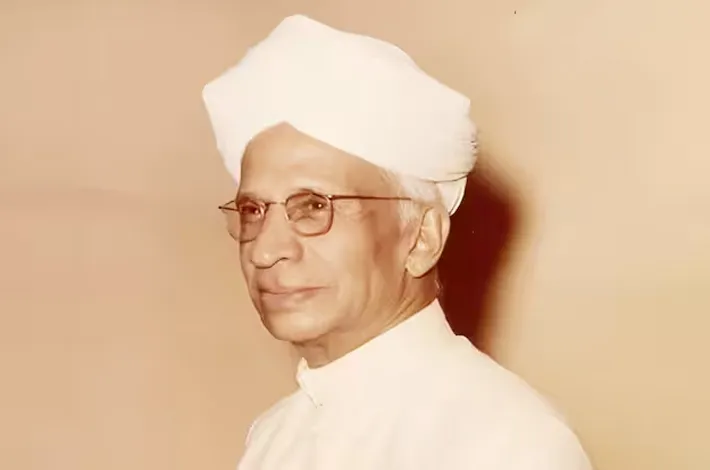
Remembering Dr. Sarvepalli Radhakrishnan on His Birthday
metro india news I hyderabad
As the soft light of September 5 dawned across India once more, classrooms filled with flowers, songs and quiet gratitude. On this day the nation pauses to honour its teachers, and at the heart of that observance stands a man whose life itself became a living classroom.
Dr. Sarvepalli Radhakrishnan, philosopher, scholar and former President of India, was born on this date in 1888. His story continues to move hearts because it is rooted in simplicity, shaped by quiet struggle and crowned by an uncommon humility.
His Telugu roots run deep into the soil of Andhra Pradesh. The family name Sarvepalli traces back to a village of the same name in Nellore district. Generations earlier, his forefathers had migrated westward from that coastal settlement, carrying with them the language, customs and quiet dignity of Telugu Niyogi Brahmins. They eventually settled near the temple town of Tiruttani in what was then the Madras Presidency. There, on 5 September 1888, a second son was born to Sarvepalli Veeraswami, a modest revenue official serving a local zamindar, and his wife Sitamma.
The household lived with limited means. Meagre earnings stretched thin across a large family, and the boy’s early years in Tiruttani and the nearby sacred town of Tirupati were marked by the rhythms of temple bells, simple meals and the constant need to make every opportunity count. From those beginnings the young Radhakrishnan rose through sheer brilliance and scholarships. He studied at local schools, then at the Hermannsburg Evangelical Lutheran Mission School in Tirupati, and later at Voorhees College in Vellore before entering Madras Christian College.
There he completed his bachelor’s and master’s degrees in philosophy. The encounter with Western thought and Christian critiques of Hinduism only deepened his resolve to understand and present Indian philosophy with clarity and dignity.
His early writings defended the ethical foundations of Vedanta and began the lifelong work of building bridges between Eastern wisdom and Western inquiry.Teaching became his true vocation. He began as a lecturer at Madras Presidency College and later served as professor at the University of Mysore and the University of Calcutta.
Crowds gathered for his lectures. Students remembered not only the depth of his scholarship but the warmth with which he guided them. He believed teachers should be among the finest minds in the country, and he lived that belief every day. International recognition followed. He delivered the Hibbert Lectures at Oxford, published as An Idealist View of Life, and in 1936 he was appointed Spalding Professor of Eastern Religions and Ethics at the University of Oxford, the first Indian to hold such a chair.
Through his books—Indian Philosophy, The Hindu View of Life and others—he introduced the world to the living spirit of Indian thought with grace and intellectual honesty.Even as his fame grew, the man remained grounded in the values of his Telugu upbringing: respect for learning, restraint and service. When independent India called upon him, he answered with the same quiet dedication. He served as Ambassador to the Soviet Union, then as the first Vice-President of India from 1952 to 1962, and finally as the second President from 1962 to 1967.
Throughout those years he accepted only a portion of his official salary, directing the rest to national relief. He continued to speak of education as the surest path to national strength and individual fulfilment.The most heartfelt chapter of his public life came in 1962, shortly after he assumed the presidency. Former students and well-wishers approached him, eager to celebrate his birthday. With characteristic grace he declined personal honour.
He asked instead that 5 September be observed as Teachers’ Day, a day dedicated to every educator who shapes young minds. “Instead of celebrating my birthday,” he said, “it would be my proud privilege if September 5 is observed as Teachers’ Day.” From that moment the nation has done so. Each year the day becomes a living tribute not only to one extraordinary teacher but to the entire profession he held sacred.
Dr. Radhakrishnan’s philosophy rested on the conviction that truth is one, though sages speak of it in many ways. He defended the spiritual heritage of India against misunderstanding while remaining open to the insights of other traditions. He saw education as a lifelong process that forms character, trains citizens for democracy and awakens the best in human nature.
Those ideas continue to guide classrooms and educational policy alike. He received the Bharat Ratna in 1954 and many international honours, including the Templeton Prize near the end of his life. He passed away on 17 April 1975 in Madras.
Decades later his presence is still felt whenever a teacher enters a classroom with patience and purpose, or whenever a student discovers the quiet power of ideas.On this birthday, as flowers are offered and tributes spoken, the nation remembers a son of Telugu soil who rose from modest circumstances in Tiruttani to the highest office of the land. He never forgot the classroom.
In asking that his own birth be remembered through the service of teachers, he gave India a gift that renews itself every year. That gift remains his most enduring and touching legacy—a reminder that true greatness lies in lifting others, in honouring the light of knowledge, and in living with humility even when the world places a crown upon one’s head.