14 September, 2026 | 3:03 AM


CM’s Tongue-in-Cheek politics with Kishan
04-06-2026 12:00:00 AM
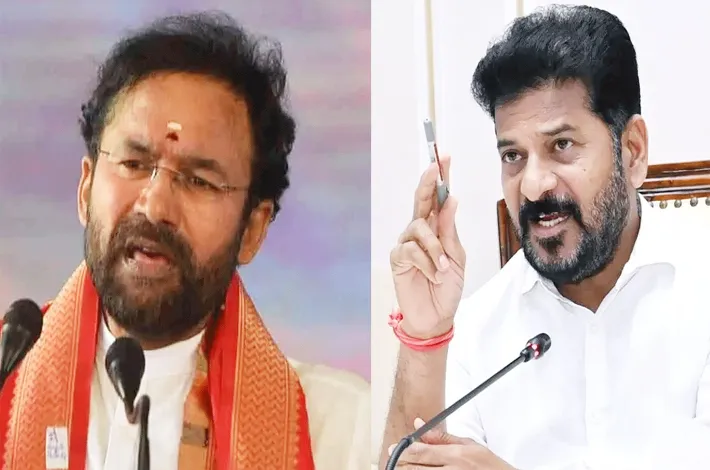
Telangana’s political dilemma lies in balancing confrontation with cooperation. While Chief Minister A Revanth Reddy attacks the Centre over alleged discrimination, the state simultaneously depends on New Delhi for funds, approvals and policy support for major projects. This dual strategy has sparked debate over whether the government is pursuing political posturing, practical governance, or a calculated mix of both
metro india news I hyderabad
Chief Minister A. Revanth Reddy’s political approach toward the Centre has come under intense discussion across Telangana, with critics questioning what they describe as a contradiction between his aggressive public rhetoric and repeated appeals to New Delhi for assistance on key state issues.
While the Chief Minister has frequently accused the Union Government of discriminating against Telangana and has issued strong warnings during public meetings, the state government continues to depend on the Centre for the resolution of several major issues, including paddy procurement, the Tummidihatti barrage dispute with Maharashtra, Hyderabad Metro Rail Phase-II, the Regional Ring Road (RRR), Musi River rejuvenation, and the implementation of Andhra Pradesh Reorganisation Act assurances.
Political observers note that despite publicly targeting the Centre, the State Government has repeatedly sought its intervention, approvals, financial support and policy relaxations. Critics argue that this has created confusion regarding the government’s actual stand—whether it is pursuing confrontation with the Centre or seeking cooperation.
The debate intensified following Revanth Reddy’s recent remarks on the Tummidihatti barrage issue. The Chief Minister said he had written to Maharashtra Chief Minister Devendra Fadnavis seeking discussions on irrigation-related concerns and the proposed barrage.
Expressing disappointment over the lack of response, he urged immediate talks and warned that neglecting the issue could create larger problems affecting both states. He also appealed to Union Minister G. Kishan Reddy to intervene and help resolve the matter, stating that the issue concerns lakhs of farmers.
At the same time, Revanth Reddy questioned why Maharashtra had not responded and warned that Telangana would not remain silent if its interests were ignored. He said he was prepared to pursue all available options to secure the state's rights.
A similar situation has emerged over paddy procurement. While the Telangana government has accused the Centre of failing to provide adequate support to farmers, it has simultaneously requested the Union Government to procure every grain produced in the state. Revanth Reddy urged Kishan Reddy to ensure procurement of paddy, maize, jowar and other crops, including rain-damaged grain. He warned that if the Centre failed to act, the state would be forced to intensify its agitation after June 15.
Observers point out that Telangana’s procurement system is heavily dependent on the Centre. The Food Corporation of India (FCI) remains the primary agency responsible for accepting rice milled from procured paddy, while key procurement targets and policies are determined by the Union Government. The Chief Minister recently wrote to Union Food Minister Pralhad Joshi seeking support for procurement and other policy measures.
The same pattern is visible in the Tummidihatti water dispute. While the state leadership has adopted an aggressive political tone against Maharashtra, it has also sought intervention from the Union Jal Shakti Ministry and the Centre to facilitate a resolution.
Several major development projects announced by the Telangana government also require substantial support from New Delhi. Hyderabad Metro Rail Phase-II depends on central approval and financial participation. The Regional Ring Road project requires central clearances and funding support. The Musi River rejuvenation initiative similarly needs environmental approvals, financial assistance and technical cooperation from the Centre. In addition, issues relating to national highways, railway projects, industrial corridors, defence investments and pending bifurcation commitments remain linked to Union Government decisions.
Another point of criticism is the government’s approach toward Union Minister Kishan Reddy. Political commentators note that despite Kishan Reddy holding a key position in the Union Cabinet and being capable of directly raising Telangana-related issues at the national level, the state government has largely chosen to communicate through public letters and statements rather than direct discussions.
Critics argue that governments should utilise every available platform to protect state interests, regardless of political differences. They question why direct engagement has not been prioritised on issues such as paddy procurement, Tummidihatti, Metro Phase-II, RRR, Musi rejuvenation and bifurcation assurances.
The BJP has alleged that the Congress government is more interested in maintaining its political narrative of “central discrimination” than in building coordination with Telangana leaders in the Union Government. According to BJP leaders, direct discussions could potentially improve the chances of resolving pending issues.
Political analysts believe the Congress is attempting to strengthen its anti-BJP positioning in Telangana by highlighting issues such as funding, irrigation disputes, procurement challenges and pending commitments. However, they also point out that administrative realities require constant engagement with the Centre for approvals, funds and policy support.
As a result, the government is seen as sending two different messages simultaneously—adopting a confrontational political stance while seeking administrative cooperation from the same government it criticises. Whether this strategy yields political dividends remains to be seen, but analysts say it has generated confusion among sections of the public regarding the state government's actual approach toward the Centre.
With repeated criticism of the Union Government on one hand and continuous requests for its intervention on the other, the debate over whether Telangana is pursuing a path of confrontation or cooperation is likely to remain a prominent political issue in the state.