17 October, 2026 | 12:11 AM


Congress-DMK Power Play Alliance or Arm-Twisting?
19-02-2026 12:00:00 AM
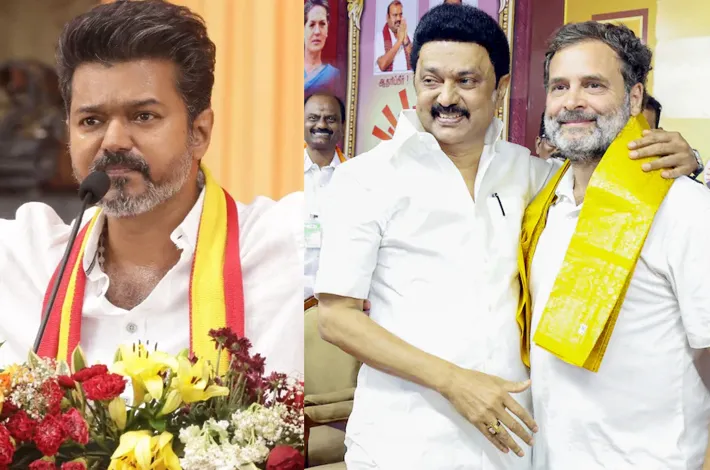
As Tamil Nadu moves steadily towards the 2026 Assembly elections, murmurs of discontent within the Congress-DMK alliance have begun surfacing in the public domain, triggering speculation over the durability of one of the state’s most enduring political partnerships. The alliance between the Indian National Congress and the Dravida Munnetra Kazhagam, which has largely remained intact for over two decades, is now facing strain over seat allocation and power-sharing expectations. While formal negotiations are scheduled to commence on February 22, public remarks by Congress leaders have already set off debate over whether the friction is genuine or a calculated bargaining strategy.
The immediate spark appears to be the Congress’s demand for a greater share of seats and a more defined role in governance if the alliance returns to power. In the 2021 Assembly polls, the Congress contested 25 seats as part of the DMK-led front, despite having won 41 seats in 2016. Party leaders argue that in 2021 they sacrificed 16 seats to accommodate allies such as the VCK and Left parties, while the DMK reduced its own allocation marginally. Congress MP Dr. Vishnu Prasad from Cuddalore has acknowledged that multiple voices within the party are advocating for a “respectable” increase in seat share in order to expand representation across Tamil Nadu. He, however, emphasized that the final decision would rest with the respective high commands, and that consensus would be achieved keeping the state’s welfare in mind.
The issue has been further amplified by vocal statements from Congress figures like MP Manickam Tagore and strategist Praveen Chakravarty, who have publicly hinted at alternative political alignments, including the possibility of engaging with actor-politician Vijay’s party, the Tamilaga Vettri Kazhagam. Though largely seen as speculative positioning, such remarks have not gone unnoticed by the DMK leadership. A senior DMK spokesperson dismissed suggestions of instability, describing the Congress-DMK relationship as ideology-driven and long-standing. He likened it to a marriage “where divorce is not possible,” underscoring confidence that high-command level discussions would iron out differences.
At the heart of the debate lies the question of leverage. Analysts suggest that the Congress may be employing a calibrated “good cop, bad cop” strategy—allowing certain leaders to express dissatisfaction publicly while maintaining official restraint at the central leadership level. Congress General Secretary KC Venugopal, during his recent visit to Chennai in connection with protests against alleged weakening of the MGNREGA framework, clarified that criticisms directed at the DMK were personal opinions and not official party positions. He urged leaders to refrain from making public comments about alliance matters and reiterated that discussions would be conducted internally with the DMK leadership.
Political observers believe this maneuvering may be aimed at strengthening Congress’s bargaining position before seat-sharing talks formally begin. With 234 Assembly constituencies at stake, even a marginal shift in allocation could influence the balance within the coalition. In 2021, the DMK contested 173 seats and secured a decisive victory. However, reducing that number significantly in 2026 could pose risks, particularly if the electoral contest becomes multi-cornered with new entrants attempting to disrupt traditional vote banks.
The emergence of the Tamilaga Vettri Kazhagam adds an additional layer of complexity. While Vijay’s political outfit is yet to face an electoral test, its perceived appeal among youth voters and urban constituencies has generated curiosity. Dr. Vishnu Prasad acknowledged that the party “cannot be brushed aside,” but cautioned that perception alone does not guarantee electoral performance. Consistency in manifesto commitments and grassroots organization, he noted, remain decisive factors in Tamil Nadu’s political culture. The DMK, meanwhile, has downplayed the threat, emphasizing its century-old movement credentials and dismissing concerns over actor-led mobilization.
Critics within the broader political spectrum argue that the Congress risks diluting its ideological identity by appearing overly dependent on the DMK. Some point to past controversies and moments of discomfort between the allies as evidence of asymmetry in the relationship. They contend that as a national party, Congress must project independent strength rather than focus narrowly on seat arithmetic. However, others counter that coalition politics in Tamil Nadu has long been pragmatic, and alliances are often sustained by mutual electoral benefit rather than ideological purity alone.
Despite the rhetorical sparring, both parties continue to stress anti-BJP unity as a binding force. The alliance’s primary objective remains preventing the BJP from expanding its footprint in Tamil Nadu. This shared goal may ultimately outweigh internal disagreements over seat numbers. Analysts predict that while negotiations could be tough and protracted, a complete rupture remains unlikely given the electoral arithmetic and historical cooperation between the two parties.
As February 22 approaches, the spotlight will intensify on closed-door discussions between senior leaders, including potential interactions between Congress high command representatives and Chief Minister MK Stalin. The coming weeks will reveal whether the current tensions represent substantive discord or merely strategic positioning ahead of high-stakes negotiations. For now, the Congress-DMK alliance stands at a delicate juncture—caught between public assertion and private diplomacy—while Tamil Nadu’s political landscape braces for what could be one of its most closely watched electoral contests in recent memory.