16 October, 2026 | 11:12 PM


Is India Splitting Economically?
19-02-2026 12:00:00 AM
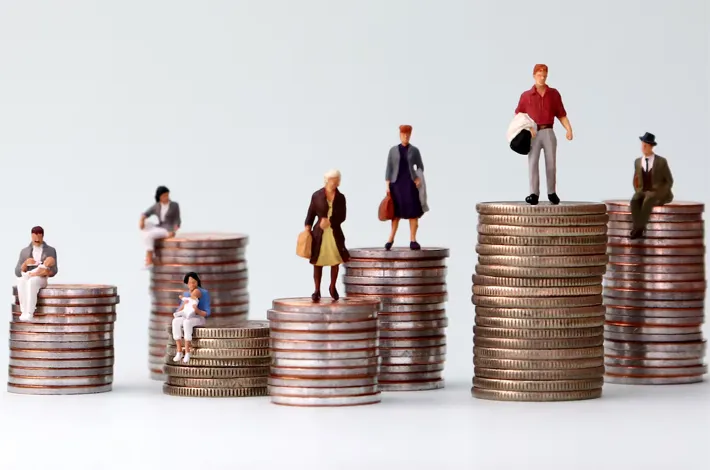
India's economic narrative has evolved beyond mere growth figures, now increasingly defined by stark disparities in salaries, widening income gaps between states, and deepening regional imbalances. These inequalities are not only reshaping the country's economic landscape but also influencing its political dynamics. Recent data highlights a profound divide, with states like Sikkim leading in average monthly income at Rs 46,978, followed by Goa at Rs 41,000 and Delhi at Rs 38,492. In contrast, Bihar languishes at the bottom with just Rs 5,053, alongside Uttar Pradesh and Manipur as among the lowest earners. This disparity underscores a broader regional pattern: South India boasts the highest average at Rs 27,000, West India at Rs 23,264, and North India at Rs 22,020. The Northeast averages Rs 13,956, Central India Rs 12,763, and East India trails at Rs 11,117, marking it as the lowest overall.
Experts describe this as a "productivity paradox," where southern states such as Tamil Nadu, Karnataka, Kerala, Telangana, and Andhra Pradesh have advanced to services-driven and high-end manufacturing economies, classified as stage-three development. Meanwhile, much of North and East India remains reliant on agriculture and primary industries. Demographics further exacerbate the divide: southern states enjoy fertility rates below replacement levels, yielding a "silver dividend" with fewer dependents and a more productive working-age population.
In states like Bihar and Uttar Pradesh, higher fertility rates create a youth bulge, but low productivity hinders progress. Analysts liken this to a "Europe versus Sub-Saharan Africa" divide within India, with Goa, Sikkim, and Delhi boasting per capita incomes over $6,000—comparable to Eastern Europe—while Bihar's remains below $800. Social indicators mirror these economic contrasts, with infant mortality at just 6 per 1,000 in Kerala compared to 38 in Uttar Pradesh. This divergence fuels massive internal migration, with income gaps as wide as 6:1 driving over 500 million Indians to relocate.
What was once seasonal movement is now semi-permanent urban settlement, particularly in southern and western metros. However, this migration has sparked political tensions, prompting states to introduce local job reservation laws amid rising nativist sentiments. Such measures could threaten India's integrated economic model, as experts warn of a potential "ticking time bomb."
Fiscal imbalances add another layer of complexity. High-performing states argue they are penalized, receiving only about 15 paise for every rupee contributed in taxes to the centre. Population trends suggest poorer northern states may gain more parliamentary seats post-delimitation, potentially shifting political power northward. This could create a scenario where economic strength resides in the south and west, while political influence moves north, painting a picture of one nation with multiple economic realities.
In a recent discussion, consulting editor of a business magazine challenged the notion that political heft will remain with the north despite its population advantage. He pointed out that leaders from economically powerful states—like MK Stalin from Tamil Nadu, N. Chandrababu Naidu from Andhra Pradesh, and Eknath Shinde from Maharashtra—are dominating national discourse. He argued that while northern states like Bihar and Uttar Pradesh have large populations, their influence is waning as aspirational individuals migrate southward and westward. He emphasized that decision-making is shifting toward economically stronger regions, diminishing the visibility of northern leaders like Nitish Kumar or Mamata Banerjee in media and policy circles.
A senior economist highlighted the often-overlooked role of inequality in these statistics. She noted that while Sikkim and other northeastern states appear high in per capita income, this masks significant wealth concentration among monopolists and industries, leaving the general population far behind. She stressed the need to track wealth concentration alongside per capita figures to fully understand the story. Addressing migration, she agreed it's no longer seasonal, with southern and western states like Tamil Nadu, Maharashtra, and Karnataka bearing the burden of incoming workers seeking better opportunities.
The debate intensified on historical and structural factors. A retired IAS officer observed that states like Punjab and West Bengal, once India's most industrialized due to colonial legacies and partition impacts, now lag behind neighbours like Himachal Pradesh and Uttarakhand. Punjab's per capita income is Rs 10,000 less than these states, and West Bengal's stands at Rs 12,000. He attributed this to insufficient political investment in industry, contrasting it with the west and south's success in manufacturing, IT, and services.
The editor however countered complaints from southern states about tax devolution by noting they benefit disproportionately from central subsidies, such as petroleum, due to higher consumption. He argued that viewing only direct tax returns ignores this indirect support. Further, he urged states to leverage their constitutional powers for new taxation avenues, like professional or agricultural taxes, to address inequality. The discussion underscored that while India's economy grows, its uneven nature demands urgent attention. From fiscal reforms to inclusive policies, bridging these divides is essential to prevent further polarization, ensuring that development is not just eastward-focused but truly nationwide.