11 October, 2026 | 8:10 PM


Cracks in INDIA Bloc
12-05-2026 12:00:00 AM
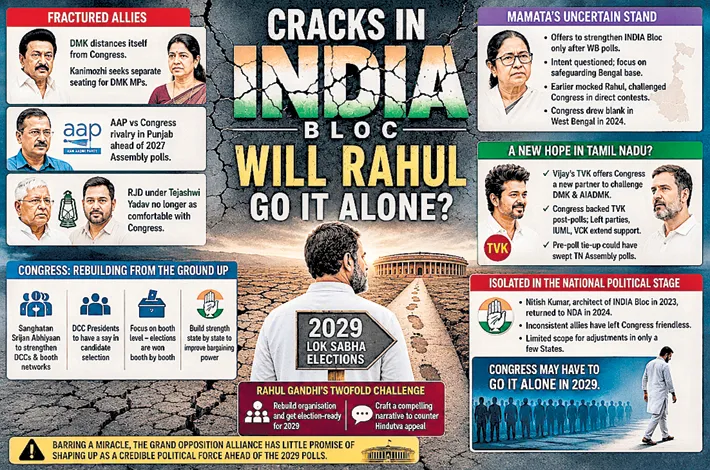
The Indian National Development Inclusive Alliance (INDIA) Bloc, not too long ago seen as shaping up as a possible alternative to the Ruling National Democratic Alliance (NDA), appears to be fractured. DMK leader M. K. Stalin has distanced his party from the Congress, while DMK Parliamentary Party leader Kanimozhi wrote to Lok Sabha Speaker Om Birla on May 7 seeking separate seating for DMK MPs. In Punjab, the rivalry between the Congress and Arvind Kejriwal-led AAP ahead of the 2027 Assembly polls makes continued INDIA bloc unity uncertain. In Bihar, the Congress once shared a smooth equation with the RJD under Lalu Prasad Yadav, but relations appear less comfortable with Tejashwi Yadav now leading the party.
These developments have left the Congress increasingly isolated on the national political stage. Nitish Kumar, one of the chief architects of the INDIA Bloc in 2023, was the first to return to the BJP-led camp in 2024. Mamata Banerjee later spoke of strengthening the alliance, but only after the West Bengal Assembly polls, raising doubts over her intent. Her move appears aimed more at protecting her political base in Bengal, where BJP leader Suvendu Adhikari is expected to intensify attacks on the Trinamool Congress. Mamata had earlier mocked Rahul Gandhi and challenged the Congress to defeat the BJP in direct contests, while the Congress drew a blank in West Bengal in 2024.
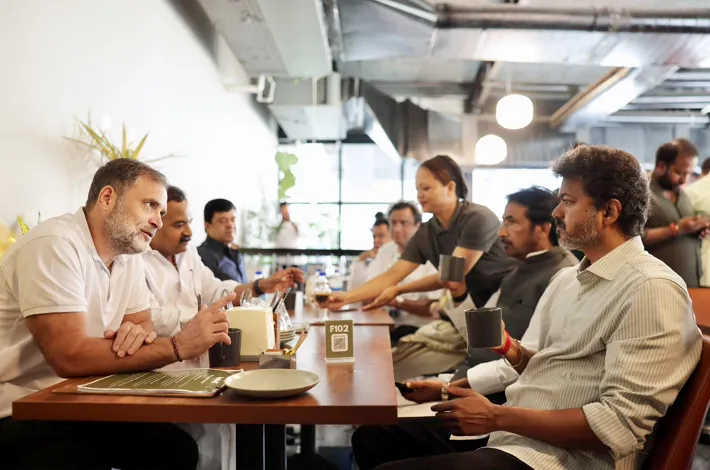
The rise of Vijay and his TVK offers a rare opening for the Congress in Tamil Nadu. Rahul Gandhi appears to see Vijay as a young, popular leader capable of challenging the dominance of Dravidian parties like the DMK and AIADMK. A Congress-TVK alliance could benefit the party in both Tamil Nadu and the 2029 Lok Sabha polls. During the Assembly elections, Rahul avoided joint rallies with M. K. Stalin amid unease within the TNCC over the DMK tie-up. After the results, Rahul quickly congratulated Vijay and backed TVK’s government-formation efforts, with the Congress also helping mobilise support from Left parties, IUML and VCK.
Rahul Gandhi believes the Congress must lead the fight against the BJP, as the party increasingly distrusts Opposition allies accused of soft-pedalling towards the saffron party. The Congress remains wary of the DMK’s shift to the BJP-led NDA after the fall of the I. K. Gujral government in 1997. Similarly, Mamata Banerjee allied with the BJP soon after forming the Trinamool Congress and later backed key NDA measures, including the GST Bill. The Congress now believes expanding its own state-level strength is essential to improve its bargaining power within any future Opposition alliance.
As a first step, the Congress is focusing on rebuilding its organisation at the grassroots level, recognising that elections are won booth by booth. The party believes its weak structure has prevented popular support from translating into votes. Through the ongoing Sanghatan Srijan Abhiyaan, it aims to strengthen District Congress Committees and booth-level networks. The Congress also plans to give DCC presidents a greater role in selecting Lok Sabha and Assembly candidates. For Rahul Gandhi, the challenge is twofold — rebuilding the party organisation for 2029 and crafting a larger political narrative capable of countering the BJP’s Hindutva appeal.
With inconsistent Allies, Rahul Gandhi can hardly map out an effective electoral strategy for the next Lok Sabha polls in 2029. At the most, the Congress may make some adjustments in two or three States; but, by and large, the party may have to go it alone.
This is likely to be the overall political scenario in the run up to the next Lok Sabha polls in 2029; barring, a last-minute dramatic change in the political landscape, which will not be short of a miracle. As of now, the Grand Opposition Alliance has little promise of shaping up as a credible political force, ahead of the polls.
(Anita Saluja is a Delhi-based senior journalist, and political commentator. Views are personal.)