17 September, 2026 | 7:01 PM


Disconnect Rights: Freedom or Fallout?
10-12-2025 12:00:00 AM
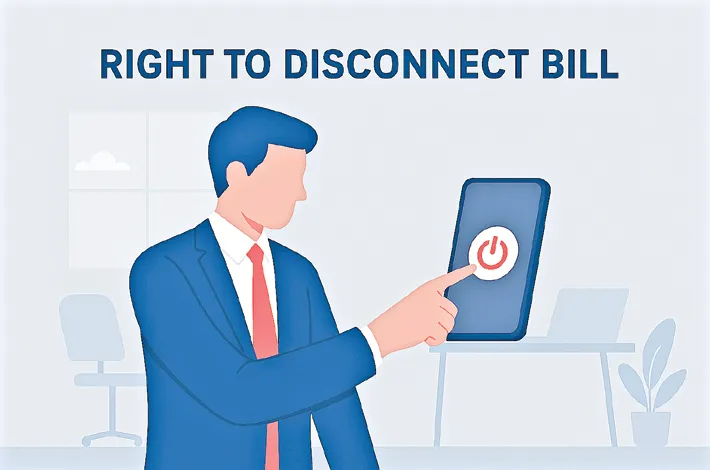
Burnout Snapshot
- India’s average weekly work hours: 46.7
- 51% of workers clock 49+ hours weekly
- 59% of corporate employees report burnout
- India aims to be world’s 3rd largest economy
- Countries like France & Australia already enforce disconnect lawsa
India is once again confronting an uncomfortable truth — a booming economy built on an exhausted workforce. The debate over whether Indians deserve the “right to disconnect” has returned to the national stage, and this time Parliament has been pulled right into the centre of it. With NCP MP Supriya Sule reintroducing the Right to Disconnect Bill, a new firestorm has erupted: should India legally allow its workers to switch off after work, or will such a law suffocate productivity in a nation racing toward becoming the world’s third-largest economy?
The provocation is not new. From Infosys co-founder Narayana Murthy’s controversial call for a 70-hour work week to corporate leaders dismissing work-life balance as a “Western concept,” India has lived in a cycle of periodic outrage followed by silence. But today’s discussion is different because it has collided with public fatigue, rising burnout, and a workforce that feels permanently wired into their jobs.
The Bill is straightforward in intent: employees should not be obliged to answer calls, texts, emails or video meetings beyond official working hours. No penalties, no subtle career punishments, no forced availability. If someone chooses to respond after hours, overtime pay is mandated. And for genuine emergencies, companies and workers are expected to mutually define special time windows.
Supporters say this is essential in a country where an average employee clocks 46.7 hours of work every week, among the highest in the world. More than half the workforce works above 49 hours, and burnout levels have quietly become a national epidemic. Digital tools, once sold as conveniences, have erased the boundary between the office and the living room.
But the pushback is equally forceful. Critics argue India cannot afford to reduce flexibility at a time when global competition is fierce and companies are already struggling with thin margins. Startups in particular fear that strict disconnection hours might choke their agility. And many within the corporate sector still believe longer hours translate to superior commitment and better output.
Dr Samir Parikh of Fortis, however, rejects the assumption that endless hours equal higher productivity. For him, workplace burnout is no longer a side concern — it is a health crisis. From his experience treating corporate stress, he argues that no high-performing individual or organization can sustain productivity without breaks. “You cannot have a 10-day test match,” he argues, drawing parallels with sports where rest is built into the very structure of performance. He sees the Bill not as a perfect solution but as a necessary spark — a sign that India must begin taking mental health seriously.
From the corporate HR perspective, the narrative is more layered. Sunil Goel, MD of GlobalHunt, acknowledges the mental-health dangers but insists India cannot afford to pull back at a time when jobs are scarce and global competition sharp. For him, the country still needs “extra effort” from its workforce, especially as industries push for innovation, R&D, and global expansion. He argues only a small fraction of managers push unreasonable demands; most organizations, he says, already offer flexibility. But critics note that “flexibility” often means being available at all hours.
On the other side of the debate, Jaideep Kalramani of TeamLease points out that productivity cannot be measured by hours logged. Quality matters more than quantity, and simply sitting at a desk longer does not produce better outcomes. He argues that organizations must create clear frameworks that define expectations and boundaries, but employees too should be empowered to communicate their limits. Mature companies, he says, already encourage these conversations; others are slowly learning.
But the biggest tension lies here: can a single law apply to all industries? That’s where Aanya Wig, co-founder of HerHaq, steps in sharply. She argues that one-size-fits-all legislation cannot work for India’s fragmented economy. Healthcare workers cannot “disconnect” during emergencies. Gig workers — who face some of the worst exploitation — are not even defined clearly in the Bill. Women, especially those balancing unpaid domestic work, face the brunt of after-hours expectations. And global-facing companies operating across time zones would require modified rules.
Aanya adds another crucial point — fear. Young workers today live under constant anxiety that someone else or some technology can instantly replace them. In an age where leadership publicly demands 70-hour weeks, this fear multiplies. Promotions often go to those willing to be available 24/7. In such an atmosphere, she argues, voluntary overwork becomes coerced overwork. Legislation helps start the discussion, but unless leadership models a healthier culture — by not sending late-night mails, not rewarding after-hours compliance — the change will remain cosmetic.
This is the cultural knot at the centre of India’s burnout economy. Many workers themselves feel compelled to stay logged in long after official hours — not because they enjoy it, but because they fear being seen as less committed. The line between dedication and desperation has blurred.
So the larger question remains: is India ready to normalize rest? Can a country that has long worn overtime as a badge of honour embrace the idea that efficiency, not exhaustion, fuels progress? Or will the fear of losing global competitiveness overshadow the need for healthier workplaces?
The Right to Disconnect Bill may not offer perfect solutions. It may need modifications, sector-wise adaptations, clearer definitions, and stronger enforcement. But it has undeniably ignited a national conversation that India can no longer postpone. Whether one supports or opposes it, the debate cuts straight to the core of how India sees work, ambition, and dignity in the modern economy.