16 September, 2026 | 12:56 PM


Fall of student politics leading to rise of social bankruptcy?
08-12-2025 12:00:00 AM
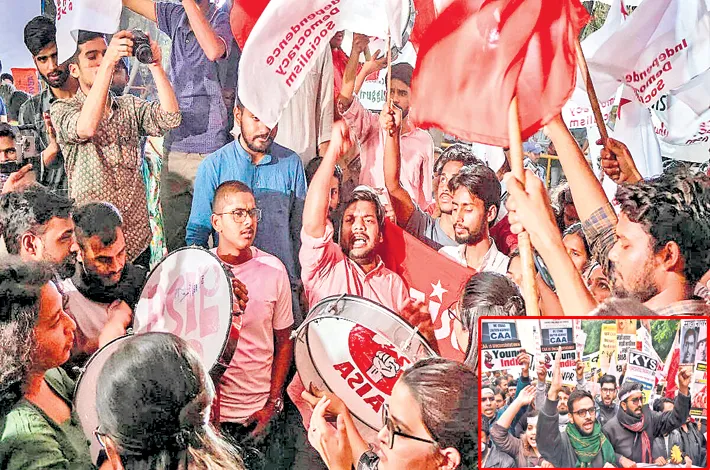
In a hard-hitting interview on a private news channel, a senior political commentator and former student leader lamented the death of ideological leadership in India and blamed the systematic destruction of student politics and the rise of corporate education and “suitcase politicians” for the crisis. He opined that today’s MLAs and MPs cannot be called leaders – they are mere politicians who buy votes with money. He also alleged that they lack vision, oratory skills, and the ability to inspire people. He asserted that true leaders used to emerge from the fiery crucible of student movements, recalling the 1960s–80s, when campuses across the country buzzed with ideological fervour.
He also reminded that in those days, every college had vibrant student unions – ABVP, NSUI, SFI, AISF, and even radical Maoist groups. Students debated poverty, injustice, and governance. National leaders like Jagjivan Ram, Morarji Desai, George Fernandes, and Atal Bihari Vajpayee used to address college meetings. We listened to everyone, argued, and sharpened our own ideology. That environment built social consciousness and produced leaders who were ready to sacrifice everything for the country.”
He blamed the ban on student unions – imposed after campus violence and the rise of extremist factions – for killing that ecosystem. He opined that banning unions did far more harm than good and added that few murders (like that of George Reddy) were highlighted, but the larger damage was the loss of ideological grounding among youth. He also stated that corporate colleges killed social awareness, pointing out the mushrooming of corporate intermediate colleges (Narayana, Chaitanya, etc.) as the turning point.
As per him, after these coaching factories came, social consciousness vanished from campuses. He pointed out that today students and parents think only about IIT, Infosys, and America and no one wants their child in a regular degree college where ideas were once debated. Can student unions be revived, he questioned.
However, when asked if student unions should be brought back to produce better leaders, he was pessimistic in the current climate. He noted that in today’s career-obsessed, consumerist society, revival seems almost impossible. The atmosphere, the teachers, the students who are willing to fight for ideology – everything is gone, he said.
Warning of growing inequality and future revolt, the veteran leader issued a stark warning about rising crony capitalism and the dangerous wealth gap. He mentioned how 80–90 % of the nation’s wealth is now concentrated with 1 % of the people and the rest are being crushed.
He also pointed out how leaders cleverly redefine poverty – ‘You eat three meals, how can you be poor?’ they ask. “But the youth see the luxury cars and lifestyles on social media. The same envy that toppled regimes in Nepal, Sri Lanka, and Bangladesh is building here. One day, people will rise – and no one can predict when.” he stated.
He quoted socialist leader Ram Manohar Lohia: “India will improve only after a period of anarchy.” Calling for 100 % free health and education, he demanded that health and education be made completely free, as in Europe. He strongly argued that until every citizen gets quality education and healthcare without paying a rupee, real development is impossible. He alleged that corporate education has become so powerful that no government even talks about making education fully free anymore.
He criticized the poor state of government schools, pointing out that even teachers and MLAs refuse to send their children there, while good government schools exist but remain inaccessible without recommendations. Defending welfare schemes, he said minimum food, education, and health support for the poor is non-negotiable, but stressed that freebies must not become vote-buying tools.
He quoted the popular saying “Give a man fish so he doesn’t starve today, but also build roads, factories, and skills so he can fish tomorrow.” Both welfare and productive investment must be balanced he asserted. Concluding on a somber note, he was of the strong opinion that, unless genuine ideological politics returns to campuses and money power is driven out of elections, India will keep getting ‘suitcase leaders’. Explaining how great human resources are migrating abroad, he made it clear that institutions like ISRO and DRDO are still world-class only because of the old foundation. If this continues, he said, the country will be left with only mediocrity and crony billionaires.