5 October, 2026 | 10:01 AM


Fast track rehabilitation for Manipur survivors Better late than never!
04-12-2025 12:00:00 AM
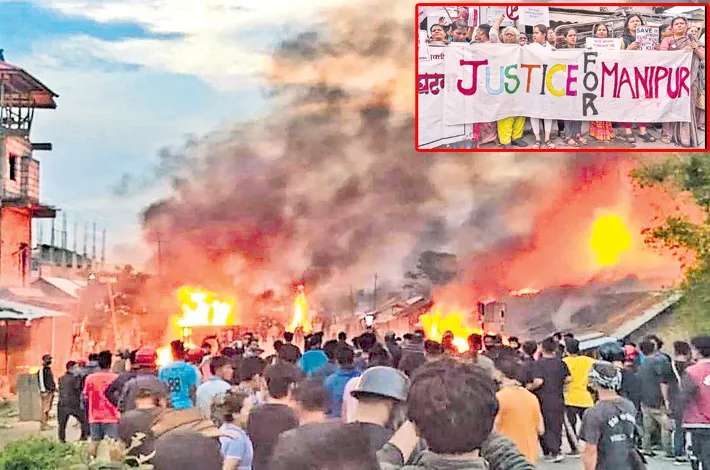
- April 20, 2023: Manipur High Court directs state government to consider the Meitei community’s demand for ST status.
- April 28, 2023: The Indigenous Tribal Leaders' Forum (ITLF) calls for a total shutdown against the government
- May 3, 2023: All Tribal Students' Union Manipur (ATSUM) organizes a march to oppose ST status for the Meitei community.
Same day, violent clashes break out between Meitei and Kekei tribes.
- May 12, 2023: All ten Kuki MLAs of Manipur, including BJP MLAs, demand a separate administration for their community.
- May 29, 2023: Union Home Minister goes on a three-day visit of the state as incidents of violence continue. Before the visit, the armed forces arrests over 20 people who were in possession of guns.
- July 20, 2023: PM Modi makes a statement about the Manipur situation for the first time since the violence broke out in May.
In a bid to bring closure to one of India’s longest-running internal displacement crises, the Manipur government has constituted a two-tier committee system to accelerate the rehabilitation of over 60,000 people displaced by ethnic violence that erupted on May 3, 2023. A state-level panel chaired by Chief Secretary will oversee policy, funding, and inter-departmental coordination, while district-level teams headed by Deputy Commissioners will execute on-ground resettlement, monitor progress, and resolve local bottlenecks.
The initiative follows a 31-day ultimatum issued last month by displaced persons and civil society groups, with the government pledging to close all 281 relief camps by the end of December through phased returns, reconstruction of homes, and restoration of livelihoods. Despite the administrative push, experts warn that security and political challenges remain formidable.
An Assistant Professor at Jawaharlal Nehru University of Delhi and a native of Manipur, stressed that buffer zones maintained by paramilitary forces must continue until a lasting political settlement is reached. Terming the measures being taken as a form of emergency governance, he cautioned that if one community crosses the line, violence can flare up again. He also reminded that past conflicts, such as the Kuki-Naga strife of the 1990s, took nearly three decades to normalize. He urged the Centre to address long-pending demands for greater autonomy in the hill districts or risk further demands for integration with Nagaland or the creation of a separate “Kukiland” for members of the Kuki tribe.
A former IPS officer described the current calm as a “heavy silence” rather than genuine peace. He termed the new committee a “knee-jerk reaction” to public pressure and expressed skepticism about the feasibility of the December deadline. He expressed concern that from July till now, virtually no substantial progress has been made in returning IDPs to their homes. Mapping families, securing travel corridors, and ensuring villages are truly conducive for return remain monumental tasks, he said, warning that “one trigger can put the entire state in flames again”. He emphasized that without an organic political solution involving all stakeholders, administrative measures alone will fail.
A retired Army major and a defence and strategic analyst, echoed the view that the government is attempting to “bite too much in too little time”. Highlighting deep-rooted issues — land ownership disputes, job insecurity, narcotics trafficking, thousands of looted and smuggled weapons still in circulation, and external spillover from the crisis in Myanmar — he called for correct diagnosis before treatment. Recollecting that Manipur enjoyed relative peace between 2008–2009 and 2023.
He emphasized the need to understand why it suddenly erupted again. Temporary pre-fabricated housing for 8,000–10,000 people from highly volatile areas such as Moreh, Churachandpur, and Kangpokpi may provide short-term relief, but permanent normalcy will require decades-long measures, including complete fencing of the 1,640-km India–Myanmar border, recovery of looted arms, and reform of the Sixth Schedule provisions, he argued.
Another opinion unanimously agreed upon was that rushing rehabilitation risks turning it into a “stage-managed” exercise that could undermine trust and reignite violence. Those familiar with north-east region advocated a phased, inclusive approach with open feedback channels between relief camp residents and authorities, coupled with sustained political dialogue led by the Centre.
As the December 31 deadline approaches, the people of Manipur — still separated by heavily guarded buffer zones — await more than just the closure of relief camps. They await a settlement that addresses the root causes of a conflict that has already lasted far longer, and cost far more, than anyone anticipated.