29 September, 2026 | 6:54 PM


‘DON’T DISPLACE PEOPLE’
15-03-2026 12:00:00 AM
Power Point vs Public Point
metro india news I hyderabad
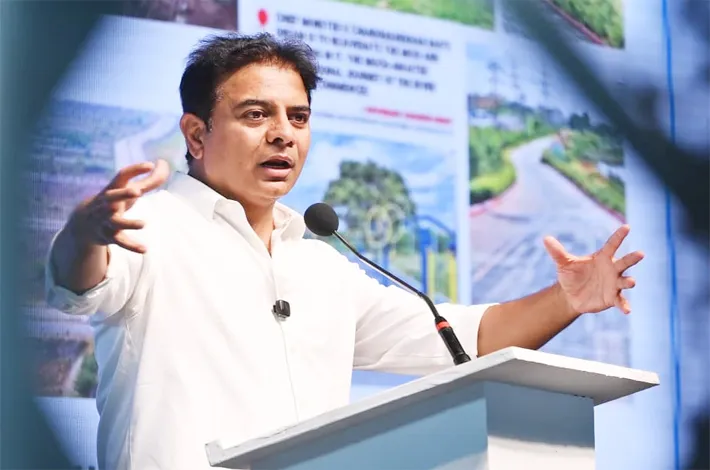
With this message, BRS Working President K T Rama Rao strongly criticised the State government’s Musi rejuvenation plan during a programme titled “Musi Rejuvenation: PowerPoint Presentation vs Public Point” held at Himayat Sagar with residents to be affected by the project.
Several locals from nearby areas, including residents of apartments and villas who fear displacement due to the project, attended the meeting and shared their concerns. Many said they had invested their life savings in their homes and were now facing uncertainty and sleepless nights after receiving notices.
Addressing the gathering, KTR said the BRS government had earlier prepared a comprehensive Musi development plan with an estimated cost of about Rs. 16,000 crore without demolishing a single house. He noted that around six kilometres of the Musi stretch in Uppal and Nagole had already been successfully developed during the previous government’s tenure without displacing residents.
He alleged that the present government was pushing a massive Musi project estimated at around Rs. 1.5 lakh crore and planning large scale demolitions that would affect thousands of poor and middle class families.
KTR questioned why properties belonging to certain leaders were not being touched while homes of ordinary people were facing demolition under the project. He also raised concerns that the project was being pursued without detailed project reports, social impact assessments, environmental studies or adequate consultations with affected communities.
According to him, the BRS government had earlier planned sewage treatment plants, flood management measures, check dams, bridges, walkways, cycling tracks and parks as part of an integrated Musi development plan. Funds exceeding Rs. 3,800 crore had been allocated for sewage treatment infrastructure to ensure that untreated water would not enter the river.
He further pointed out that even large scale national river programmes such as the Namami Gange project covering hundreds of kilometres were implemented at far lower costs, questioning why a 55 kilometre Musi stretch required such huge expenditure.
KTR alleged that the government was eyeing nearly 3,300 acres of land along the river, estimated to be worth about ₹1.5 lakh crore, under the guise of river rejuvenation. He said the BRS was not opposed to Musi development but would strongly resist any attempt to demolish homes or displace people for what he described as a corruption driven project.
He assured affected residents that the BRS would stand firmly with them and support their struggle. KTR said if citizens collectively resisted such measures, a future BRS government would ensure protection of their homes and lands.
Several residents who attended the meeting expressed anger and anxiety over the proposed project and appealed to the government not to disrupt livelihoods of families that had been living in the area for decades. BRS leaders assured them of continued support.
The programme was attended by party leaders including MLAs Sabitha Indra Reddy, KP Vivekanand, Bandaru Lakshma Reddy, MLC Shambipur Raju, former Council Chairman Swamy Goud and BRS leader R S Praveen Kumar, among others.
Musi Jan Andolan critiques plan
Hyderabad: Musi Jan Andolan (MJA), an independent platform advocating for the Musi River and riverside communities, issued a preliminary response to the Telangana government’s Musi Riverfront Project, recently presented by the MD, MRDCL and the Chief Minister. MJA did not attend in person, citing a democratic deficit, but observed the proceedings digitally to assess the government’s plans and direction.
MJA reaffirmed its independence from political parties and stressed that genuine river rejuvenation requires ecologically sound planning without mass displacement or commercialized riverfronts. The movement criticized the focus on parks, walkways, and pumping water from other rivers, stating these measures will not clean the Musi.
Concrete embankments, they warned, worsen flooding, destroy vegetation, reduce groundwater recharge, and fail to address industrial effluents.
The group highlighted contradictions in government statements. The Chief Minister claimed only 10,000 families live along the river, whereas MRDCL’s SEIAA submission notes 12,204 families affected in Phase 1. Project costs of 6,500–7,000 crore INR exceed the 5,641 crore INR submitted to SEIAA. MJA also pointed out lack of strategies to control industrial effluents and improper attribution of 2025 floods solely to heavy rains, ignoring dam safety lapses.
Concerns were raised over water being prioritized for data centers, barrages proposed for boating conflicting with claims of restoring natural heritage, and references to secularism and Gandhi to justify large-scale infrastructure and displacement. MJA warned that the project risks ecological, financial, and social harm, stressing that clean water, pollution control, and preservation of natural ecosystems are essential for meaningful rejuvenation.
MJA plans to continue detailed analysis and make formal submissions to the government.
Musi Riverfront: Ganga Jamuna Tehzeeb
metro india news I hyderabad
The Musi Riverfront Development Project is set to highlight Hyderabad’s historic secular ethos and Ganga Jamuna Tehzeeb through a unique multi faith cultural corridor planned as part of Phase 2 of the initiative.
Managing Director of the Musi Riverfront Development Corporation Limited, MRDCL, E V Narsimha Reddy, IAS, revealed that proposals are under consideration to develop major religious landmarks along the Musi River as part of the broader vision to celebrate the city’s inclusive cultural fabric.
According to officials, the plan includes the development or construction of a Temple at Manchirevula, a Mosque near Puranapool, a Gurudwara at Gowliguda and a Church at Nagole along the riverfront corridor.
Speaking about the proposal, the MD noted that Manchirevula already houses an 800 year old Veera Bhadra Swamy temple spread across nearly seven to eight acres.
Renovating and giving a facelift to this historic shrine could transform the location into a significant spiritual and tourism destination, attracting large numbers of devotees and visitors.
Similarly, the proposed mosque near Puranapool, the gurudwara at Gowliguda and the church at Nagole are envisioned as symbolic landmarks that represent the diverse religious traditions that have shaped Hyderabad’s identity for centuries.
The initiative is part of the strategic planning for the 55-kilometre Musi River corridor stretching from Gandipet to Gowrelly, which aims to integrate heritage, tourism and community spaces along the riverfront.
Officials said the proposed religious sites will complement existing historic landmarks such as the Qutb Shahi Tombs, Mecca Masjid and Taramati Baradari, creating a vibrant cultural and heritage corridor along the Musi.
The project aims to promote community engagement, heritage tourism and cultural harmony, reinforcing Hyderabad’s long standing reputation as a city where multiple faiths and traditions coexist peacefully. A final decision on these proposals will be taken while approving the Detailed Project Report for Phase 2 of the Musi Riverfront Development Project, officials said.