18 October, 2026 | 8:05 AM


How “narrative battle” is won before product maturity?
16-02-2026 12:00:00 AM
A veteran marketing expert declaring the current era an "attention economy" and, more importantly, a "narrative economy." In this landscape, the end consumer—not the channel—is the true target. Brands, he said, win by crafting narratives that resonate with communities, generating trust and driving purchases
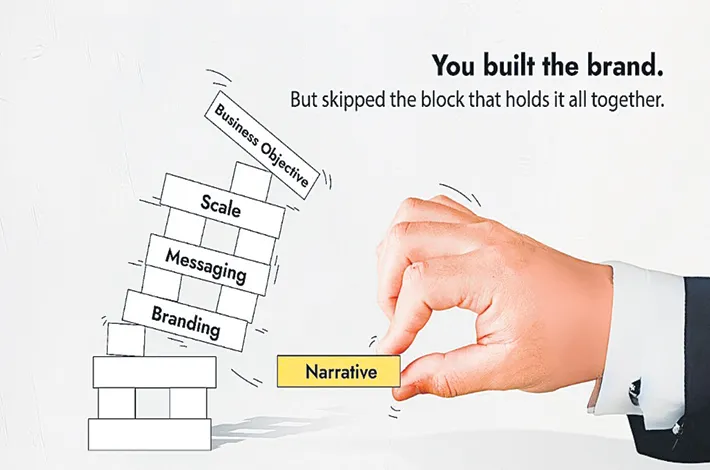
The narrative has become strategic capital in today's markets, where perception often drives success more than product features alone. Experts from various industries made it clear that that effective brands transcend traditional messaging to become shared thoughts, identities, and cultural forces. The whole debate challenged traditional marketing views, emphasizing that in today's perception-driven markets, effective narrative building acts as strategic capital, often outpacing product features in creating competitive advantage.
A business strategist and consultant argued that marketing has evolved through phases—from pure sales, to broader marketing, to branding, to finance-driven efficiency, and now to storytelling. He likened modern marketing to classic fairy tales ("once upon a time"), tapping into human emotions like the seven sins, greed and FOMO(Fear of Missing Out) to push and pull consumers. He questioned whether this approach truly works, setting the stage for debate. He defined a brand not as a physical entity but as a thought—a metaphysical concept he likened to the Sanskrit word "Maya," something present yet intangible.
A veteran advertising professional agreed that marketing has shifted dramatically but reframed the core challenge. He dismissed the popular notion of an "attention deficit" disorder among younger audiences, calling it a myth perpetuated by lazy marketers. Instead, he described the real issue as a "meaning deficit." People still devote hours to binge-watching series, long podcasts, or deep Wikipedia dives when content provides genuine meaning.
Brands, he argued, must move beyond broadcasting messages and instead create open narrative frameworks that allow consumers to co-author their own meaning. This co-authorship fosters deeper resonance, turning the brand into an extension of personal identity and building an "emotional moat" that's hard for competitors to cross. He cited Nike's "Just Do It" as a prime example—an incomplete sentence that invites endless personal interpretations, integrating the brand into users' lives.
A veteran marketing expert declaring the current era an "attention economy" and, more importantly, a "narrative economy." In this landscape, the end consumer—not the channel—is the true target. Brands, he said, win by crafting narratives that resonate with communities, generating trust and driving purchases. He highlighted podcast consumption where millions of listeners engage for hours with creator-led content. These strong, trust-based communities become highly receptive to products endorsed within authentic narratives, as trust emerges from consistent storytelling rather than fleeting ads.
A representative of consumer goods sector introduced another critical trend: purpose. He described purpose as the new imperative, especially for the Alpha generation (the largest living cohort today, succeeding Gen Z and others). Unlike outdated targets (seen as greedy metrics), vision statements (ignored corporate boilerplate), or mission statements (disconnected from reality), purpose transcends business. It represents "good karma" and action in practice—something felt, seen, touched, and experienced. Modern consumers, particularly younger ones, seek brands that shift from "evil" to "good" across products, solutions, and companies. Purpose, he stressed, is not a tagline or strategy confined to marketing offices; it's lived reality.
A retired bank professional, speaking on behalf of the services sector emphasized that brands must align strategies with core performance indicators such as awareness (built via trust, network effects, and stories). In an AI-driven era where attention shrinks and content floods feeds (with much now AI-generated), trust becomes harder to earn. The solution lies in human connection: authentic stories, trusted opinions, cultural relevance, and hyper-localization. He noted that conversion now prioritizes depth—listen rates, sustained attention, and small but devoted communities of brand advocates—over sheer volume or impressions. Attention, he concluded, is the most expensive future currency.
The session wrapped as a thought-provoking, debate-rich exploration of branding's evolution—from transactional sales to meaningful, co-created narratives that build trust, purpose, emotional moats, and cultural relevance in an attention-scarce, imitation-heavy world.