21 October, 2026 | 2:10 PM


Hyd's water crisis reaches a tipping point
17-06-2026 12:00:00 AM
EKALAVYA MALLEPALLI I hyderabad
Record tanker bookings, falling groundwater levels, relentless urban expansion and delayed monsoon rains are pushing Hyderabad's water system to the brink, exposing the growing strain on the city's ageing infrastructure.
For a city celebrated as India's technology and innovation hub, Hyderabad is now confronting an increasingly visible and troubling reality: thousands of residents are struggling to secure something as basic as drinking water. What was once an occasional summer inconvenience has evolved into a full-fledged urban challenge, driven by a combination of extreme heat, unchecked growth, declining groundwater reserves and mounting pressure on civic infrastructure.
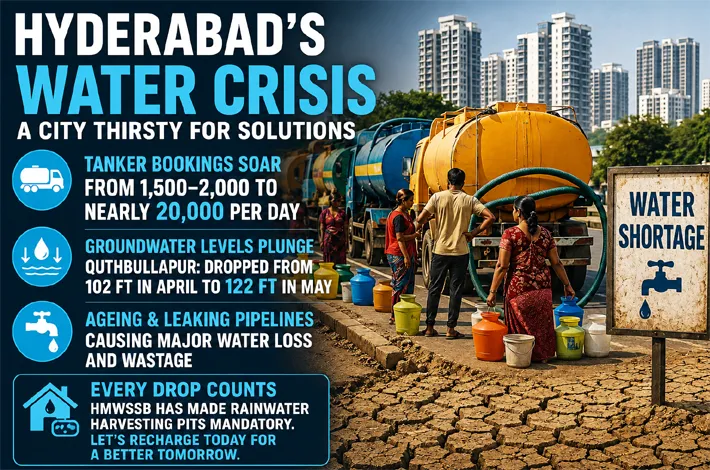
According to officials of the Hyderabad Metropolitan Water Supply and Sewerage Board (HMWSSB), the city's demand for tanker water has surged dramatically this year. Until recently, daily tanker bookings averaged between 1,500 and 2,000. By the end of May, however, bookings had crossed 15,000 a day, with estimates suggesting demand is now inching towards 20,000 tankers daily in several parts of the city.
Although the Water Board expanded its supply capacity to around 13,000 tankers a day and introduced round-the-clock operations through three shifts, demand has continued to outpace supply. Residents in western Hyderabad, particularly in areas such as Serilingampally, Kukatpally, Patancheru and Quthbullapur, have complained of waiting periods stretching from one to several days for tanker deliveries.
Officials attribute much of the crisis to the alarming depletion of groundwater. The absence of meaningful rainfall in May, coupled with intense heat conditions linked to El Niño influences, accelerated the decline in water tables across the city. Monitoring data showed groundwater levels in Quthbullapur dropping from 102 feet below ground level in April to 122 feet in May,
while similar declines were recorded in other western suburbs. Rapid urbanisation has further worsened the situation. Hyderabad district officially has around 2.5 lakh borewells, but authorities estimate the actual number to be much higher. Across Greater Hyderabad, the figure is believed to be close to 10 lakh borewells. Despite the Water, Land and Trees Act (WALTA), 2002 restricting drilling beyond 400 feet, officials say illegal borewell operations continue, with some extending beyond 1,000 feet. The crisis extends beyond scarcity alone.
Residents in some neighbourhoods report municipal water supply arriving only once every four to five days. Complaints of contaminated water in pockets such as Rasoolpura have also raised public health concerns. Ageing and leaking pipelines have added another layer to the problem, resulting in water losses and wastage even as demand peaks.
Political parties have traded accusations over the deteriorating situation. Hyderabad currently requires around 700 to 750 million gallons of drinking water every day, and that demand is expected to rise further as the city expands.
Officials maintain that projects linked to future Godavari water augmentation could provide significant relief. HMWSSB has also been urging residents to adopt rainwater harvesting, making the installation of rainwater harvesting pits mandatory in households and new developments to improve groundwater recharge.
For now, Hyderabad's water crisis stands as a stark reminder that rapid urban growth without corresponding investment in sustainable infrastructure can leave even the country's most modern cities waiting for the next tanker — and the next spell of rain.