18 September, 2026 | 3:55 AM


India, Sweden to collectively face AI challenges
14-12-2025 12:00:00 AM
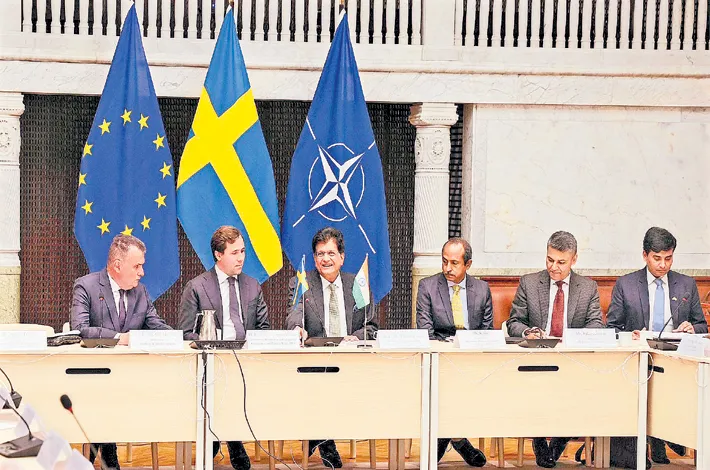
In a high-level roundtable hosted at the Swedish Embassy in New Delhi, diplomats, business leaders, and innovators from Sweden and India gathered to explore opportunities for collaboration on artificial intelligence (AI) for global good. The discussion, part of a pre-summit event, comes ahead of the India AI Impact Summit scheduled for February, which will focus on AI solutions tailored for the Global South, emphasizing inclusivity, sustainability, and reducing inequality.
The Swedish Ambassador to India highlighted the significance of India hosting the summit, noting that it marks a shift from previous AI gatherings in the UK and Paris, which centered on principles, to a more human-focused approach on impact. "India is showing leadership by inviting the Global South not just to participate but to lead the conversation," the Ambassador said. He stressed themes such as "leaving no one behind," democratizing AI access, and leveraging connectivity—areas where Swedish companies have contributed to India's digital infrastructure rollout.
The Ambassador expressed optimism that the summit could serve as a launchpad for deeper Sweden-India partnerships in industrial innovation and AI applications. Business representatives underscored practical applications and mutual strengths. A representative from a Swedish cosmetics giant with 30 years in India, described how AI-powered apps are empowering women entrepreneurs by simplifying product recommendations and knowledge-sharing without requiring expensive training. "AI makes entrepreneurship accessible and user-friendly, bringing big changes to lives," she noted, emphasizing democratization.
From the energy sector, a Hitachi Energy executive pointed to longstanding Sweden-India synergy, citing High Voltage Direct Current (HVDC) technology invented in Sweden 70 years ago and now scaled globally, including for India's renewable energy integration. "Sweden brings domain expertise and original equipment, while India offers massive scale—together, we can pilot solutions once and implement them worldwide," he said, expressing excitement about AI-enabled energy transitions.
A representative of the Swedish government revealed that 60% of Swedish companies in India plan increased investments, many with growing AI competence centres and global capability centres (GCCs). She advocated for stronger industrial collaborations, similar to those among major Swedish firms like Ericsson, AstraZeneca, and Saab, and sees the summit as a boost to the Sweden-India AI corridor. Indian perspectives highlighted challenges and opportunities. Founder of an AI startup, argued against a purely sovereign approach to AI development, favouring global best practices while calling for a stronger domestic venture ecosystem.
"India needs venture capitalists to take bigger risks to build foundational data infrastructure and large language models," he said, warning against repeating past misses in social media innovation and praising the government's India AI Mission. The discussion also touched on the proposed EU-India Free Trade Agreement (FTA), seen as a potential game-changer. Industry voices, including from Volvo Cars and others, viewed it as opening doors for technology transfer, investment flows, and small-to-medium enterprises. The Ambassador noted it could nurture startups, with Sweden acting as a "nursery" for Indian firms scaling globally. Also mentioned about were ways of leveraging government investments in cloud platforms and subsidized GPUs to train talent and develop sector-specific solutions, such as predictive maintenance for trucking and semiconductor design automation. A representative of a top Indian IT firm praised India's modern, scalable digital stack as replicable in Sweden, while suggesting Sweden's seamless digital identification could enhance trust in Indian systems.
Representatives from Volvo Eicher Commercial Vehicles and IKEA shared real-world examples. Volvo highlighted AI-driven connected vehicles reducing logistics downtime in India, aligning with national goals to cut logistics costs. IKEA's Patrick discussed ethical AI for better customer experiences and last-mile delivery, including acquiring a Bangalore-based AI logistics firm and investing in Rajasthan solar farms to power sustainable AI operations. On global AI governance, participants supported predictable regulatory frameworks. IKEA endorsed common rules for business flourishing, while Business Sweden echoed calls for stability, with predictability topping Swedish firms' wishes for India in 2026.
The roundtable underscored a shared vision: combining Sweden's deep tech expertise with India's scale and talent to deliver trusted, impactful AI solutions worldwide. With strong backing from Sweden, the upcoming India AI Impact Summit is poised to produce concrete outcomes for equitable global development.