18 September, 2026 | 4:55 AM


playing Politics over pollution
14-12-2025 12:00:00 AM
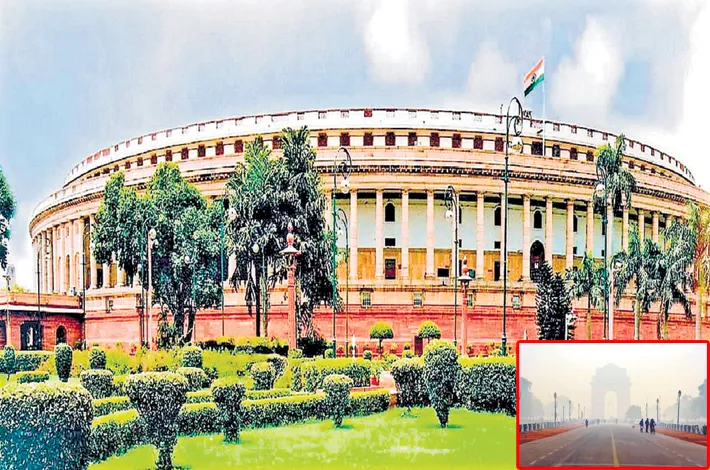
In Parliament, the Centre clarified that World Health Organization (WHO) guidelines are merely advisory and not binding, while India adheres to its own National Ambient Air Quality Standards (NAAQS) set in 2009. Environment Minister of State Kirti Vardhan Singh emphasized that no official global country-wise pollution rankings exist
As Delhi and much of northern India choke under toxic smog, the ongoing winter session of Parliament has drawn sharp criticism for devoting virtually no time to discussing the country's severe air pollution crisis. According to calculations, MPs have spent zero hours debating pollution—excluding brief remarks by Congress leader Rahul Gandhi—while over 40 hours have been lost to disruptions, 12 hours to electoral reforms, and 10 hours to debates over "Vande Mataram." Instead of addressing the public health emergency, the session has been consumed by petty controversies, including walkouts, and acrimonious exchanges.
Critics argue these distractions come at a devastating cost, with a leading medical journal estimating that air pollution claims around 12,000 lives annually in India. The only significant mention of pollution came from Leader of the Opposition Rahul Gandhi, who urged the government to develop a comprehensive plan to tackle urban air quality and offered full cooperation. Describing the issue as non-ideological, Gandhi stressed that the time for blame games and finger-pointing is over.
A former Delhi minister and Aam Aadmi Party (AAP) leader emphasized the need to first acknowledge the problem through accurate data, criticizing the government's repeated claims of "no data" on pollution-related deaths—a pattern seen during COVID-19 and other crises. He accused authorities of manipulating indicators, such as allegedly using water sprinklers on AQI monitors to artificially lower readings, and urged recording air pollution as a cause of death on certificates.
BJP leaders acknowledged pollution as a serious issue causing widespread discomfort but questioned the quantifiability of deaths, aligning with government statements in Parliament that no conclusive link has been established. Tyagi defended ongoing efforts like increased green cover, electric vehicle promotion, and anti-smog sprinklers, insisting the Centre is working "tirelessly." However, he rejected Gandhi's leadership on the issue, citing a lack of trust and accusing the opposition of habitual walkouts.
In Parliament, the Centre clarified that World Health Organization (WHO) guidelines are merely advisory and not binding, while India adheres to its own National Ambient Air Quality Standards (NAAQS) set in 2009. Environment Minister of State Kirti Vardhan Singh emphasized that no official global country-wise pollution rankings exist, dismissing indices like IQAir and WHO databases as unofficial. This position comes amid claims of improvement in Delhi's air quality, with "good to moderate" days increasing from 110 in 2016 to 200 in 2025 so far, and average AQI dropping to 187 (January-November 2025) from higher levels in previous years.
However, critics argue this deflects from the crisis, where India's standards allow PM2.5 limits eight times higher than WHO recommendations. Environmentalists welcomed the potential discussion but criticized statements implying "Indian lungs" differ from global norms or that no deaths occur due to pollution. They contrasted India's modest spending on air quality governance (Rs 20,000 crore over six years for 130 cities) with Beijing's aggressive annual investments, stressing the need for a pan-India approach beyond Delhi-centric measures. One particular researcher called for addressing root causes like coal plants, construction dust, and vehicle emissions, rather than symptom-focused measures like roadside sprinklers.
A Delhi BJP leader defended efforts, including dust mitigation and increased green cover, denying allegations of tampering with monitors. He noted Delhi's unique Commission for Air Quality Management and GRAP enforcement but acknowledged pollution control requires time and multi-pronged strategies. A Congress spokesperson appreciated the government's agreement to discuss but demanded higher standards and city-wise action plans, warning against lowering benchmarks to match current pollution levels.
Stage 2 of the Graded Response Action Plan (GRAP) is currently implemented across Delhi-NCR, banning open burning and certain construction activities. Anti-smog measures, including mist systems at key junctions and fines for violations, are in place. If "very poor" conditions persist, GRAP-3 restrictions—potentially including vehicle curbs—could be imposed soon.
A key point of contention remains India's air quality standards, unchanged since 2009 and significantly laxer than current World Health Organization guidelines—allowing limits eight times higher. Experts, including renowned pulmonologist Dr. Randeep Guleria, argue that air pollution acts as a "silent killer," exacerbating conditions like asthma and heart disease without being listed on death certificates. This systemic gap, they say, allows denial of the crisis's scale.