8 October, 2026 | 3:25 AM


Kharge-Modi ‘Terrorist’ Row
24-04-2026 12:00:00 AM
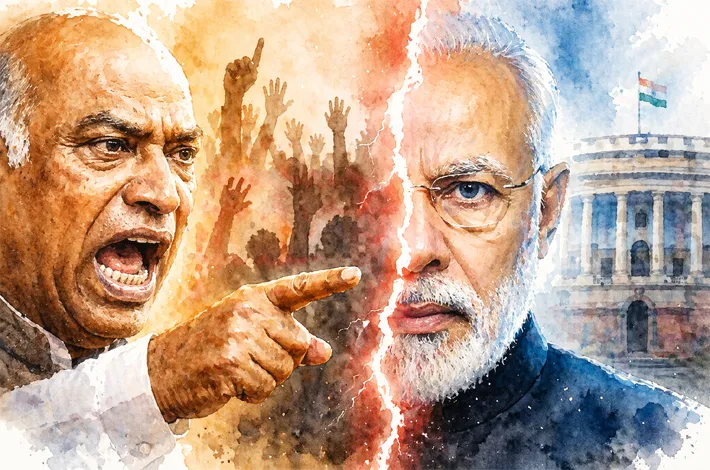
Fall of Parliamentary grace
Where once political adversaries sparred over policies with rhetorical finesse, today's exchanges too often descend into epithets that blur the line between critique and calumny
metro india news I hyderabad
In the sweltering heat of a southern Indian campaign trail, the fragile veneer of democratic decorum cracked once more. Congress President Mallikarjun Kharge, an 83-year-old veteran whose career spans decades of parliamentary service, unleashed a remark that reverberated far beyond the rally grounds of Chennai.
Addressing the final day of campaigning ahead of the April 23 polls, Kharge assailed the AIADMK for its alliance with the Bharatiya Janata Party (BJP), declaring pointedly: "How can they join with Modi? He is a terrorist."
The words landed like a thunderclap in an already polarized arena. What followed was not measured rebuttal but a nationwide firestorm of outrage, condemnation, and weary resignation. Senior BJP leaders, including Union Minister Piyush Goyal, swiftly demanded an unconditional apology, framing the statement as an affront not merely to the Prime Minister but to the dignity of the nation itself.
Kharge, sensing the tempest, attempted a rapid pivot in clarification: his reference, he insisted, was to "tax terrorism" and the alleged weaponization of central agencies to "terrorize" opposition leaders. Yet the damage was done. The initial visceral charge had already ignited debates across television studios, social media platforms, and legislative halls, underscoring a grim milestone in the steady corrosion of India's political discourse.
This incident is no isolated lapse. It represents the culmination of a longer, more insidious shift—from the "gentleman's game" of ideological contestation to a no-holds-barred arena of personal vitriol and character assassination. Where once political adversaries sparred over policies with rhetorical finesse, today's exchanges too often descend into epithets that blur the line between critique and calumny.
For a leader of Kharge's stature and seniority, the linguistic ambiguity—whether tactical misstep or calculated provocation—lowers the bar perilously. Critics rightly note that such rhetoric risks normalizing extremes, eroding the very foundations of civil debate in the world's largest democracy.
The Congress party bears familiar scars from similar episodes. Recall the costly gaffe by senior leader Manishankar Aiyar, who once branded Narendra Modi a "neech aadmi" (lowly person), a remark that haunted the party electorally and lingers in public memory as emblematic of its disconnect. Kharge's utterance invites parallel scrutiny. Notably, the Gandhi family—Sonia, Priyanka, and Rahul—has maintained a conspicuous silence, leaving the octogenarian president exposed. Whispers within political circles suggest an urgent imperative: the Congress must hasten the infusion of middle-aged and younger leaders to revitalize its ranks and avert further self-inflicted wounds.
The shock of Kharge's statement intensifies when juxtaposed against India's golden era of statecraft, an age when ideological foes preserved personal respect and institutional reverence. Consider the luminous rapport between Jawaharlal Nehru and Atal Bihari Vajpayee.
Though Vajpayee, as a rising star of the Jana Sangh, offered trenchant critiques of Nehru's policies, the Prime Minister discerned in him a future leader of substance. Nehru's prophetic admiration for Vajpayee's intellectual depth spoke volumes of a political culture that valued talent beyond partisan trenches.
Vajpayee himself embodied this grace. Upon assuming the role of External Affairs Minister in the 1977 Janata Party government, he discovered Nehru's portrait missing from his office. Without hesitation, he ordered its restoration: "This is where Panditji's portrait used to be; I want it back."
Such gestures transcended politics, affirming a shared heritage. Even more striking was Prime Minister P.V. Narasimha Rao's decision in 1994 to dispatch his chief rival, Vajpayee, to lead India's delegation to the UN Human Rights Commission in Geneva. There, Vajpayee defended the nation's position on Kashmir with eloquence and authority—a bipartisan trust unimaginable amid today's hyper-partisan suspicions.
This legacy of mutual respect stands in stark contrast to contemporary trends, where criticism has morphed from policy dissection to personal and identity-laden assaults. A comparative glance across eras reveals the trajectory:
In the 1950s through the 1980s, discourse centered on substantive policy critique, punctuated by moments of grace—Vajpayee hailing Indira Gandhi as "Durga" for her resolve in the 1971 war. The 1990s and 2000s emphasized coalition negotiations and civility, exemplified by Sonia Gandhi's solicitous call to Vajpayee following the 2001 Parliament attack. From 2014 onward, however, the tone has sharpened into personal barbs: "Maut ka Saudagar" (merchant of death), "Chowkidar Chor Hai" (watchman is a thief), and now "terrorist." What was once debate has become demolition.
Empirical observations and psychological insights illuminate the broader ramifications. The deployment of incendiary labels like "terrorist" or "anti-national" by senior figures exerts a cascading influence on the polity. It legitimizes polarization on social media, where algorithms reward outrage, and emboldens supporters toward reciprocal venom. When the vocabulary of democracy equates a sitting Prime Minister with those who perpetrate violence against civilians and sovereignty, it bankrupts the lexicon of governance itself.
Several structural forces propel this descent. The 24/7 news cycle hungers for viral soundbites, privileging shock over substance. Social media echo chambers amplify extremism, as engagement metrics incentivize ever-more aggressive posturing. Elections, increasingly perceived as existential battles for survival, reframe opponents not as worthy adversaries to be defeated at the ballot but as existential enemies to be annihilated. In this cauldron, nuance evaporates, and dignity becomes collateral damage.