22 September, 2026 | 6:03 AM


MSMEs cry foul over new power charges
25-12-2025 12:00:00 AM
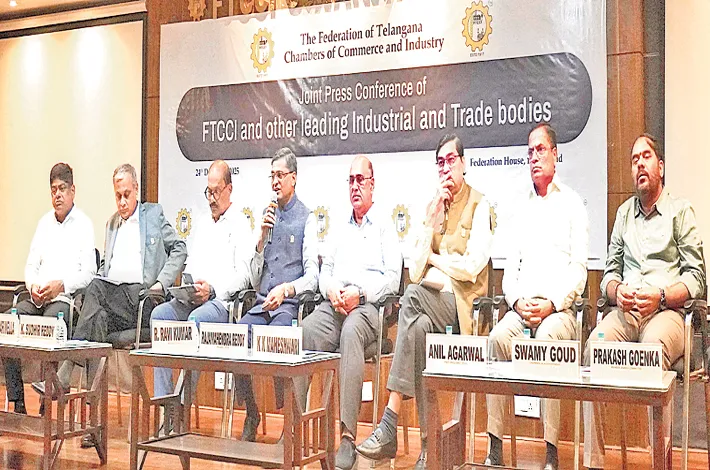
50,000 industrial units across Telangana urge the Government to rethink
In a show of solidarity, over 50,000 industrial units across Telangana, represented by major trade bodies like the Federation of Telangana Chambers of Commerce and Industry (FTCCI), Telangana Industrialists Federation (TIF), and others, have united to urge the state government for a consultative approach to policies crippling their operations. At a joint press conference held at FTCCI on Wednesday, leaders voiced alarm over soaring power costs, relocation uncertainties, and stalled green energy investments, warning that these could erode investor confidence and hamper employment.
The primary grievance centers on the abrupt shift to kVAh (kilovolt-ampere-hour) billing by Telangana DISCOMs, replacing the traditional kWh system for commercial and industrial consumers, including MSMEs. This change emphasizes power factor (PF) management, where a low or leading PF can inflate bills by 10-20% without increased consumption. Industry stakeholders decry the "unblocking of lead kVArh," which penalizes consumers for injecting reactive power back into the grid—a practice that historically supported grid stability without charges. The sudden implementation, with just three months' notice, has led to bills tripling or quintupling, threatening competitiveness.
“The shift to kVArh billing is not just about paying electricity bills differently—it is about how efficiently enterprises use power. Businesses that do not actively manage their Power Factor risk hidden costs and a steep rise in energy expenses. With smart monitoring and corrective measures, companies can not only avoid penalties but also turn energy efficiency into a competitive advantage,” explained the members of the industry bodies.
Another leader added, “The shift from kWh to kVArh billing is not just a technical adjustment; it is a paradigm change in energy cost management. For businesses, especially SMEs and industries with high power usage, understanding this change is crucial. If ignored, it can silently increase power bills by 10–20% without any increase in consumption. But with proper awareness and corrective action, it can also become an opportunity to optimise costs and improve operational efficiency. Our objective of this program is to equip you with the right knowledge, practical tools, and real-time examples so that your businesses can adapt smoothly to this regulation.”
Industry leaders demanded a phased rollout, awareness programs, and an expert committee involving associations, technical institutions like IITs/NITs/JNTU, generators, and DISCOMs to assess grid needs and create a transition roadmap. They cited successful implementations in Gujarat and Tamil Nadu, where stakeholders were consulted and given ample time.
D Srinivas Reddy, President of Cherlapally Industries Association (CIA), highlighted MSME struggles: "Micro and small industries are suffering with the new system that came into force from December. A stakeholders meeting has to be held to create awareness about the new system, its advantages etc before implementing it. We want the decision to be kept on hold for six months to create enough awareness and then roll out so that both industry and the government will be in a win-win situation."
Rajamahendra Reddy, President of Telangana Small Industries Associations (FETSIA) criticized the lack of consultation: "The MSMEs were not properly taken into confidence or meetings held with stakeholders before the roll out of the new electricity billing."
Swamy Goud, Chairman, IALA-Gandhinagar, quantified the impact: "kVArH billing has come off a big shock for the MSME sector, which mostly exists in a land of 300 to 500 sq.yards. The previous power bills that were in the range of Rs 15,000 have now increased three times while those paying Rs one lakh bill earlier are now getting Rs 1.9 lakh to Rs 2 lakh bills under the new system."
Srinivas Garimella, Vice-president, FTCCI sought leniency: "They are not opposing the government decision but are seeking a transition time of one year to create awareness in the industry before the new system can be rolled out." Venkat NKK echoed similar sentiments.
K Sudhir Reddy, President, Telangana Industrialists Federation (TIF) stressed ecosystem needs for any changes.
Apart from this, Industries called for restoring the Rs 1.50 per unit night ToD concession or higher daytime discounts, leveraging cheaper solar power procurement by DISCOMs to share benefits and encourage sustainable usage. As regards Clean & Green Energy Bottlenecks, the observation was investments were stalled due to delayed NOCs for solar developers since the policy's January 2025 launch, high surcharges, wheeling charges, and property taxes, freezing renewable projects and eroding confidence.
Relocation woes
Under the Hyderabad Industrial Lands Transformation Policy (HILTP), industries fear vague, unilateral relocation mandates outside of ORR without clarity on support, compensation, or alternative sites. Leaders like K Sudhir Reddy urged creating outer ecosystems with residential colonies: "Industry bodies have created the present ecosystem in the said industrial areas by investing their decades of time and energies. Suddenly for them to start from zero at a new location far off from the city, particularly inconvenient for the workforce to travel to and fro for five to six hours daily is a big worry unless residential quarters are set up in those industrial estates."
Rajamahendra Reddy added: "The government must create industrial estates with residential colonies for the industries to seriously think of relocating. Else, the policy will just remain on paper and cannot be fully implemented as desired."
The coalition has approached cabinet ministers, awaiting a "positive decision" to align with Telangana's 2047 growth vision.
What is kVArh?
kVArh (kilovolt-ampere-hour) measures not just electricity consumed but also how efficiently it is used. Unlike kWh billing, it factors in power factor and reactive power. A poor or leading power factor can raise electricity bills by 10–20% even without higher consumption.