17 October, 2026 | 8:27 AM


‘Che-mystery’ of molecular handedness, nonlinear effects and autocatalysis
17-10-2026 12:00:00 AM
Science Corner
In the 1980s, Kagan showed that very small differences in the amounts of two mirror-image molecules can become greatly amplified during a chemical reaction
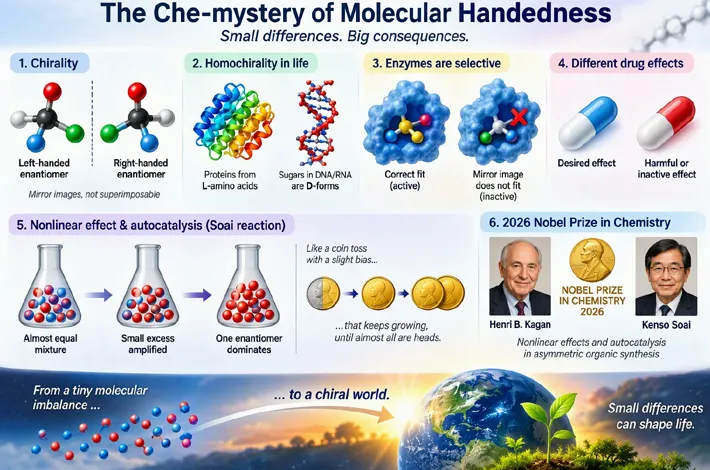
Our bodies appear symmetrical from the outside, but many biological processes and internal structures are not. A similar phenomenon exists in chemistry and is called chirality, or molecular “handedness.” Some molecules occur in two forms that are mirror images of each other, much like our left and right hands.
Although they contain the same atoms and have the same chemical formula, one form cannot be perfectly superimposed on the other. These mirror-image molecules are called enantiomers. One form can be described as left-handed and the other as right-handed. While they appear nearly identical, living systems can recognize and respond to them very differently.
Life on Earth uses almost exclusively L-amino acids to build proteins and D-sugars in many essential biological molecules. This preference for single molecular handedness is called homochirality. Scientists always wondered why nature selected one form instead of an equal mixture of both, which is typically produced in ordinary laboratory reactions. The reason this is important is that biological systems are highly selective.
Enzymes, which act as natural catalysts, function like locks that accept only the correct key. A helpful analogy is a glove: a right-handed glove fits only a right hand. Similarly, one enantiomer of a molecule may fit an enzyme perfectly, while its mirror image may not fit at all. As a result, one form of a molecule can be biologically useful, whereas the other may be inactive or even harmful. This principle is particularly important in medicine. Two mirror-image forms of a same drug can produce very different effects. One may provide the intended therapeutic benefit, while the other may be ineffective or cause undesirable side effects. Consequently, chemists strive to produce only the desired enantiomer when manufacturing pharmaceuticals.
A major breakthrough came from the work of Henri B.Kagan and Kenso Soai recipients of the 2026 Nobel Prize in Chemistry, for the discovery of “nonlinear effects and autocatalysis in asymmetric organic synthesis”. In the 1980s, Kagan showed that very small differences in the amounts of two mirror-image molecules can become greatly amplified during a chemical reaction. This phenomenon is known as a nonlinear effect. He demonstrated how tiny initial imbalance can greatly favour one product over the other. Soai later developed a remarkable reaction now known by his name, the Soai reaction.
In this reaction, the product acts as its own catalyst, a process called autocatalysis. If one mirror-image form is present in even a tiny excess, it helps create more molecules of the same type. As the reaction continues, this small advantage becomes larger and larger until one form can dominate almost completely.
For example, if a reaction starts with 50.0001% right-handed molecules and 49.9999% left-handed molecules, the right-handed form gradually promotes the production of even more right-handed molecules. Over time, the small difference becomes very large, and one form can dominate almost completely. A simple analogy is a coin toss in which a slight excess of heads is continuously amplified until almost every outcome becomes heads.
The discoveries of Kagan and Soai revealed how tiny molecular imbalances can grow into overwhelming dominance of a single enantiomer. Their work has provided a possible explanation for the origin of biological homochirality, advances the production of safer pharmaceuticals, and deepens our understanding of one of chemistry’s most fascinating mysteries: why life ultimately chose one molecular hand over the other.
(Dr Swarnabala Ganti is a seasoned chemist, regulatory affairs specialist and R&D scientist across India, Iran, Japan, and Taiwan. A Consultant at Swaram Biochem, Agrilife India & Som Phytopharma.)