15 October, 2026 | 12:00 PM


Not a right, but organized exploitation
23-06-2026 12:00:00 AM
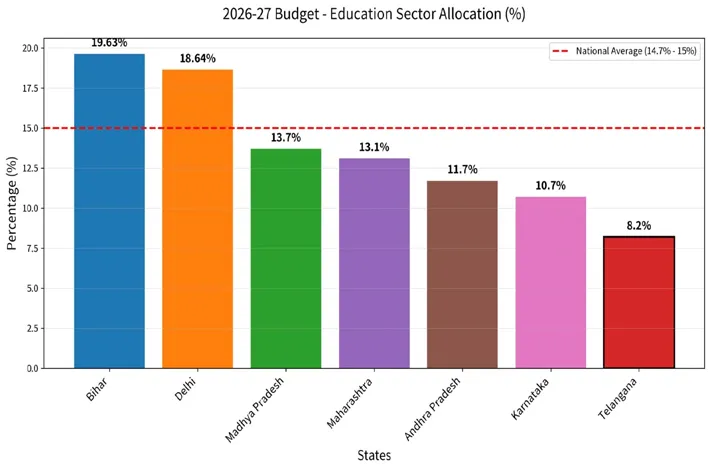
Education in Telangana
Metro India News | Hyderabad
Telangana is not merely a geographical region. It is a historic aspiration realized through the sacrifices of countless martyrs and the hopes, dreams, and self-respect of millions of people. During the Telangana movement, promises were made to build a “Social Telangana” that would provide education, employment, and a dignified life to every poor family. The slogan “Free Education from KG to PG” generated immense hope among the people.
However, twelve years after the formation of Telangana, the reality tells a different story. Instead of a socially inclusive Telangana, what has emerged is a Telangana increasingly driven by privatization. Particularly in the education sector, the government's responsibility has gradually diminished while the dominance of private institutions has expanded. As a result, education has ceased to be a right and has become a commodity that must be purchased.
According to UDISE statistics for 2014–15, Telangana had 43,839 schools, of which 28,822 (65.74%) were government schools, while 14,438 (32.93%) were private schools. By 2026, the share of government schools had fallen to 60.89 percent, reflecting a significant decline in public confidence in the government education system. In 2014–15, 46.49 percent of students studying in Classes 1 to 8 were enrolled in government schools. Today, that figure has dropped to around 28 percent. This clearly indicates a massive migration of students from government schools to private institutions after the formation of Telangana.
A crucial question remains unanswered: Why does Telangana not have an effective law to regulate the fees charged by private educational institutions? During the united Andhra Pradesh era, GO 91 (2009) proposed the establishment of District Fee Regulatory Committees (DFRCs), requiring schools to obtain approval before implementing fee structures. Private school managements challenged these provisions in court. Although courts acknowledged the need for fee regulation, certain provisions of the GO were questioned. After Telangana's formation, in 2017, the Tirupati Rao Committee recommended the establishment of District Fee Regulation Committees and suggested that annual fee hikes be capped at 10 percent. Yet its recommendations were never implemented.
Rapid privatization of education
One of the most significant changes in Telangana since statehood has been the rapid privatization of education. In 2018, the Telangana government enacted legislation allowing private universities. Nearly 20 private universities emerged in the state, compared to only 19 public universities. A particularly troubling aspect is the absence of social justice in recruitment within many private universities. Reservations for SCs, STs, and BCs are generally not implemented. At the same time, nearly twelve years after statehood, regular faculty recruitment in public universities remains inadequate. Many institutions continue to function with ad hoc, contractual, and guest faculty members.
Failure to implement Right to Education Act
One of the most important educational reforms in independent India is the Right to Education (RTE) Act, 2009. Its objective is to overcome social and economic inequalities and provide quality education to every child. Section 12(1)(C) of the Act mandates that private and corporate schools reserve 25 percent of entry-level seats for children from economically weaker and disadvantaged sections. The expenditure is shared by the Central and State Governments in a 60:40 ratio. While 22 states across India have implemented this provision, Telangana has failed to do so.
Medical and engineering education: Increasingly out of reach
Although Telangana has 35 government medical colleges and 19 private medical colleges, nearly 4,200 out of approximately 8,415 medical seats are in the private sector. Engineering education is also dominated by private institutions. Fees in these sectors have reached levels beyond the reach of ordinary families. From schools to universities, an industry worth thousands of crores has emerged, with parents ultimately bearing the financial burden.
Education is not an expenditure; it is an investment in society's future. But if education is transformed into a business and public responsibility is transferred to private interests, inequality will only deepen. The successful protest organized at Indira Park against issues such as the NEET paper leak demonstrates the power of Gen Z. The Gen Z youth of Telangana must now also raise their voices against the ongoing commercialization and exploitation of education in the state.
(T Chiranjeevulu
is a retired IAS officer and Chairman of BC Intellectuals Forum Hyderabad.)