2 October, 2026 | 3:31 AM


Oil demand falls as supply shortages intensify globally
29-04-2026 12:00:00 AM
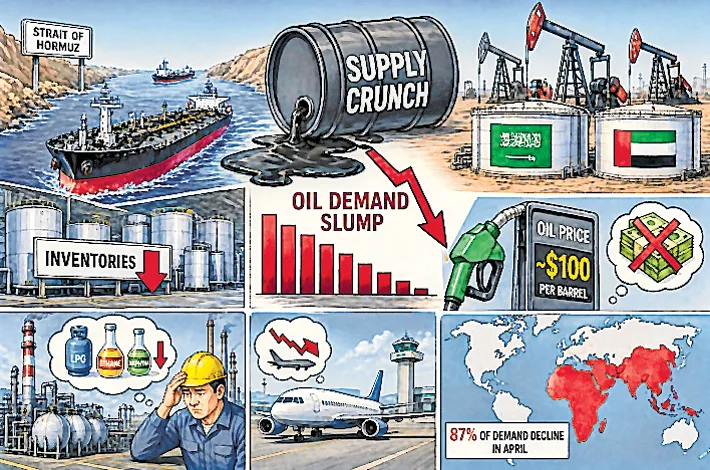
Global consumption drops as supply shortages tighten availability, triggering forced demand loss despite stable prices and limited response from producers
A sharp slowdown in global oil demand in April has been driven primarily by supply disruptions rather than elevated prices, according to a report by JP Morgan.
The report highlights that the current trend reflects “forced demand loss”, where physical shortages constrain consumption, instead of traditional price-led demand destruction.
Global supply disruptions surged significantly, rising from 9.1 million barrels per day (mbd) in March to 13.7 mbd in April, largely due to tensions around the Strait of Hormuz. Despite the scale of disruption, conventional balancing mechanisms failed to respond adequately.
Spare production capacity, mainly concentrated in Saudi Arabia and the United Arab Emirates, was not effectively deployed to offset supply losses. In the United States, the shale sector’s response remains slow, with only 0.3–0.7 mbd expected over three to six months, and up to 1 mbd over a year. Meanwhile, Russia has limited spare capacity of around 300,000 barrels per day, with output already curtailed due to infrastructure disruptions.
With supply responses constrained, the market turned to inventories. Global stockpiles declined by 4.0 mbd in March and a sharper 7.1 mbd in April, reflecting heavy reliance on reserves. However, even these drawdowns have failed to fully bridge the supply gap. As a result, global oil demand fell by 2.8 mbd in March and is estimated to drop further by 4.3 mbd in April.
Notably, this decline has occurred despite relatively moderate prices. Brent crude averaged just under $100 per barrel during March and April, suggesting that price levels were not high enough to trigger conventional demand destruction. Instead, physical shortages directly curtailed consumption. Feedstock shortages, including LPG, ethane and naphtha, have forced industrial units in Asia to scale back operations. Despite inventory drawdowns and falling demand, a residual gap of around 2 mbd persists, indicating further adjustments will be required to restore balance in the global oil market. Aviation demand has also weakened due to disruptions in flight activity. In India, LPG consumption declined 13% y/y in March, underscoring the broader impact.