17 October, 2026 | 5:12 PM


Polavaram: Decades of delay, soaring costs, interstate tensions
16-07-2026 12:00:00 AM
KIRANMAI TUTIKA| AMARAVATI
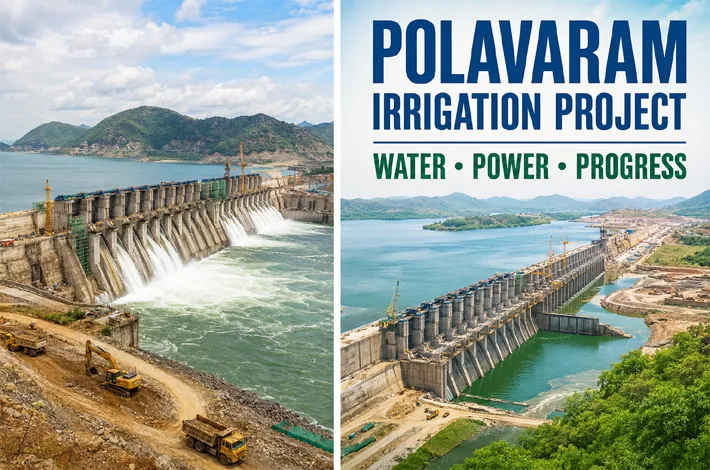
The Polavaram Irrigation Project on the Godavari River is one of India’s largest and most ambitious multi-purpose river projects. Designed to provide irrigation, drinking water and hydropower, it has also become one of the country’s most debated infrastructure ventures due to delays, rising costs, environmental concerns and inter-state disputes. As of July 15, 2026, the project, now overseen by the Polavaram Project Authority (PPA) as a National Project, has gained momentum but continues to face legal and rehabilitation challenges.
A vision decades in the making
The project’s origins date back to 1941 when engineer Diwan Bahadur L. Venkatakrishna Iyer proposed a reservoir at Polavaram. While the foundation stone was laid in 1980 by Chief Minister Tanguturi Anjaiah, significant progress began only in 2004 under Y.S. Rajasekhara Reddy.
The project includes a 3.72-km earth-cum-rockfill dam, one of the world’s largest spillways capable of handling 50 lakh cusecs, and extensive canal networks. At a Full Reservoir Level of 45.72 metres, it will store about 194 TMC of water and generate 960 MW of hydropower. It is expected to irrigate over seven lakh acres, stabilize existing ayacut in the Godavari and Krishna deltas, supply drinking water to Visakhapatnam and other regions, and facilitate the Godavari-Krishna river link.
Delays and rising costs
Construction, which effectively began in 2004, encountered several obstacles. After Andhra Pradesh’s bifurcation in 2014, the Centre declared it a National Project and created the PPA to oversee execution and funding.
Technical challenges proved formidable. The project required a 6.6-km river diversion and a deep diaphragm wall because of unstable alluvial foundations. Flood damage, cofferdam failures and repairs to the crucial Gap-2 section delayed progress. A new diaphragm wall was completed in April 2026.
Costs have risen sharply from the original estimate to over Rs 47,000 crore. Contractor changes, engineering complexities and repeated delays added to the financial burden.
The project will submerge around 276 villages, affecting nearly 1.8-4 lakh people, many from tribal communities. Although land acquisition has crossed 90%, rehabilitation remains incomplete. Environmental concerns, including forest loss and backwater impacts extending into Odisha and Chhattisgarh, have also slowed progress.
Current status
Under Chief Minister N. Chandrababu Naidu, construction has accelerated. Headworks are about 80% complete, spillway concreting has advanced, and work on the remaining earth-cum-rockfill dam gaps is progressing rapidly. Canal connectivity and twin tunnels are also nearing completion.
Authorities aim to enable gravity flow from the upper cofferdam in 2026 and complete major civil works before the 2027 Godavari Pushkarams. Full commissioning is targeted between 2027 and 2029. While land acquisition is largely complete, rehabilitation is only about 45%. International experts from the US and Canada have reviewed the project because of its complex geology.
Despite its long history of delays, Polavaram is closer to completion than ever before. Yet its ultimate success will depend not only on engineering achievements but also on effective rehabilitation, environmental safeguards and the resolution of inter-state disputes.
The AP vs Telangana Issue
Bifurcation in 2014 added a sharp inter-state dimension. Telangana has given in-principle consent under the Reorganisation Act but contests aspects of implementation, particularly backwater impacts on areas like Bhadrachalam. In 2022, raising the upper cofferdam height sparked flooding concerns in Telangana villages, leading to disputes over Full Tank Level (FTL) and rehabilitation responsibilities.
Telangana seeks return of certain villages for administrative access. More recently, Andhra’s ambitious Polavaram-Banakacherla (or Nallamala Sagar) Link proposal—to divert surplus Godavari waters (up to 200 TMC) to drought-prone Rayalaseema—has intensified conflict. Telangana argues it violates the 2014 Act, the Godavari Water Disputes Tribunal award, and equitable sharing principles, encroaching on its water share without clearances from river boards.
It challenged central financial aid and preparatory works in the Supreme Court. In January 2026, the apex court heard arguments but suggested it suits a civil suit on inter-state water disputes; as of mid-July 2026, the Court declined to hear a related plea citing procedural issues, leaving the matter unresolved. Telangana views the expansions as contrary to cooperative federalism post-bifurcation, while Andhra sees Polavaram as vital for its water-scarce regions and overall development. The disputes highlight deeper Krishna-Godavari sharing tensions.
Polavaram represents hope for irrigation security and economic growth in Andhra Pradesh but at significant human, ecological, and fiscal cost. With accelerated construction and central backing, completion targets appear more realistic than in past decades. Yet, unresolved rehabilitation, environmental monitoring, and the Telangana dispute could delay full benefits.
As India grapples with water stress and climate variability, Polavaram’s success—or failure—will offer critical lessons on balancing mega-projects with federal harmony and sustainable development. Stakeholders must prioritize transparent data, inclusive rehabilitation, and negotiated resolutions to realize its potential without exacerbating regional divides.