17 October, 2026 | 6:07 PM


Rare Jain sculptures unearthed in Adilabad
16-07-2026 12:00:00 AM
Metro India News | hyderabad
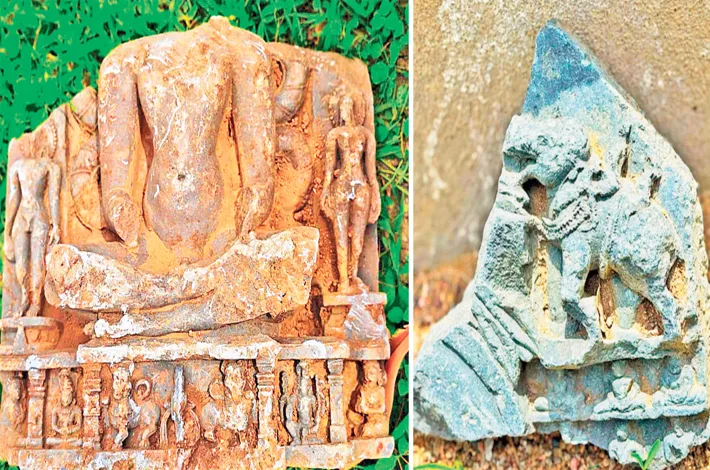
A remarkable archaeological discovery in Chand village of Adilabad district has revealed evidence that the area was once an important Jain religious centre. Researchers have identified several damaged Jain sculptures, including a rare ninth-century idol of Parshvanatha with unique iconographic features that experts say has never before been documented in Telangana.
The discovery was made by Prithviraj Roddawar, a research member of the Kotha Telanganacharitrabrundam, along with Sai Raj Kamble and Katturi Subhash during a survey of the village, where numerous broken sculptures were found in a neglected condition.
The most significant find is a headless sculpture of Parshvanatha seated in the ardha-padmasana (half-lotus) posture with a serpent coiled around the back. On either side are two Jain Tirthankaras depicted in the kayotsarga, or standing meditation, posture. The pedestal features a Dharmachakra carved between two lions, while serpent canopies shelter the Jain Yaksha Dharanendra and Yakshini Padmavati. The outer panels portray male and female devotees, known as Shravaka and Shravika, offering salutations.
Speaking to Metro India, Kotha Telanganacharitrabrundam Convener Sriramoju Haragopal said the sculptural style indicates the idol dates back to the 9th century. He noted striking similarities with Parshvanatha sculptures preserved at Rajgir in Bihar's Indian Museum and at Erandol in East Khandesh, Maharashtra. Haragopal added that the Dharmachakra carved on the pedestal is described in the Jain iconographic text Jain Rupamandana.
He clarified that although the presence of the Dharmachakra could lead some to mistake the sculpture for Buddha, it lacks the Dharmachakra Pravartana teaching gesture and the sanghati, or monastic robe, that are characteristic of Buddhist images, confirming it is a Jain sculpture.
Renowned archaeologist and Pleach India Foundation CEO Dr. Emani Siva Nagireddy described the discovery as exceptionally rare, stating that no sculpture of this type has previously been reported from Telangana.
Researchers also documented another damaged sculpture featuring an elephant performing abhisheka on the upper left side, with three Jain Tirthankaras arranged in two rows below. Based on descriptions in Jain Rupamandana, the fragment is believed to have belonged to another Parshvanatha sculpture.
Earlier, Roddawar had identified a damaged sculpture of the 17th Jain Tirthankara, Kunthunatha, in Chand village. The presence of multiple Jain sculptures has led researchers to conclude that Chand was once the site of a Jain Basadi, or temple-monastery, highlighting the village's forgotten significance in Telangana's Jain heritage.