15 September, 2026 | 10:31 AM


Putin in Delhi: Power Play or Provocation?
05-12-2025 12:00:00 AM
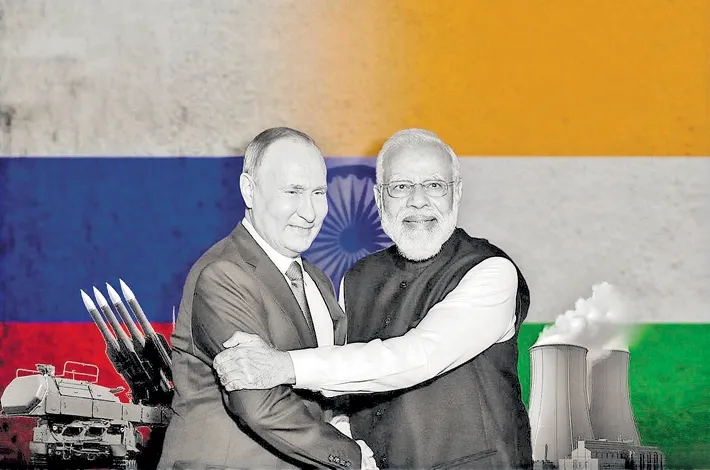
At the heart of the controversy lies India’s unwavering pursuit of strategic autonomy — a principle that has defined New Delhi’s foreign policy for decades
Global Pulse
- 55% – Share of Indian military hardware sourced from Russia
- USD 65 Billion – India–Russia trade volume this year
- 35% – Share of India’s crude oil imports from Russia
- 5th Largest – India’s current rank in global GDP
- 2027 – Year India is projected to become the world’s 3rd-largest economy
India’s latest summit with Russia has triggered a political, diplomatic and media firestorm worldwide, raising the question once again: Is India strengthening an old friendship, or provoking a geopolitical realignment in an already tense global arena? As Russian President Vladimir Putin landed in Delhi for a high-stakes bilateral summit, the world watched closely — the West with unease, China with curiosity, and India with a mix of confidence and caution. The meet, packed with symbolism, timing, and strategic messaging, has become the center of a heated debate on India’s foreign policy direction.
At the heart of the controversy lies India’s unwavering pursuit of strategic autonomy — a principle that has defined New Delhi’s foreign policy for decades. While much of the West demanded a harder posture against Russia following the Ukraine conflict, India chose a different path: engagement without endorsement. This summit signals to the world that India will decide its own strategic priorities, even if they do not align perfectly with the US or Europe. Critics, however, argue that India is walking into a diplomatic minefield, risking alienation of its Western partners who currently support India’s economic and defense rise.
But India sees calculations far deeper than optics. The Russia relationship has remained foundational to India’s military architecture, with over 55% of India’s active military hardware still of Russian origin. From S-400 air defense systems to nuclear submarines, the Indo-Russian defense pipeline is deeply entrenched. The summit’s agenda included further strengthening this cooperation, including discussions on joint manufacturing, spare parts supply chains and service support — a move crucial for India’s long-term security posture. New Delhi, analysts argue, cannot risk a sudden rupture with Moscow without compromising operational readiness.
Yet the conversation isn’t merely transactional. The backdrop of the summit is framed by the China factor. Russia and China have grown increasingly close, positioning themselves as counterweights to the US-led bloc. For India, this dynamic is both an opportunity and a complication. Some strategic thinkers believe India’s warm ties with Russia serve as a subtle balancing tool against China’s influence — a way to ensure Moscow doesn’t drift too far into Beijing’s embrace. Others fear the opposite: that Russia’s deepening dependence on China could limit how much Moscow can truly support India, especially on sensitive issues like border tensions.
Despite the geopolitical risks, India seems committed to defending its multi-vector diplomacy. Prime Minister Narendra Modi’s meeting with Putin projected a sense of confident independence, as if signaling that the world’s fifth-largest economy will not be coerced into choosing sides. Western commentary, however, has been quick to read the summit as symbolic defiance — particularly in a year marked by global instability, war escalations and energy realignments.
The economic angle added further weight to the discussions. India–Russia bilateral trade touched an unprecedented USD 65 billion this year, driven overwhelmingly by discounted Russian crude oil purchases. India’s decision to ramp up Russian oil imports has been one of the most controversial foreign-policy choices in recent years. While it brought economic relief to India through cheaper fuel, it also attracted scrutiny from Western capitals who accused India of indirectly strengthening Russia’s war economy. India, in response, asserts that its decisions are purely based on national interest and domestic welfare, not geopolitical signaling.
Energy cooperation featured prominently in the summit talks, with discussions around long-term crude supply arrangements, expanded LNG cooperation and nuclear energy collaboration via Kudankulam units. For India’s rapidly growing economy — set to become the world’s third largest by 2027 — securing affordable, stable energy supplies is not just an advantage but a necessity. Russia, isolated from many Western markets, finds in India one of its most stable, large-volume buyers.
However, not everyone within India views the rosy optics without skepticism. Critics in the strategic community warn that aligning too closely with a sanctioned state carries long-term risks. The global financial system, largely influenced by the West, may complicate payments, logistics and technology flows if pressure continues. Diplomatic balancing, they argue, must be handled with far more caution than the overt warmth displayed during this summit.
The global reaction to the summit has been predictably polarised. Western analysts termed the meeting “ill-timed” and “politically insensitive,” especially given ongoing geopolitical strains. Meanwhile, Russian commentators projected the visit as proof that Moscow retains strong, influential partners despite Western attempts to isolate it. In Asian power circles, the summit has been viewed as a signal that the world is no longer bipolar — and countries like India are emerging as autonomous power centers shaping their own strategic destinies.
Back home, social media turned into a battleground of views. Supporters of the summit hailed it as a demonstration of India’s sovereign decision-making, while critics questioned whether India is jeopardising its partnerships with the US, Japan and Europe — allies central to India’s Indo-Pacific strategy.
At its core, the India–Russia summit marks more than a bilateral meeting. It is a manifestation of India’s evolving identity: a nation unwilling to be dictated to, a country charting its own path amidst global flux, and an emerging power redefining the rules of engagement in the 21st century multipolar order.
The debate will continue — fiery, divided, and ideological — but one thing remains clear: India is no longer just reacting to global power shifts; it is influencing them.