2 October, 2026 | 1:11 PM


‘Reddy vs BC’ battle heats up
01-04-2026 12:00:00 AM
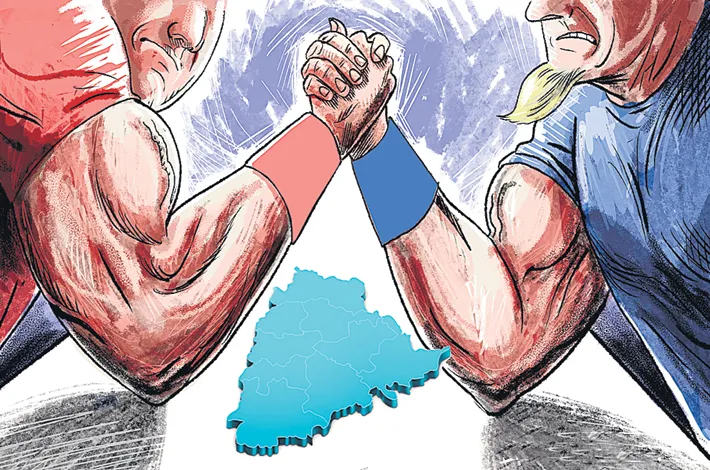
Even as nearly two-and-a-half years remain for the next Assembly elections in Telangana, the Congress party has found itself grappling with an internal debate over the chief minister’s post, triggering widespread discussion in political circles. What initially appeared to be routine assertions of confidence has now snowballed into a larger controversy, increasingly being viewed through the lens of a ‘Reddy versus Backward Classes (BC)’ narrative.
Chief Minister Revanth Reddy has repeatedly expressed confidence that the Congress will retain power in the next elections and has asserted that he will once again occupy the top post. On the other hand, Telangana Pradesh Congress Committee (TPCC) president Mahesh Kumar Goud has taken a different stand, stating that the next chief minister should be from the BC community. These contrasting claims from two key leaders have created confusion among party cadres and sparked a debate over leadership ambitions within the ruling party.
While both leaders have publicly maintained that they are working together in coordination—often describing their functioning as being in sync—political observers note that these differing statements suggest underlying differences. The situation has led to criticism that the Congress may be slipping back into its old pattern of internal factionalism, a charge that has historically plagued the party, especially when in power.
The Congress, which ruled the undivided Andhra Pradesh for a decade before the state’s bifurcation, remained out of power in Telangana for nearly ten years. Its return to power in the state was seen as a significant political comeback. However, with the current government yet to complete even half of its term, the emergence of internal disagreements over the chief minister’s position is being viewed as untimely and potentially damaging.
Traditionally, both national and regional parties decide on the chief ministerial candidate only after elections, based on the consensus of elected MLAs and the direction of the party high command. In contrast, the open assertions being made by senior Congress leaders in Telangana well ahead of elections have raised eyebrows. Even within the party, there are voices cautioning against such premature positioning, arguing that it could send the wrong message to voters.
Political analysts point out that while it is natural for leaders to aspire for higher positions, projecting individual claims too early may not be strategically beneficial. Instead, they argue, the focus should remain on governance, delivery of promises, and strengthening the party’s grassroots presence. The current debate has also intersected with the growing political importance of BC communities in Telangana, adding a social dimension to what might otherwise have remained an internal party matter.
The Congress had, ahead of the Assembly elections, announced the Kamareddy Declaration, promising 42 per cent reservations for BCs in local bodies and employment. Although the state government passed a resolution to this effect and forwarded it to the Governor and the President, legal constraints regarding the 50 percent cap on reservations have stalled its implementation. The issue became more contentious when the government proceeded with local body elections without fulfilling this promise, drawing criticism from BC groups as well as opposition parties.
In this backdrop, the renewed emphasis on the chief ministerial post—especially framed around social categories—has intensified political debate. Critics argue that instead of addressing pending promises and governance challenges, the party leadership is allowing internal discussions to dominate the narrative.
With elections still some distance away, many believe the Congress would benefit more from maintaining unity and focusing on performance rather than engaging in leadership speculation. If the current differences continue to surface publicly, it could provide political ammunition to rivals and create uncertainty among supporters.